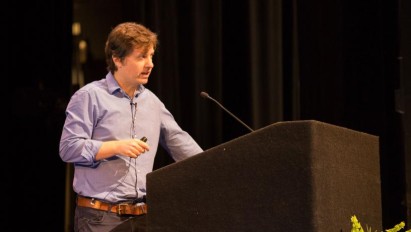
More than a thousand attendees packed into Lerner Hall for Columbia’s fourth annual Data Science Day, eager to hear from experts from across the university who are transforming disciplines and industries through thoughtfully applied data. Columbia Engineering faculty showcased innovative research ranging from blockchain security to extracting speech from brainwaves, while professors from the Law School, Journalism School, School of International and Public Affairs, Medical Center, and more discussed work in areas like protecting data security, understanding online radicalization, and improving patient outcomes.
In lightning talks throughout the April 3 daylong summit, affiliates of Columbia’s Data Science Institute (DSI) shared their work applying machine learning to an impressive variety of challenges. In a panel moderated by Professor Garud Iyengar, chair of Columbia Engineering’s Industrial Engineering and Operations Research (IEOR) department, electrical engineering Professor Nima Mesgarani discussed his ground-breaking work in brain-computer interfaces and acoustic signal processing. Recently, he managed to reconstruct intelligible speech from brain activity—a potential game-changer for those who’ve lost the ability to speak—and is also addressing the “cocktail party problem” in hearing aids, which currently amplify more audio than listeners wish to hear.
Among a panel moderated by Professor Shipra Agrawal of IEOR were computer science Professors Michael Collins and Tim Roughgarden. Collins walked the audience through his research in natural language processing and speech recognition, highlighting dramatic improvements thanks to new neural methods, while Roughgarden talked about his investigations of online automated auction reserve pricing, an area with vast implications for sponsored search results. In another panel, fellow computer science faculty member Ronghui Gu discussed his work using mathematical methods to improve the security and reliability of blockchain technology.
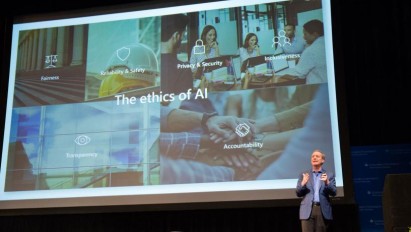
Amid all the potential of cutting-edge data science, there are also potential pitfalls, argued the day’s keynote speaker Brad Smith ’84LAW, president and chief legal officer of Microsoft. Unchecked, “mass surveillance at an unprecedented scale” could quickly turn societies Orwellian, he said, unless nations institute rigorous new legal standards to protect privacy, promote transparency, and ensure accountability.
“We are the first generation of people in the history of this planet to give machines this kind of power,” Smith said. “We’re basing our lives on all of this technology, we’re basing our societies on all of this technology, so more than ever the world needs to be able to trust this technology… Ultimately, we need a global conversation about these issues.”
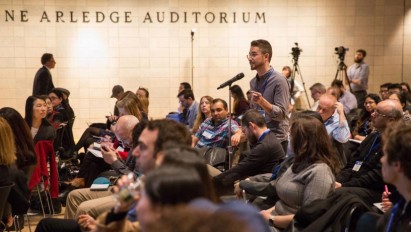
Later, attendees explored dozens of demos and posters from students and faculty, ranging from full-duplex wireless enabling simultaneous transmission and reception to software analyzing indices to predict outcomes of complex global events such as Brexit. A research team from computer science Professor Steven Feiner’s Computer Graphics and User Interfaces Lab was voted best demo for their augmented/virtual reality system that allows multiple users to explore an immersive computer-generated 3D urban model of New York City.
“This new system is about multiple users collaborating in either AR or VR as they explore, organize, and share data associated with an urban environment in the context of that environment,” said Carmine Elvezio, a researcher in Feiner’s lab. “We place users in a virtual scale model where they see tweets, Yelp reviews, and NYC 311 complaints relative to the locations from which they are generated.”
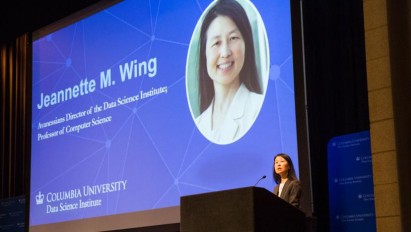
Introducing proceedings, Avanessians Director of the Data Science Institute and computer science Professor Jeannette Wing noted that the collective’s overarching mission is “to use data for good.”
“Data Science Day is our moment to showcase our pioneering research and celebrate our engagements with industry,” she said.
Smarter Cities = Situationally Aware Vehicles
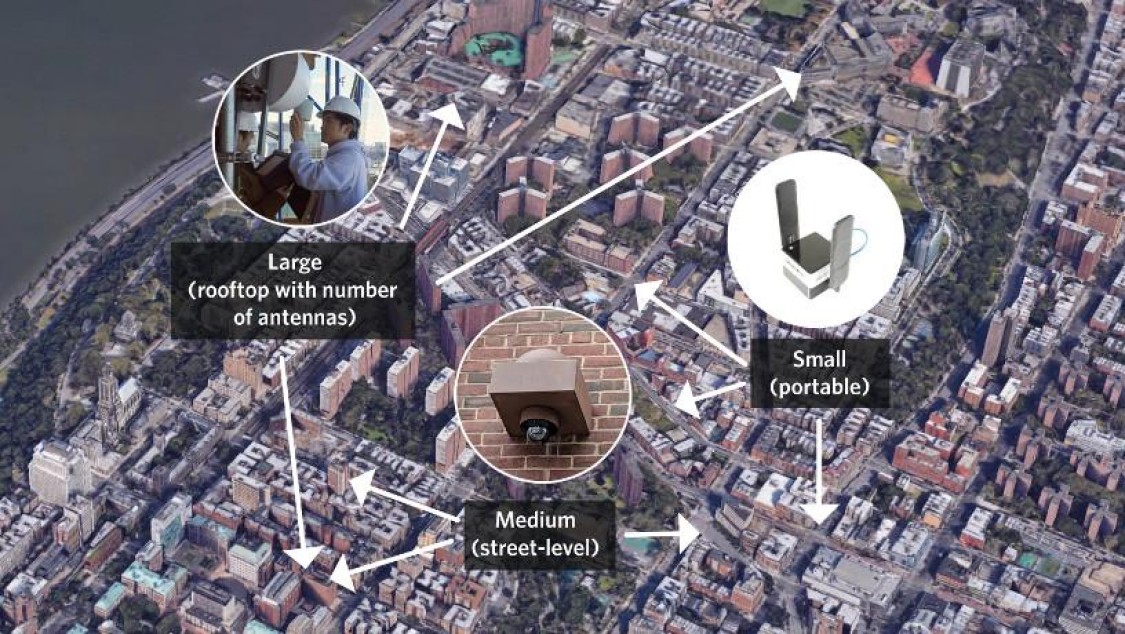
Underlying each of these applications is a central premise—the need for highly coordinated data collection from a huge network of widely distributed sensors. But with the advent of COSMOS—one of only two 5G-and-beyond testbeds currently being deployed in the United States—Columbia Engineering faculty are gaining access to an unprecedented outdoor lab. COSMOS enables not only more sophisticated analysis, but also new capabilities through performance enhancements such as millimeter-wave wireless communications, edge cloud computing, close integration of wireless and optical networks, and full-duplex radios that enable simultaneous two-way data transmission.
Occupying a square mile of Manhattan adjacent to Columbia’s Morningside campus, COSMOS is a National Science Foundation– funded effort composed of a consortium of universities, the local community, and industry. The initiative is led by Rutgers University, Columbia University, and New York University, plus the City of New York, Silicon Harlem, City College of New York, University of Arizona, and IBM.
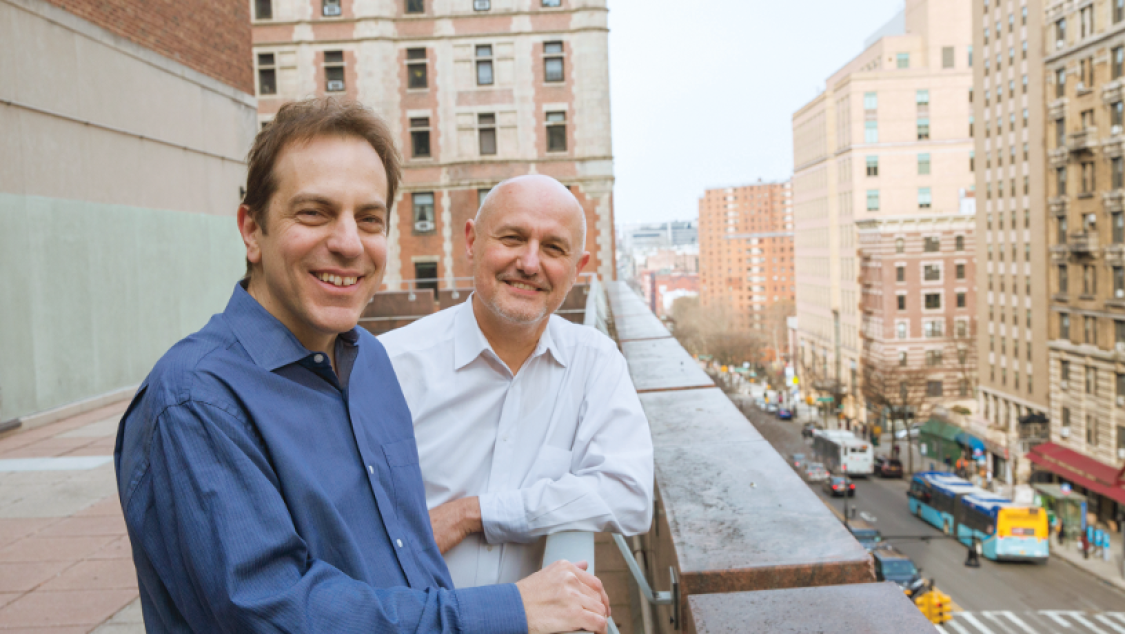
According to Electrical Engineering Associate Professor Gil Zussman, Columbia’s PI on the project, the testbed’s infrastructure will include several large wireless nodes—or base stations— containing software-defined radios to be located on top of buildings such as Columbia Engineering’s current home in Mudd. About 40 medium-size nodes will be placed at street level at building sides or on light poles, and some 200 experimental mobile devices will be hooked into the network. Edge cloud computing—servers integrated into the wireless access network—will speed up the data processing and response time.
The project leverages the talents of several Columbia engineers, including Harish Krishnaswamy, associate professor of electrical engineering, and Henning Schulzrinne, a professor of computer science and electrical engineering. Electrical Engineering Associate Professor Zoran Kostic has tapped into COSMOS to study the busy intersection at 120th Street and Amsterdam Avenue. Here, Kostic is piloting technologies designed to enable the future of smart-city traffic—where swarms of autonomous vehicles move seamlessly around crowds of pedestrians. To achieve such intricate synchronization, these vehicles must share data between cameras, optical radars, positional sensors, and infrastructure using ultrafast millimeter-wave radios with miniscule latencies. Harmonizing the movement of vehicles and pedestrians without human intervention requires real-time learning systems deployed by on-site edge computing nodes. “Places like Manhattan will require assisted vehicle autonomy, facilitated by infrastructure to vehicle and vehicle to infrastructure communication,” Kostic points out.
For the elderly and visually impaired, in particular, that level of situational awareness will become crucial for safely navigating driverless intersections. But this work will lead not just to better coordination between cars and pedestrians; it’ll also enable smoother traffic flow overall. In fact, Mudd’s 12th floor currently houses several 3D bird’s-eye video cameras that are already accumulating data to help train a deep learning model for traffic control, while more cameras at the second-floor level collect data on pedestrian movements. In the next phase, slated for the winter, University vehicles will be equipped with sensors and transmitters. Initial experiments will explore the ways human drivers can benefit from real-time data about potential hazards and about the real-time activity of other vehicles. To implement and emulate use cases representative of the most challenging traffic conditions, the team has built a miniature model of the 120th Street and Amsterdam Avenue intersection at Winlab, hosted at Rutgers’ New Brunswick campus.
Smarter Cities = Climate-proofed Infrastructure
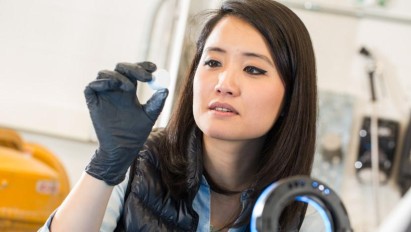
Unchecked, the cost of climate change could severely impact a city’s bottom line. This is particularly true for the vast majority of urban centers that sit near coastal areas. A new methodology using Lower Manhattan as a test case is being designed to compute the optimal protective strategy for buffering coastal infrastructure subject to storm surge combined with rise in sea level. Developed by civil engineer George Deodatis, optimization expert Daniel Bienstock, and applied mathematician Kyle Mandli, this smart decision scheme factors in prescribed budgets to help municipalities consider various measures—including seawalls, artificial islands/reefs, wetland restoration, raising infrastructure, strategic retreat, and others—in order to implement solutions that are ultimately cheaper than taking no action.
To ensure long-term sustainability, cutting emissions remains another crucial piece of the climate-proofing equation. Today, between 5 percent and 8 percent of man-made carbon emissions derive from cement manufacturing. Burning enough current raw material—typically, quarried limestone—to produce one ton of cement also releases one ton of CO2.
In a bid to dramatically increase the sustainability of our infrastructure’s core building blocks, Shiho Kawashima, associate professor of civil engineering, investigates new manufacturing techniques for alternative binders—building a new intelligence into the system from the ground up.
In her search for abundant, inexpensive, sustainable alternatives to source raw materials for clinkers and binders, Kawashima is collaborating with colleagues from the chemical engineering department. Associate Professor Daniel Esposito is developing a technique for electrochemically harvesting metal hydroxides from seawater, which can replace cement and significantly reduce the CO2 associated with concrete.
With Ah-Hyung (Alissa) Park, an associate professor in both earth and environmental engineering and chemical engineering as well as director of the Lenfest Center for Sustainable Energy, Kawashima is also examining techniques to utilize materials derived from upcycling of wastes and carbon sequestration as alternative binders.
Ultimately, the kind of convergence illustrated in each of these projects is precisely what leads to smarter outcomes, by marrying a specific vision with diverse strategies and a flexible approach—one that respects natural resources while balancing the needs of government, industry, and communities.
“You don’t create technology just to have technology,” says Culligan. “You create technology to serve people. Our school’s vision for smarter cities is one that aims to improve the lives of urban inhabitants.”
9 Ways to Make a Smarter City
“The energy-air-water-food nexus is the existential question of our times,” says Sanat Kumar, the Bykhovsky Professor of Chemical Engineering.
Recognizing the interdependence of the earth’s resources, Kumar believes developing affordable, sustainable energy solutions will be at the heart of increasing access to pure air, clean water, and food security for developing countries.
Advanced membranes will play a key role in this undertaking. For decades, membrane technology has been driving efficiencies in water purification, gas separation for more sustainable energy production systems, and ion separation for energy storage and batteries. Yet, the separation capabilities of standard polymer-based membranes (plastic films) are limited.
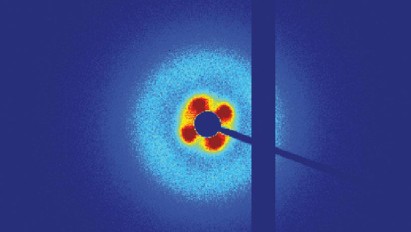
Kumar’s research group focuses on developing novel hybrid materials that combine polymers with nanoparticles to gain desired properties and improve separating abilities while reducing plastics consumption. Membranes perform best when the dispersion of nanoparticle fillers is uniform in the polymer matrix. His team has developed a process to chemically bond polymer chains to the fillers in such a way that they self-assemble into regular arrays, exhibiting the evenness needed for better performance.
To date, Kumar has developed materials that perform two to five times better than existing technologies for gas separation and has ideas for further improvements that could translate these methods for commercial use.
In another research thrust, his group seeks to improve the mechanical or electrical properties of polymeric membranes by drawing inspiration from nature, particularly nacre, commonly known as mother-of-pearl. Further advances in this area could lead to more sustainable, composite materials that are durable enough to replace structural materials in buildings and infrastructure.
With the potential for climate change to exacerbate social inequalities, Kumar feels a sense of urgency in bringing about sustainable technologies that will benefit all.
“It is our responsibility, especially as a school dedicated to engineering for humanity, to focus on the poor and provide them with the means to live their lives with dignity.”