Bacteria in a Dish
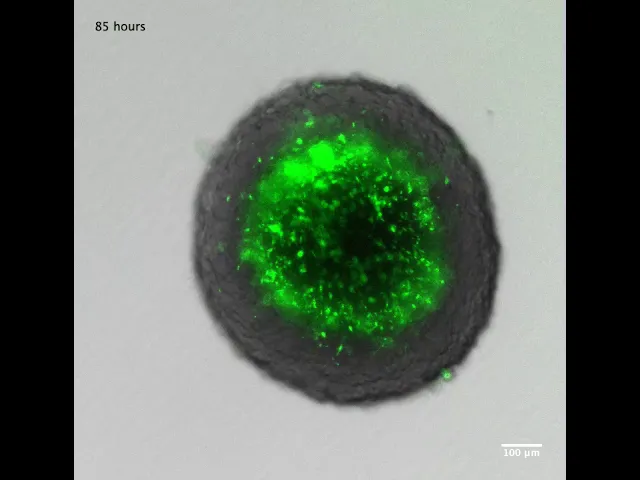
The team used the BSCC’s high-throughput system to rapidly characterize pools of programmed bacteria
The researchers knew that, while many bacteria can grow inside a tumor because of the reduced immune system there, bacteria are killed outside the tumor where the body’s immune system is active. Inspired by this mechanism, they searched for an antibacterial agent that can mimic the bacteria “killing” effect outside the spheroids.
They developed a protocol that uses the antibiotic gentamicin to grow bacteria inside spheroids that are similar to tumors in the body. Using BSCC, they then rapidly tested a broad range of programmed anticancer bacterial therapies made of various types of bacteria, genetic circuits, and therapeutic payloads.
“We used 3D multicellular spheroids because they recapitulate conditions found in the human body, such as oxygen and nutrient gradients—these can’t be made in a traditional 2D monolayer cell culture,” says the paper’s lead author Tetsuhiro Harimoto, who is a PhD student in Danino’s lab. “In addition, the 3D spheroid provides bacteria with enough space to live in its core, in much the same way that bacteria colonize tumors in the body, also something we can’t do in the 2D monolayer culture. Plus, it’s simple to make large numbers of 3D spheroids and adapt them for high-throughput screening.”
The team used the BSCC’s high-throughput system to rapidly characterize pools of programmed bacteria and then to quickly narrow down the best candidate for therapeutic use. They discovered a potent therapy for colon cancer, using a novel bacterial toxin, theta toxin, combined with an optimal drug delivery genetic circuit in attenuated bacteria Salmonella Typhimurium. They also found new combinations of bacterial therapies that can improve anticancer efficacy even more.
The researchers compared their BSCC results to those found in animal models and found similar behavior of bacteria in those models. They also discovered that their top candidate—theta toxin—is more potent than therapies created in the past, demonstrating the power of BSCC’s high-throughput screening.
While Danino’s group focused on cancer therapy in this study, they hope to expand BSCC to characterize bacteria-based therapeutics for various diseases, including gastrointestinal disease and infections. Their ultimate goal is to use these new bacterial therapies in clinics around the world.
Columbia Engineering
Columbia Engineering, based in New York City, is one of the top engineering schools in the U.S. and one of the oldest in the nation. Also known as The Fu Foundation School of Engineering and Applied Science, the School expands knowledge and advances technology through the pioneering research of its more than 220 faculty, while educating undergraduate and graduate students in a collaborative environment to become leaders informed by a firm foundation in engineering. The School’s faculty are at the center of the University’s cross-disciplinary research, contributing to the Data Science Institute, Earth Institute, Zuckerman Mind Brain Behavior Institute, Precision Medicine Initiative, and the Columbia Nano Initiative. Guided by its strategic vision, “Columbia Engineering for Humanity,” the School aims to translate ideas into innovations that foster a sustainable, healthy, secure, connected, and creative humanity.
About the Study
The study is titled “Rapid screening of engineered microbial therapies in a 3-D multicellular model.”
Authors are: Tetsuhiro Harimoto a, Zakary S. Singer a, Oscar S. Velazquez a, Joanna Zhang a, Samuel Castro a, Taylor E. Hinchliffe a, William Mather b, and Tal Danino a,c,d.
a Department of Biomedical Engineering, Columbia Engineering
b BioCircuits Institute, University of California, San Diego
c Data Science Institute, Columbia University
d Herbert Irving Comprehensive Cancer Center, Columbia University
The study was supported by Honjo International Scholarship Foundation 4160341 (Tetsuhiro Harimoto), National Cancer Institute F32CA225145 (Zakary Singer) R00CA197649-02 & P30CA013696 (Tal Danino), and Department of Defense LC160314 & BC160541 (Tal Danino).
T.H., Z.S.S., and T.D. have filed a provisional patent application with the US Patent and Trademark Office related to this work.