About the Study

Journal: Nature Chemistry

Title: Highly conducting single-molecule topological insulators based on mono- and di-radical cations

Authors: Liang Li1, Jonathan Z. Low1, Jan Wilhelm2, Guanming Liao3, Suman Gunasekaran1, Claudia R. Prindle1, Rachel L. Starr1, Dorothea Golze4, Colin Nuckolls1, Michael L. Steigerwald1, Ferdinand Evers*2, Luis M. Campos*1, Xiaodong Yin*3, Latha Venkataraman*1,5 1Department of Chemistry, Columbia University, New York, New York 10027, United States 2Institute of Theoretical Physics, University of Regensburg, Regensburg, Germany 3Beijing Key Laboratory of Photoelectronic/Electrophotonic Conversion Materials, School of Chemistry and Chemical Engineering, Beijing Institute of Technology, Beijing, 102488, P. R. China 4Technische Universitat Dresden, Konig-Bau, Bergstrasse 66 c, 01069 Dresden, Germany 5Department of Applied Physics and Applied Mathematics, Columbia University, New York, New York 10027, United States

The study was supported by the National Science Foundation, under grant DMR-1807580.

COI: The authors declare no financial or other conflicts of interest.


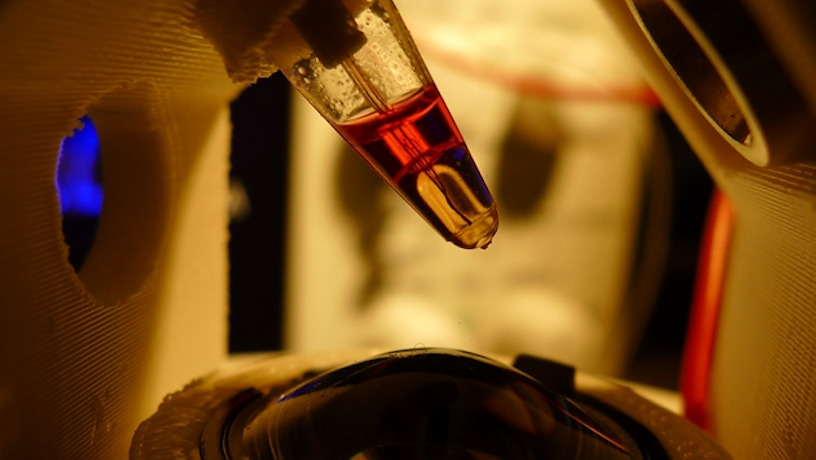
Header image: A brief abstract figure of this work. The geometry of the highest conducting trimer (n=3) molecule in the molecular junction. Red and blue regions are artistic depictions on the coupling between the two edge states.

About the Studies

Journal: Science Advances

Title: Ionic communication for implantable bioelectronics

Authors: Zifang Zhao, George Spyropoulos, Claudia Cea, Jennifer N. Gelinas and Dion Khodagholy.

Jurnal: Advanced Science 

Title: Anisotropic Ion Conducting Particulate Composites for Bioelectronics

Authors: Dickson R. Yao, Han Yu, Onni J. Rauhala, Claudia Cea, Zifang Zhao, Jennifer N. Gelinas and Dion Khodagholy.

Department of Electrical Engineering.
Department of Neurology.

Institute for Genomic Medicine.

Both these studies were supported by the Columbia University School of Engineering and Applied Science, the Columbia University Medical Center, Department of Neurology and Institute for Genomic Medicine, NIH grant 1U01NS108923-01, NIH grant R01NS118091, NIH grant R21 EY 32381-01, NSF CAREER award 1944415, and NSF EAGER grant 2027135.

COI: The authors declare no financial or other conflicts of interest.

Subscribe to Research