
A Greener Path Forward for the Chemical Industry
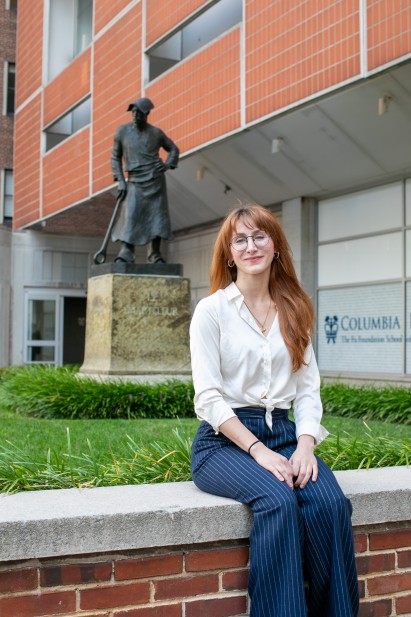
Marissa Beatty PhD’22 is pushing the chemical production industry toward net-zero carbon emissions.
By Kate Cammell
Gas prices were astronomical when Marissa Beatty was in high school — and she drove a gas-guzzling pickup truck. She and her father, who was an engineer at Ford Motor Co., experimented with making biodiesel fuel to cut costs. She found the process of building a product thrilling.
Despite her remarkable accomplishment, it took some convincing for Beatty to choose engineering. She wanted to chart a path that was different from her family’s and felt the profession was out of reach.
Now, Beatty, a chemical engineer, is the founder and CEO of Turnover Labs, a venture-backed climate technology startup leading efforts to decarbonize the chemical production industry.
A human approach to science
When Beatty arrived at Michigan State University (MSU) as an undergraduate, she was randomly placed in the engineering residences. The coincidence sparked a conviction that Beatty was meant for the profession.
“I see engineers as a liaison between the public and the bleeding edge of science,” she says. “Engineers use research to build better technologies for people. I loved that it was a human approach to scientific work.”
After graduating from MSU, Beatty was drawn to Columbia by the School’s Engineering for Humanity mission. A member of the Solar Fuels Engineering Lab, she researched electrolyzers, which are reactors that transform chemicals using renewable electricity and without involving fossil fuels. While studying at Columbia, she took on the challenge of making this sustainable technology widely adopted by the chemical industry.
“These systems are currently built like Lamborghinis. They’re very expensive to run and maintain,” she says. “We’re essentially trying to build a heavy-duty tractor.”
The making of an entrepreneur
Beatty understood the need to move quickly with this technology to address climate change. “Preventing one ton of carbon from entering the atmosphere today is worth more than preventing 10 tons from entering the atmosphere in 10 years,” she notes.
Her research revealed that systems the size of shipping containers could be built and installed at existing plants. It’s a much faster solution than building sustainable plants from the ground up.
Beatty’s adviser, Dan Esposito, encouraged her to apply for the Activate Fellowship, an entrepreneurial program for climate scientists who want to commercialize technology. In 2022, Beatty became part of the Activate Fellowship’s inaugural New York City cohort.
The same year, Beatty founded Turnover Labs. The company is pioneering an electrolysis process that harnesses CO2 waste to create petrochemicals without using fossil fuels. Once scaled and adopted, the technology she is piloting will be capable of transforming 10,000 tons of CO2 emitted by the chemical industry annually. It’s a significant step toward pushing chemical production toward net-zero carbon emissions.
From Columbia Lion to industry leader
In 2023, Beatty was named to the Forbes 30 Under 30 list for her work in climate change — a recognition she says felt very meaningful.
She notes that while being a startup founder is rewarding, the public only sees the success, not the struggle and failure. Working on climate change solutions can be taxing, since the problem is massive and urgent.
Still, Beatty remains optimistic: “There are very few times in history where the best scientific and engineering minds are aligned on a singular problem — across nations, across industries. People are unified in ways that I’ve never seen before. There is hope.”