Great Minds in Engineering: Shih-Fu Chang with Kai-Fu Lee
Columbia Engineering Interim Dean Shih-Fu Chang speaks with AI pioneer Kai-Fu Lee
AI pioneer and best-selling author Kai-Fu Lee recently sat down with Columbia Engineering Interim Dean Shih-Fu Chang for a wide-ranging conversation touching on key technologies, such as machine learning, cryptocurrencies, and virtual reality, and how they might shape our lives over the next 20 years.
Lee, whose new book “AI 2041: Ten Visions for Our Future” was recently published, is a seminal figure in AI technology, inventor of the first AI to defeat a world champion in the game Othello in 1988. Lee got his academic start in computer science with a bachelor’s from Columbia in 1983 and went on to be a president of Google China and executive at Microsoft, SGI, and Apple. He is currently CEO of Sinovation Ventures and president of Sinovation Ventures’ Artificial Intelligence Institute.
Dean Chang is also a professor of computer science and electrical engineering, as well as inaugural director of Columbia Center of Artificial Intelligence Technology. He is a world-renowned expert in computer vision, multimedia, and artificial intelligence.
The talk and audience questions were moderated by Jessica Tsoong BS’08, a tech entrepreneur and angel investor currently based in the Bay Area, California.
Header image: Columbia Engineering Interim Dean Shih-Fu Chang and Kai-Fu Lee
Engineering for Humanity: HEALTHY

The RoAR lab develops innovative robots and methods to help humans relearn, restore, and improve functional movements.
Your Trunk Support Trainer (TruST) is a great example of that. It was created to assist those with spinal cord injuries. Later, you demonstrated that it’s also effective in helping children with cerebral palsy. Was this an unexpected development, due to overlap in the nature of these disorders, or do you find that you often translate your work to meet different challenges?
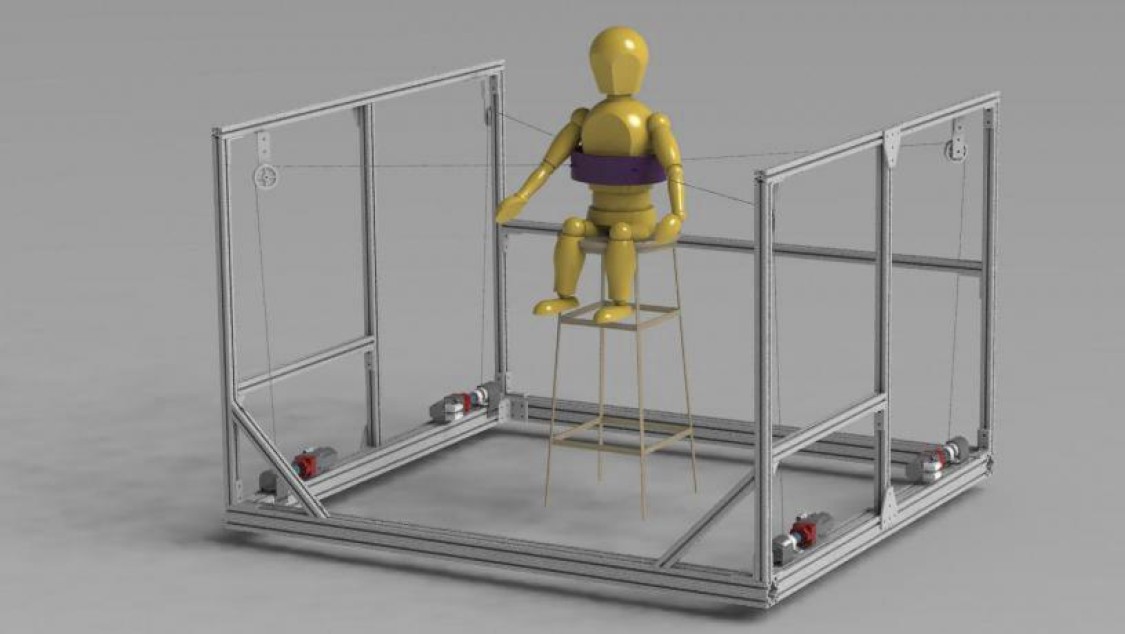
Poor trunk control is a functional impairment that we see in different medical conditions, including spinal cord injury, cerebral palsy, stroke and many others. The TruST robotic device was designed with the following goal in mind: How to provide active support to the trunk at different levels in the upper body while simultaneously challenging a participant to perform tasks that take them outside their base of support. Through an intensive training of the task and changing the level/magnitude of the support, participants are able to relearn and regain their muscle activity and coordination. A similar procedure could be applied to both participants with SCI and children with cerebral palsy. However, TruST had to be fine tuned for the two different patient groups. We just started a new National Institutes of Health-funded project to perform a clinical trial using TruST with a group of 85 children with cerebral palsy to evaluate the efficacy of TruST relative to typical standard of care. We are optimistic that TruST will be able to restore and retrain trunk control in children with cerebral palsy who absolutely need these to be functional in their daily life.