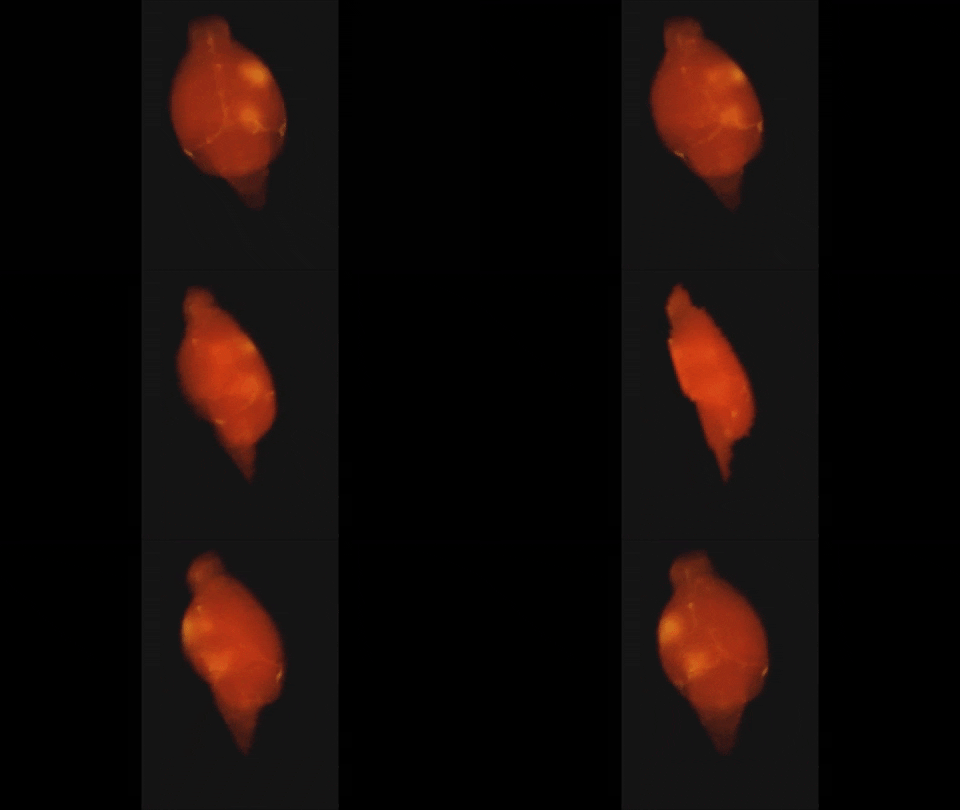
New Ultrasound Technique is First to Restore Dopaminergic Pathway in Brain at the Early Stages of Parkinson's Disease
June 06, 2019
June 06, 2019
May 07, 2019

Faculty & Staff
April 17, 2019
The undergraduate program in Biomedical Engineering is accredited by the Engineering Accreditation Commission of ABET: http://www.abet.org.
The Biomedical Engineering Design course is a required, two-semester capstone course for undergraduate students. Students work in a team to tackle a real-world, open-ended design project in the biomedical field.
Undergraduate students have the opportunity to get involved in cutting-edge research within the Department of Biomedical Engineering.
Many BME labs welcome qualified undergraduates to join their research teams, either through work-study or as paid research assistants. These hands-on experiences allow students to apply classroom knowledge, explore areas of interest, and contribute to ongoing innovations in the field.
For more information on the work-study program, please visit Student Financial Services.
Research conducted outside the BME department may count for BMEN E3998 credit if approved. In this case, students must register under their BME academic advisor, who will coordinate with the external research supervisor. To qualify:
BME labs offer summer research positions through internships, research assistantships, and work-study. Students can receive technical elective credit by enrolling in BMEN E3998 during the summer.
Additionally, many BME faculty participate in Columbia’s Summer Undergraduate Research Fellowship (SURF). Qualified students are encouraged to apply.
The Biomedical Engineering Department at Columbia University is dedicated to preparing our graduating students for the following:
We strive to ensure that our students successfully attain the following:
Graduates of our program go on to graduate studies, medical school, and employment. Students have gone onto sectors including pharmaceuticals, medical devices, diagnostics, governmental oversight organizations (FDA, NIH, OSHA, etc.), and even finance. Through the program, students can meet entrance requirements for graduate training in the various allied health professions. For instance, no more than three additional courses are required to satisfy entrance requirements for most U.S. medical schools, and can be chosen to also fulfill elective requirements for graduation.
A statistical breakdown of each class is available below (numbers as of Fall 2023):
| 2018 | 2019 | 2020 | 2021 | 2022 | 2023 | |
|---|---|---|---|---|---|---|
| Sophomores | 36 | 35 | 40 | 44 | 44 | 40 |
| Juniors | 49 | 41 | 44 | 55 | 53 | 57 |
| Seniors | 48 | 52 | 40 | 47 | 55 | 54 |
| Total | 133 | 128 | 124 | 146 | 152 | 151 |
The MS degree program in the Department of BME prepares students for research activities at the highest level. 90% of our MS students participate in cutting edge research during the course of their degree program. The Department of Biomedical Engineering also maintains a strong partnership with the Columbia University Medical Center, fostering interdisciplinary collaborations that add to the quality and strength of the program. Research areas of particular interest include biomechanics, cellular and tissue engineering, artificial organs, regenerative medicine, auditory biophysics, biosignals and biomedical imaging, point-of-care diagnostics, and neural engineering. The MS degree program is well equipped to prepare students for admission to highly competitive doctoral programs across the United States, as well as employment within industry fields of biotechnology and medical devices.
"This flexible program allowed me to sample many fields underneath the biomedical engineering umbrella while having the opportunity to conduct mentored research either for credit towards my degree or as a volunteer. The coursework I completed and research experience I received were what prepared me best for the life of research I have chosen to pursue and helped build the strong resume I needed to apply to top tier doctoral programs."
Christian Aurup
MS '15, PhD candidate Columbia University
The MS degree program in the Department of BME provides students with unparalleled training and mentorship in medical technology innovation and entrepreneurship. Project-based courses in the design and commercialization of medical innovations offered by the Department of Biomedical Engineering, complemented by courses offered by other departments and schools, including the Columbia Business School and Columbia University Medical Center, provide students with a rich interdisciplinary educational experience. Graduates of our MS degree program are able to contribute to and drive medical innovation and support the promotion, development, and realization of the clinical potential of translational research.
"I didn't start Columbia expecting to be involved in entrepreneurship, but after going through the biodesign process in an MS Biomedical Design course, the idea of entrepreneurship was very exciting. We made the decision to continue our biodesign project after competing in and receiving our first funding from the Columbia Venture Competition, and we couldn't have started Neopenda and gotten this far without the encouraging support from Columbia."
Sona Shah
MS '16, Co-Founder & CEO, Neopenda
MS degree students in the Department of BME come from diverse training, including research and industry, and backgrounds, including sciences (such as physics, chemistry, and biology), mathematics, and several fields of engineering (such as mechanical, electrical, and chemical engineering). The program offers a flexible curriculum that allows students interested in transitioning into biomedical engineering the opportunity to individualize their experience and complete the necessary requirements to prepare for advanced study at the graduate-level. MS degree students work closely with their Faculty advisor to identify courses and research/project experiences that will allow for a seamless transition into the field of BME. The program also provides excellent preparation for students interested in transitioning into the health sciences and the study of medicine.
All applicants to our MS program should have a solid foundation in mathematics, including multivariate calculus, linear algebra, and differential equations and experience in computer programming (Matlab or Python).
"I chose Columbia BME for the inspiring faculty, the research opportunities that reflected my own interests in the field, and the flexibility of the curriculum. As someone coming from a non-engineering background, like many of my fellow classmates, this program has allowed me to develop a strong engineering foundation by giving me the freedom to select courses that reflected my specific needs, while continually offering guidance and mentorship during this transition. Columbia BME encourages networking and diversity within our own department, as well as collaboration between departments, creating an atmosphere of innovation and opportunity throughout the university."
Liz Hulphers
MS '16
Please find below answers to frequently asked questions about the Master of Science program. If your question isn't answered here, please e-mail [email protected].
Students in BME have often been attracted to off-campus part-time internships during the academic year and full-time internships during the summer. BME offers students the opportunity to participate in internships and receive academic credit pending review and approval by the department. To receive academic credit, the internship must provide students with an experience that is relevant and complementary to their degree course curriculum. If the internship meets this requirement, the student may be eligible to receive academic credit at the department’s discretion. In order to register for the Fieldwork course, students must receive approval from the department by following the guidelines corresponding to your degree level.