2025 Millard Chan ‘99 Tech Challenge
Sirin Samman/Columbia Engineering
Bringing robotics to the factory floor
The first place prize of $25,000 was awarded to Kathedra, which is developing an AI-guided robotic upholstery system that brings innovation to the $180 billion upholstered furniture market.
A key goal is to free workers from strenuous, repetitive manual work and enable manufacturers to produce diverse chair designs at high volume in the US. Their aim is to solve a critical labor shortage the industry is currently facing.
“We are so grateful to Columbia for providing the resources. It’s been so amazing to be part of this community,” said David Faes ‘24GS, a co-founder of Kathedra. Faes, a recent alumnus of the School of General Studies, and his co-founder, Oliver Chasan, said furniture manufacturers have enthusiastically welcomed their idea, noting that nothing like it currently exists. The team, which includes mechanical engineering senior Kyle Cash, is connecting with the Catawba Valley Furniture Academy, a reputable college for careers in furniture making, to seamlessly integrate automation into the industry.
By women for women
Awarded $15,000, second-place prize went to Milkshaker, co-founded by five Engineering seniors–Hope Hersom, Pricilla Dua, Valentina Marini Fichera, Elise Yang, and Kavita Parikh. This innovation aims to prevent and treat mastitis, an inflammation of the breast tissue causing pain and fever in nursing mothers.
The only known solution is a lymphatic drainage breast massage performed by certified physical therapists, noted Hersom, and the pool of these trained specialists is limited. Even in Manhattan, she said, only two such specialists exist, underscoring how inaccessible the treatment is for the majority mothers.
A bra-like garment, MilkShaker is wearable tech with a built-in mechanism and rechargeable batteries. The device mimics the work of a certified therapist by massaging the breast— pushing fluid from the top and bottom of the breast away from the nipple and milk ducts— to prevent clogging. The team has produced a prototype, with next steps to obtain a patent and ultimately enter into clinical trials.
A breath of fresh air
The third-place winner of a $10,000 prize was awarded to SWERV (Smart Windows Energy Recovery Ventilators). Founded by a three-member team led by Austin Riesenberger, SWERV is hoping to improve indoor air quality, especially for those with asthma. Compared to traditional ventilators with costs ranging from $2,000 to $4,000 and require major renovation, SWERV is window-mounted and efficiently cycles fresh air while recovering heat and moisture.
“I feel great because this is our first seed money that will help us build more prototypes, finalize deals with manufacturers and obtain a patent,” said Riesenberger, a mechanical engineering senior.
Smarter glasses, powered with AI for the visually impaired
Cadre Technologies received this year’s Engineering for Humanity Prize of $10,000. Cadre is producing AI-powered glasses for the visually impaired. Unlike other glasses which do only object detection, this features real-time object recognition, text reading, and facial identification. It processes visual data instantly, converting it into audio feedback to help users navigate their surroundings with confidence.
“We've conducted 1,357 trials in different parts of India, but we're working to get approval to start trials in the U.S., and this prize money will help achieve that,” said Cadre founder Muneer Khan MS’22, who studied electrical engineering at Columbia.
Since 2021, Chan has been providing not only financial support, but mentorship for startups. “I’ve been where you are today, and I can relate. Sometimes you are smart. Sometimes you are lucky. You need both,” he said in his remarks to attendees. With robust experience in establishing successful startups, Chan urged winners to take advantage of all the networks and resources Columbia offers.
Impressed by the quality of this year’s entries, one of the judges, Lan Huang, a leading scientist, inventor and biotech entrepreneur said selection was based on viability of the start-up, competitive advantage, and team composition.
“It gets better every year,” she said of the annual competition. “I can tell you, as an entrepreneur myself, it’s not the technology that makes a company successful but the team who can stick together to the end.”
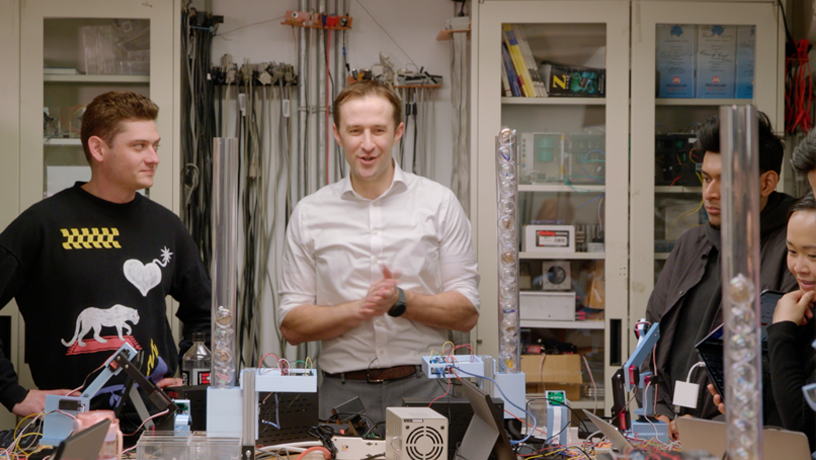
Lead Photo Caption: The MilkShaker team wins second-place prize of $15,000 in startup funding
Lead Photo Credit: Sirin Samman/Columbia Engineering
Event highlights
Credit: Diane Bondareff/Columbia University
Recognizing the importance of open conversations about career journeys, Columbia Engineering Dean Shih-Fu Chang and Columbia University Interim President Katrina Armstrong, both joined the event; Dean Chang gave introductory remarks and President Armstrong kicked off the discussion and shared her own experience as a woman in STEM.
Armstrong talked about her unconventional career path– from studying architecture as an undergraduate to completing medical school and ultimately rising through the ranks in higher education in leadership roles at the University of Pennsylvania, Harvard, and now, at Columbia. She encouraged attendees to regularly check in with themselves, emphasizing the importance of making changes before reaching burnout. She also highlighted the value of finding what works for each individual. She shared a personal anecdote about how she became known for letting her kids sleep in their school clothes instead of pajamas—a simple adjustment that made hectic mornings a little easier.
“The best advice I ever received was to be yourself because you're not going to change who you are,” Armstrong said. “And if you try to be somebody else, you're going to be so much less effective than just being who you are.”
Building connections
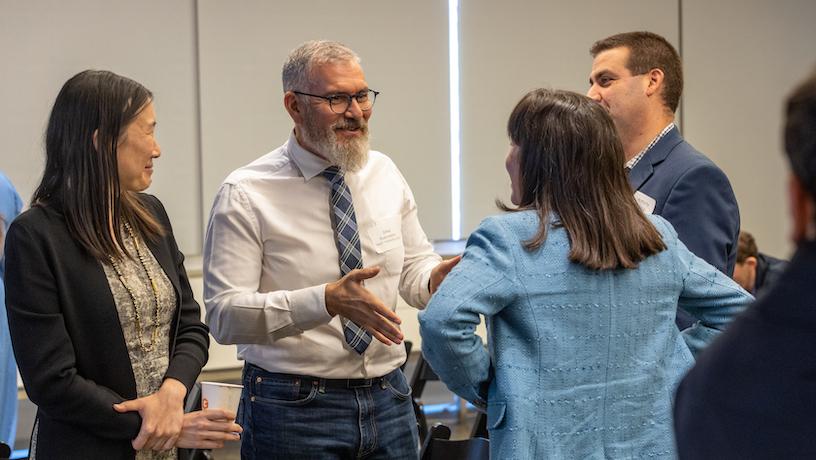
The second half of the event consisted of breakout sessions between small groups of students and women faculty members from across Columbia. With cups of coffee in hand, students and professors–women in STEM– exchanged stories, laughter, and insights.
A common theme professors shared with students was the importance of advocating for yourself and pursuing what you're passionate about. University Professor and Mikati Foundation Professor of Biomedical Engineering Gordana Vunjak-Novakovic emphasized that when you truly love what you do, it never feels like work—even when challenges arise. Christine Hendon, associate professor of electrical engineering, encouraged students to believe in themselves, even when others doubt their ideas.
"If someone says it won’t work, figure it out, run some simulations, test for tolerance analysis, and if it looks feasible—go for it," Hendon said. "When you finally get to the point where it works, it’s the best feeling ever.”
In this relaxed setting, conversations flowed and what started as casual chats soon turned into meaningful discussions about careers, research, and personal experiences.
“This event showcases the magic of Columbia,” said Githika, “and how there is a community that wants to not just collaborate with each other, but grow with each other.”
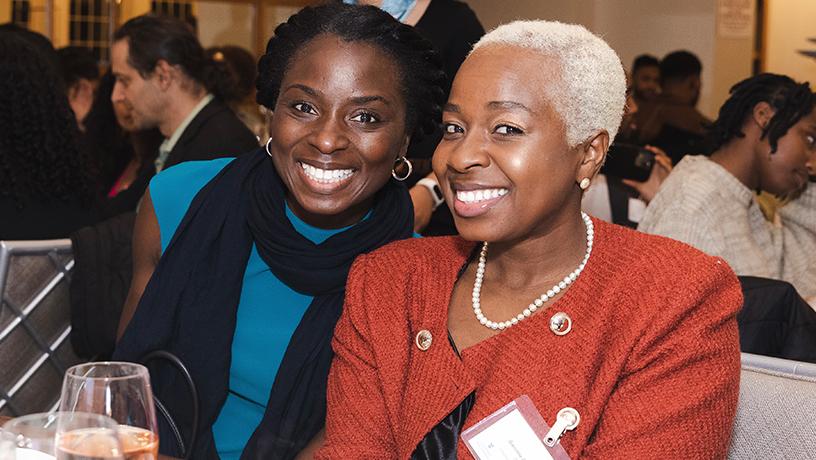
Lead Photo Caption: Columbia faculty, students and staff gathered in Carleton Commons March 7 for a special networking opportunity for women in STEM.
Lead Photo Credit: Diane Bondareff/Columbia University
Teaching robots to build simulations of themselves
Credit: Creative Machines Lab/Columbia Engineering
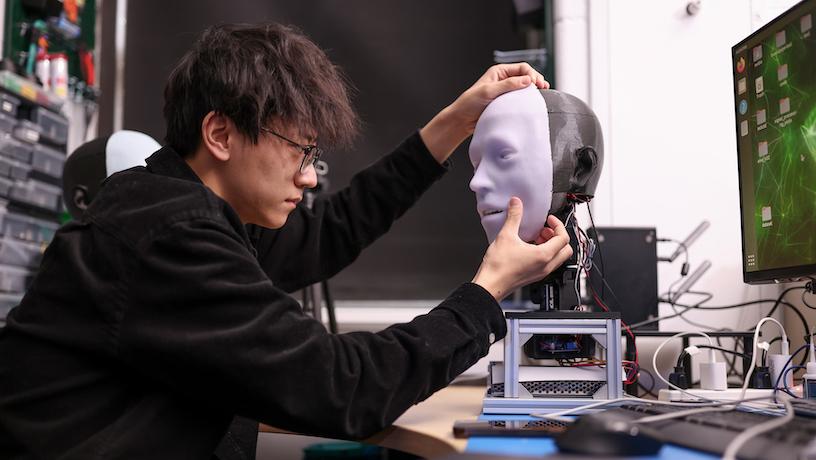
In the new study, the researchers instead developed a way for robots to autonomously model their own 3D shapes using a single regular 2D camera. This breakthrough was driven by three brain-mimicking AI systems known as deep neural networks. These inferred 3D motion from 2D video, enabling the robot to understand and adapt to its own movements. The new system could also identify alterations to the bodies of the robots, such as a bend in an arm, and help them adjust their motions to recover from this simulated damage.
Such adaptability might prove useful in a variety of real-world applications. For example, "imagine a robot vacuum or a personal assistant bot that notices its arm is bent after bumping into furniture," Hu says. "Instead of breaking down or needing repair, it watches itself, adjusts how it moves, and keeps working. This could make home robots more reliable—no constant reprogramming required."
Another scenario might involve a robot arm getting knocked out of alignment at a car factory. "Instead of halting production, it could watch itself, tweak its movements, and get back to welding—cutting downtime and costs," Hu says. "This adaptability could make manufacturing more resilient."
As we hand over more critical functions to robots, from manufacturing to medical care, we need these robots to be more resilient. “We humans cannot afford to constantly baby these robots, repair broken parts and adjust performance. Robots need to learn to take care of themselves, if they are going to become truly useful,” says Lipson. “That’s why self-modeling is so important.”
The ability demonstrated in this study is the latest in a series of projects that the Columbia team has released over the past two decades, where robots are learning to become better at self-modeling using cameras and other sensors.
In 2006, the research team’s robots were able to use observations to only create simple stick-figure-like simulations of themselves. About a decade ago, robots began creating higher fidelity models using multiple cameras. In this study, the robot was able to create a comprehensive kinematic model of itself using just a short video clip from a single regular camera, akin to looking in the mirror. The researchers call this newfound ability “Kinematic Self-Awareness.”
“We humans are intuitively aware of our body; we can imagine ourselves in the future and visualize the consequences of our actions well before we perform those actions in reality,” explains Lipson. “Ultimately, we would like to imbue robots with a similar ability to imagine themselves, because once you can imagine yourself in the future, there is no limit to what you can do.”
The researchers detailed their findings February 25 in the journal Nature Machine Intelligence.
Lead Photo Description: A robot observes its reflection in a mirror, learning its own morphology and kinematics for autonomous self-simulation. The process highlights the intersection of vision-based learning and robotics, where the robot refines its movements and predicts its spatial motion through self-observation.
Credit: Jane Nisselson/Columbia Engineering
About The Study
Journal: Nature Machine Intelligence
Title: Teaching Robots to Build Simulations of Themselves
Authors: Yuhang Hu 1, Jiong Lin 1, and Hod Lipson 1, 2
Affiliations:
1 Creative Machines Laboratory, Mechanical Engineering Department, Columbia University, New York, NY 10027, USA
2 Data Science Institute, Columbia University, New York, NY, 10027, USA
DOI: 10.1038/s42256-025-01006-w
Funding/Acknowledgements: This work was supported in part by the U.S. National Science Foundation (NSF) AI Institute for Dynamical Systems (DynamicsAI.org), grant 2112085.
All the authors declare that they have no competing interests.
Homayoon Beigi