Columbia University's Makerspace
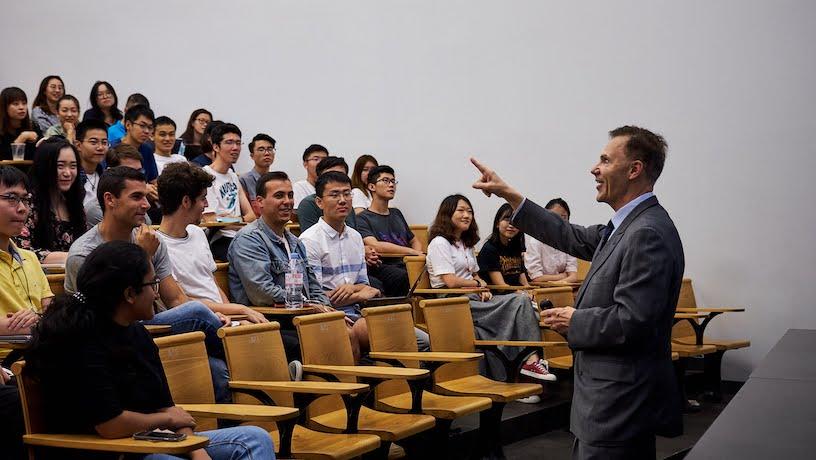
Explore the innovative hub for creativity and learning at Columbia University's Makerspace.
Mutations in the MYH9 Gene Cause Spectrum Disorders
Left: The fruit fly provides a unique opportunity to "watch" the effects of disease-associated mutations. Right: These changes in embryo shape require cell movements driven by mechanical forces.
They used high-resolution confocal fluorescence imaging to take movies of the process, together with biophysical approaches such as laser ablation, or laser nano-dissection, to measure the forces generated by the mutated myosin II motor proteins in vivo.
Kasza found that, while the mutated myosin II motor proteins actually went to the proper places inside cells and were able to generate force, the fine-scale organization of the myosin proteins and the speed of their movement inside cells were different than for the normal wild-type myosin protein. The team saw slower movements of cells within tissues that brought about abnormalities in embryo shape during development.
“By ‘watching’ how cells move and generate forces inside living tissues, we’ve uncovered new clues as to why mutations in the MYH9 gene cause a broad spectrum of disorders in humans,” Kasza observes. “Our work sheds new light on how motor proteins generate forces inside living tissues and on how genetic factors alter these forces to result in disease. This mechanistic understanding will help us better understand these diseases and could lead to new diagnostic or therapeutic strategies down the road.”
The researchers are now working on new approaches to very precisely manipulate the forces generated by myosin motors inside living cells and tissues. These new tools will help the team to uncover how mechanical forces influence biochemical processes that control cell movements and cell fate. These studies will be essential to better understanding how dysregulation of mechanical forces contributes to disease.
Columbia Engineering
Columbia Engineering, based in New York City, is one of the top engineering schools in the U.S. and one of the oldest in the nation. Also known as The Fu Foundation School of Engineering and Applied Science, the School expands knowledge and advances technology through the pioneering research of its more than 220 faculty, while educating undergraduate and graduate students in a collaborative environment to become leaders informed by a firm foundation in engineering. The School’s faculty are at the center of the University’s cross-disciplinary research, contributing to the Data Science Institute, Earth Institute, Zuckerman Mind Brain Behavior Institute, Precision Medicine Initiative, and the Columbia Nano Initiative. Guided by its strategic vision, “Columbia Engineering for Humanity,” the School aims to translate ideas into innovations that foster a sustainable, healthy, secure, connected, and creative humanity.
Images by Karen Kasza/Columbia Engineering | Photo Credit: Karen Kasza/Columbia Engineering & Sara Supriyatno/Sloan Kettering Institute
About the Study
The study is titled “Cellular defects resulting from disease-related myosin II mutations in Drosophila.”
Authors are: Karen E. Kasza1,2,; Sara Supriyatno1; and Jennifer A. Zallen1.
1Howard Hughes Medical Institute and Developmental Biology Program, Sloan Kettering Institute;
2Department of Mechanical Engineering, Columbia Engineering.
The study was supported by NIH/NIGMS R01 grant GM102803 to JAZ. KEK holds a Career Award at the Scientific Interface from the Burroughs Wellcome Fund, a Clare Boothe Luce Professorship, and a Packard Fellowship. JAZ is an investigator of the Howard Hughes Medical Institute.
The authors declare no financial or other conflicts of interest.
Demonstration of Robotic Neck Brace for ALS Patients
“To the best of my knowledge, Professor Agrawal and his team have investigated, for the first time, the muscle mechanisms in the neck muscles of patients with ALS. Their neck brace is such an important step in helping patients with ALS, a devastating and rapidly progressive terminal disease,” said Hiroshi Mitsumoto, Wesley J. Howe Professor of Neurology at the Eleanor and Lou Gehrig ALS Center at Columbia University Irving Medical Center who, along with Jinsy Andrews, assistant professor of neurology, co-led the study with Agrawal. “We have two medications that have been approved, but they only modestly slow down disease progression. Although we cannot cure the disease at this time, we can improve the patient’s quality of life by easing the difficult symptoms with the robotic neck brace.”
Commonly known as Lou Gehrig’s disease, ALS is a neurodegenerative disease characterized by progressive loss of muscle functions, leading to paralysis of the limbs and respiratory failure. Dropped head, due to declining neck muscle strength, is a defining feature of the disease. Over the course of their illness, which can range from several months to more than 10 years, patients completely lose mobility of the head, settling in to a chin-on-chest posture that impairs speech, breathing, and swallowing. Current static neck braces become increasingly uncomfortable and ineffective as the disease progresses.
To test this new robotic device, the team recruited 11 ALS patients along with 10 healthy, age-matched subjects. The participants in the study were asked to perform single-plane motions of the head-neck that included flexion-extension, lateral bending, and axial rotation. The experiments showed that patients with ALS, even in the very early stages of the disease, use a different strategy of head-neck coordination compared to age-matched healthy subjects. These features are well correlated with clinical ALS scores routinely used by clinicians. The measurements collected by the device can be used clinically to better assess head drop and the ALS disease progression.
“In the next phase of our research, we will characterize how active assistance from the neck brace will impact ALS subjects with severe head drop to perform activities of daily life,” said Agrawal, who is also a member of Columbia University’s Data Science Institute. “For example, they can use their eyes as a joystick to move the head-neck to look at loved ones or objects around them."
Columbia Engineering
Columbia Engineering, based in New York City, is one of the top engineering schools in the U.S. and one of the oldest in the nation. Also known as The Fu Foundation School of Engineering and Applied Science, the School expands knowledge and advances technology through the pioneering research of its more than 220 faculty, while educating undergraduate and graduate students in a collaborative environment to become leaders informed by a firm foundation in engineering. The School’s faculty are at the center of the University’s cross-disciplinary research, contributing to the Data Science Institute, Earth Institute, Zuckerman Mind Brain Behavior Institute, Precision Medicine Initiative, and the Columbia Nano Initiative. Guided by its strategic vision, “Columbia Engineering for Humanity,” the School aims to translate ideas into innovations that foster a sustainable, healthy, secure, connected, and creative humanity.
About the Study
The study is titled “A Robotic Brace to Characterize Head-Neck Motion and Muscle EMG in Subjects with ALS.”
The authors are Haohan Zhang (Columbia Engineering); Biing-Chwen (Columbia University); Jinsy Andrews (Columbia University College of Physicians and Surgeons, Department of Neurology and ALS center); Hiroshi Mitsumoto (Columbia University, Department of Neurology and ALS center); and Sunil Agrawal (Columbia Engineering, Department of Mechanical Engineering and Rehabilitation Medicine).

The authors declare they have no competing financial interests.
The 21st Century Cane for Walking Stability
New York, NY—August 6, 2019—By adding electronics and computation technology to a simple cane that has been around since ancient times, a team of researchers at Columbia Engineering have transformed it into a 21st century robotic device that can provide light-touch assistance in walking to the aged and others with impaired mobility.
A team led by Sunil Agrawal, professor of mechanical engineering and of rehabilitation and regenerative medicine at Columbia Engineering, has demonstrated, for the first time, the benefit of using an autonomous robot that “walks” alongside a person to provide light-touch support, much as one might lightly touch a companion’s arm or sleeve to maintain balance while walking. Their study is published today in the IEEE Robotics and Automation Letters.
“Often, elderly people benefit from light hand-holding for support,” explained Agrawal, who is also a member of Columbia University’s Data Science Institute. “We have developed a robotic cane attached to a mobile robot that automatically tracks a walking person and moves alongside,” he continued. “The subjects walk on a mat instrumented with sensors while the mat records step length and walking rhythm, essentially the space and time parameters of walking, so that we can analyze a person’s gait and the effects of light touch on it.”
The light-touch robotic cane, called CANINE, acts as a cane-like mobile assistant. The device improves the individual’s proprioception, or self-awareness in space, during walking, which in turn improves stability and balance.
“This is a novel approach to providing assistance and feedback for individuals as they navigate their environment,” said Joel Stein, Simon Baruch Professor of Physical Medicine and Rehabilitation and chair of the department of rehabilitation and regenerative medicine at Columbia University Irving Medical Center, who co-authored the study with Agrawal. “This strategy has potential applications for a variety of conditions, especially individuals with gait disorders.”
To test this new device, the team fitted 12 healthy young people with virtual reality glasses that created a visual environment that shakes around the user—both side-to-side and forward-backward—to unbalance their walking gait. The subjects each walked 10 laps on the instrumented mat, both with and without the robotic cane, in conditions that tested walking with these visual perturbations. In all virtual environments, having the light-touch support of the robotic cane caused all subjects to narrow their strides. The narrower strides, which represent a decrease in the base of support and a smaller oscillation of the center of mass, indicate an increase in gait stability due to the light-touch contact.
“The next phase in our research will be to test this device on elderly individuals and those with balance and gait deficits to study how the robotic cane can improve their gait,” said Agrawal, who directs the Robotics and Rehabilitation (ROAR) Laboratory. “In addition, we will conduct new experiments with healthy individuals, where we will perturb their head-neck motion in addition to their vision to simulate vestibular deficits in people.”
While mobility impairments affect 4% of people aged 18 to 49, this number rises to 35% of those aged 75 to 80 years, diminishing self-sufficiency, independence, and quality of life. By 2050, it is estimated that there will be only five young people for every old person, as compared with seven or eight today.
“We will need other avenues of support for an aging population,” Agrawal noted. “This is one technology that has the potential to fill the gap in care fairly inexpensively.”
Columbia Engineering
Columbia Engineering, based in New York City, is one of the top engineering schools in the U.S. and one of the oldest in the nation. Also known as The Fu Foundation School of Engineering and Applied Science, the School expands knowledge and advances technology through the pioneering research of its more than 220 faculty, while educating undergraduate and graduate students in a collaborative environment to become leaders informed by a firm foundation in engineering. The School’s faculty are at the center of the University’s cross-disciplinary research, contributing to the Data Science Institute, Earth Institute, Zuckerman Mind Brain Behavior Institute, Precision Medicine Initiative, and the Columbia Nano Initiative. Guided by its strategic vision, “Columbia Engineering for Humanity,” the School aims to translate ideas into innovations that foster a sustainable, healthy, secure, connected, and creative humanity.
Journal
IEEE Robotics and Automation Letters
About the Study
The study is titled, “Effects of a person-following light-touch device during overground walking with visual perturbations in a virtual reality environment.”
The other contributors are Danielle M. Stramel (Columbia Engineering); Robert M. Carrera (Columbia University Irving Medical Center), Sam A. Rahok (Oyama National College of Technology/visiting CUIMC); Joel Stein (Columbia University Irving Medical Center) and Sunil Agrawal (Columbia Engineering).
The authors declare they have no competing financial interests.