Multi-Materials 3D Printing with Laser Inversion
New York, NY—July 27, 2020—Additive manufacturing—or 3D printing—uses digital manufacturing processes to fabricate components that are light, strong, and require no special tooling to produce. Over the past decade, the field has experienced staggering growth, at a rate of more than 20% per year, printing pieces that range from aircraft components and car parts to medical and dental implants out of metals and engineering polymers. One of the most widely used manufacturing processes, selective laser sintering (SLS), prints parts out of micron-scale material powders using a laser: the laser heats the particles to the point where they fuse together to form a solid mass.
“Additive manufacturing is key to economic resilience,” say Hod Lipson, James and Sally Scapa Professor of Innovation (Mechanical Engineering). “All of us care about this technology—it’s going to save us. But there’s a catch.”
The catch is that SLS technologies have been limited to printing with a single material at a time: the entire part has to be made of just that one powder. “Now, let me ask you,” Lipson continues, “how many products are made of just one material? The limitations of printing in only one material has been haunting the industry and blocking its expansion, preventing it from reaching its full potential.”
Wondering how to solve this challenge, Lipson and his PhD student John Whitehead used their expertise in robotics to develop a new approach to overcome these SLS limitations. By inverting the laser so that it points upwards, they invented a way to enable SLS to use—at the same time—multiple materials. Their working prototype, along with a print sample that contained two different materials in the same layer, was recently published online by Additive Manufacturing as part of its December 2020 issue.
“Our initial results are exciting,” says Whitehead, the study’s lead author, “because they hint at a future where any part can be fabricated at the press of a button, where objects ranging from simple tools to more complex systems like robots can be removed from a printer fully formed, without the need for assembly.”
Selective laser sintering traditionally has involved fusing together material particles using a laser pointing downward into a heated print bed. A solid object is built from the bottom up, with the printer placing down a uniform layer of powder and using the laser to selectively fuse some material in the layer. The printer then deposits a second layer of powder onto the first layer, the laser fuses new material to the material in the previous layer, and the process is repeated over and over until the part is completed.
This process works well if there is just one material used in the printing process. But using multiple materials in a single print has been very challenging, because once the powder layer is deposited onto the bed, it cannot be unplaced, or replaced with a different powder.
“Also,” adds Whitehead, “in a standard printer, because each of the successive layers placed down are homogeneous, the unfused material obscures your view of the object being printed, until you remove the finished part at the end of the cycle. Think about excavation and how you can’t be sure the fossil is intact until you completely remove it from the surrounding dirt. This means that a print failure won’t necessarily be found until the print is completed, wasting time and money.”
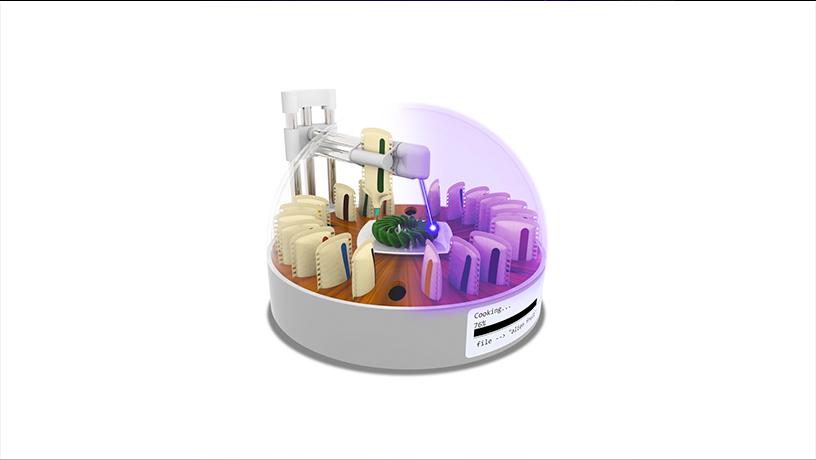
The researchers decided to find a way to eliminate the need for a powder bed entirely. They set up multiple transparent glass plates, each coated with a thin layer of a different plastic powder. They lowered a print platform onto the upper surface of one of the powders, and directed a laser beam up from below the plate and through the plate’s bottom. This process selectively sinters some powder onto the print platform in a pre-programmed pattern according to a virtual blueprint. The platform is then raised with the fused material, and moved to another plate, coated with a different powder, where the process is repeated. This allows multiple materials to either be incorporated into a single layer, or stacked. Meanwhile, the old, used-up plate is replenished.
In the paper, the team demonstrated their working prototype by generating a 50 layer thick, 2.18mm sample out of thermoplastic polyurethane (TPU) powder with an average layer height of 43.6 microns and a multi-material nylon and TPU print with an average layer height of 71 microns. These parts demonstrated both the feasibility of the process and the capability to make stronger, denser materials by pressing the plate hard against the hanging part while sintering.
“This technology has the potential to print embedded circuits, electromechanical components, and even robot components. It could make machine parts with graded alloys, whose material composition changes gradually from end to end, such as a turbine blade with one material used for the core and different material used for the surface coatings,” Lipson notes. “We think this will expand laser sintering towards a wider variety of industries by enabling the fabrication of complex multi-material parts without assembly. In other words, this could be key to moving the additive manufacturing industry from printing only passive uniform parts, towards printing active integrated systems.”
The researchers are now experimenting with metallic powders and resins in order to directly generate parts with a wider range of mechanical, electrical, and chemical properties than is possible with conventional SLS systems today.
Columbia Engineering
Columbia Engineering, based in New York City, is one of the top engineering schools in the U.S. and one of the oldest in the nation. Also known as The Fu Foundation School of Engineering and Applied Science, the School expands knowledge and advances technology through the pioneering research of its more than 220 faculty, while educating undergraduate and graduate students in a collaborative environment to become leaders informed by a firm foundation in engineering. The School’s faculty are at the center of the University’s cross-disciplinary research, contributing to the Data Science Institute, Earth Institute, Zuckerman Mind Brain Behavior Institute, Precision Medicine Initiative, and the Columbia Nano Initiative. Guided by its strategic vision, “Columbia Engineering for Humanity,” the School aims to translate ideas into innovations that foster a sustainable, healthy, secure, connected, and creative humanity.
ABOUT THE STUDY
The study is titled “Inverted multi-material laser sintering.”
Authors are: John Whitehead and Hod Lipson, Mechanical Engineering, Columbia Engineering.
The authors declare no financial or other conflicts of interest.
Reducing Transit Transmission
Rising sophomore Destiny Meyers ’23 is among a group of civil and mechanical engineers looking at how to make mass transit like New York City’s subway less amenable to viral transmission. Having previously partnered with two of her teammates in Columbia’s remote DIY Ventilator Challenge in the spring, Meyers was excited to apply her background in civil engineering to rethinking public transportation. Her team’s concept—Stay In The Loop, a customizable and economical system of frequently sanitized hooks and loops allowing riders to stand balanced on moving trains without having to touch handrails—was inspired in part by theme parks that provide visitors with bracelets and 3D glasses later returned and cleaned for reuse.
“We knew it would be difficult to limit the number of people on the subway, especially since essential workers use it as their primary mode of transportation,” she says from her home in New Mexico. “But if we could decrease the transmission of germs through high-touch surfaces, we might have something special.”
While her teammates explored hook prototypes and means of sterilizing mechanisms, Meyers focused on designing the loops—initially investigating whether plastic or fabric would make the most sense and then, after calculating that fabric would be both cheaper and easier to clean, utilizing her sewing skills to design and iterate a prototype. The group met frequently online and regularly consulted with peers and faculty like civil engineering Professor Sharon Di and electrical engineering Senior Lecturer David Vallancourt on fine-tuning their design, documenting their work, and mapping out potential next steps.
The team has continued to hone their system after earning second place at the first round of competition in July, connecting with transit officials in Miami-Dade for feedback and hopefully to participate in a future pilot program. They also plan to apply for an ignition grant from Columbia to support their progress.
I’m amazed at the progress we made working from the unknown to the known. We had no idea that we’d end up creating a platform that would make a difference to first-years as we learned the importance of centering design on the user.
Improving Access to Vaccines
For the time being prevention is our best weapon against the pandemic and others yet to come, but vaccines will hopefully become available sooner rather than later. For biomedical engineer Min Tsou ’23, rising to the challenge of improving vaccine access in moments of extreme demand was a huge draw—especially once she learned that the special borosilicate glass used in vials is in perilously short supply.
Joining forces with biologist Bhoomika Kumar ’23CC and computer scientist Erin Liang ’23, Tsou is exploring creating a new multidose vial at less cost using cheaper materials while still seamlessly accommodating all the logistical issues of scaling up production within existing manufacturing and distribution processes. After extensive R&D, they came up with VaxFlask, a modular design which holds four doses per vial using just 14% of the scarce borosilicate glass.
Since constraints of time and equipment made it tough to present judges with a tangible product, the team—dubbed The Immunogeniuses—focused on the unique learning experience the challenge entailed, with extensive access to faculty experts and industry mentors alike imparting invaluable insights into the multidimensional contexts of delivering pharmaceuticals to patients.
“Our concept evolved a lot as we spoke with vaccine manufacturers,” Tsou says from home in Hawaii. “It really showed how important it is to consult with industry professionals at every stage of the process. Getting all the feedback helped us follow FDA regulations and develop a design that can be easily incorporated into existing production lines.”
Like many of their fellow teams, The Immunogeniuses approached the competition as a launching pad for further exploration of their concept. “In addition to working on 3D-printing a prototype, we’re in the process of reaching out to vial manufacturers for prototyping as well as pharmaceutical companies potentially interested in testing their vaccines in VaxFlask,” Tsou says. “It’s been incredibly rewarding to work on solving an important real-world issue affecting the health and lifestyles of billions worldwide.” After taking second in the first round, the team ultimately earned the $5000 grand prize, which they’re already investing in prototyping and initial tests.
Enhancing Communication
Pandemic notwithstanding, countless patients still need medical attention for a myriad of issues, routine and otherwise. For people who are hearing-impaired, particularly in developing nations, every step of that process can be a slog—a disproportionate burden that inspired a project known as Communic-aid for the challenge about reducing inequities. After extensive research, an international team of incoming data science and business analytics M.S. candidates devised an array of communication aids to help convey complex descriptions and terminologies. Their initial focus: working with India’s Ministry of Social Justice and Empowerment to assist deaf COVID patients in the state of Rajasthan.
“Based on the feedback, we’re planning to expand to cover multiple diseases across the hospital environment,” says Tushar Agrawal MS’22 from home in Dubai. “Next up, we’re recreating our visual aids in several regional languages and Indian Sign Language.” After taking second place in the first round, the Communic-aid team went on to win the $2000 prize in the finals’ “Connected” category. They’re now in the process of applying for an ignition grant to extend and refine their work.
In the challenge devoted to making the overall practice of medicine safer, three researchers from Professor Kristin Myers’ Soft Tissue Lab teamed up with a peer from Tuskegee University to explore how smarter communication could help keep expecting mothers out of the hospital as much as possible. Streamlining existing technologies, the team sought to improve telemedicine for prenatal care with a versatile and easy-to-use device helping pregnant women measure vitals at home and remotely coordinate with physicians.
“The thing that surprised me the most was that we spent more time thinking and researching and talking to doctors and new moms about flaws in the system and potential improvements than actually working on our prototype,” says mechanical engineer Arielle Feder ’22 from Westchester County, New York. “In the end, our solution felt relatively simple and I was surprised that nothing like it was already implemented. It taught me the importance of honing in on the problem before jumping to solutions, and that the most effective solution does not have to be the most complicated.”
Beyond medicine, human fellowship is no less important to public health—among students as much as anyone. For the challenge geared to facilitating social interaction in times of COVID, a diverse team worked out Columbia Connect, a hyperlocal network linking distant Columbians around the world.
“Our initial ideas revolved around different groups of people and how to make online interaction more intimate until we settled on a platform for incoming freshmen like me,” says aspiring computer scientist Martha Wangechi Njuguna ’24 from her home in Nairobi, Kenya. Aiming to create spaces for online interaction as natural as meeting in person, the group hosts a variety of virtual events and curates tips, memes, playlists and more for students. Along the way, they’ve consulted with Professors Lydia Chilton and Harry West on making their design as user-friendly as possible.
“I’m amazed at the progress we made working from the unknown to the known,” Njuguna says. “We had no idea that we’d end up creating a platform that would make a difference to first-years as we learned the importance of centering design on the user.” After earning first place in their competition, the team is currently collaborating with student groups and fostering self-sustaining virtual communities.
Smarter Energy Storage
In the end, the challenges gave many participants new insight into how their talents can best be used to improve human conditions. For a group of incoming first-years, the competition combating climate change through smarter energy storage marked their inaugural experience as Columbia engineers. As Team Beyond Organic, the novices developed a flexible system using renewables to charge battery-powered hydroponic farms with lower carbon emissions and using far fewer resources than conventional farming techniques—earning first place in their competition’s initial round in the process.
“I really enjoyed learning how renewables fit into the electrical grid and want to continue on that topic during my time at Columbia,” says aspiring earth and environmental engineer Andrew Fagerheim ’24 from home in upstate New York. “I’m so glad to have had the experience because it’s given me so much to think about and look forward to over the next few years."
“We wanted to scientifically demonstrate how robotic TruST can be used to deliver an intense activity-based postural and reaching training to improve the functional sitting abilities of children with CP and trunk control problems”, says Victor Santamaria, a physical therapist and associate researcher scientist in Agrawal’s Robotics and Rehabilitation Laboratory, and first author of the paper.
Recent developments in robotic equipment have enabled clinicians to address engagement, repetition, and intensity for their patients to practice task-oriented movements in CP. A team led by Agrawal, together with other researchers at Teacher’s College and the Columbia University Irving Medical Center, recently won a five-year National Institutes of Health R01 award (#1R01 HD101903-01) to conduct a randomized clinical trial.
The project—"Improving seated postural control and upper extremity function in bilateral CP with a robotic Trunk-Support-Trainer (TruST)"—will involve up to 80 children with poor trunk control. Some will use the TruST robotic rehabilitation while others will try conventional rehabilitation. This new NIH study will compare the efficacy of the motorized TruST to engage children in play-oriented practice while advancing their skill progression with static trunk support.
“Our new NIH project is a randomized clinical trial with a large sample size to study the efficacy of TruST-intervention as a unique therapeutic solution to promote seated functional abilities in children with bilateral CP,” Agrawal adds
Columbia Engineering
Columbia Engineering, based in New York City, is one of the top engineering schools in the U.S. and one of the oldest in the nation. Also known as The Fu Foundation School of Engineering and Applied Science, the School expands knowledge and advances technology through the pioneering research of its more than 220 faculty, while educating undergraduate and graduate students in a collaborative environment to become leaders informed by a firm foundation in engineering. The School’s faculty are at the center of the University’s cross-disciplinary research, contributing to the Data Science Institute, Earth Institute, Zuckerman Mind Brain Behavior Institute, Precision Medicine Initiative, and the Columbia Nano Initiative. Guided by its strategic vision, “Columbia Engineering for Humanity,” the School aims to translate ideas into innovations that foster a sustainable, healthy, secure, connected, and creative humanity.
ABOUT THE STUDY
The study is titled “Promoting Functional and Independent Sitting in Children with Cerebral Palsy Using the Robotic Trunk Support Trainer.”
Authors are: Victor Santamaria, Moiz Khan, Tatiana Luna, Jiyeon Kang, Joseph Dutkowsky, Andrew Gordon, and Sunil Agrawal, Department of Mechanical Engineering, Columbia Engineering.
The pilot study was partially funded by the Langer Foundation as administered by The Order of Malta. The authors declare no financial or other conflicts of interest.