Columbia Engineering Class Day 2020: Undergraduate Degrees
Columbia Engineering Class Day 2020: Graduate Degrees
Columbia University Commencement 2020
Class of 2020 Award Winners
Valedictorian and Illig Prize – Emma Schechter
Salutatorian – Pranav Shrestha
George Vincent Wendell Prize – Albert Tai
Morton B. Friedman Memorial Prize for Excellence – Negar Reiskarimian
Graduate Student Life Leadership Awards – Ashritha Eadara and Sheila Misheni
Doctoral Graduate Student Life Leadership Award – Christopher Mosher
Faculty Award Winners
Edward and Carole Kim Award for Faculty Involvement -
Shiho Kawashima, Associate Professor of Civil Engineering and Engineering Mechanics
Janette and Armen Avanessians Diversity Award -
Allie Obermeyer, Assistant Professor of Chemical Engineering
View the Full Talk
Lead Photo Caption: Danqi Chen, assistant professor of computer science at Princeton, delivered the AI Lecture at Columbia on Dec. 6.
Fast Pitch 2019: Columbia Engineering
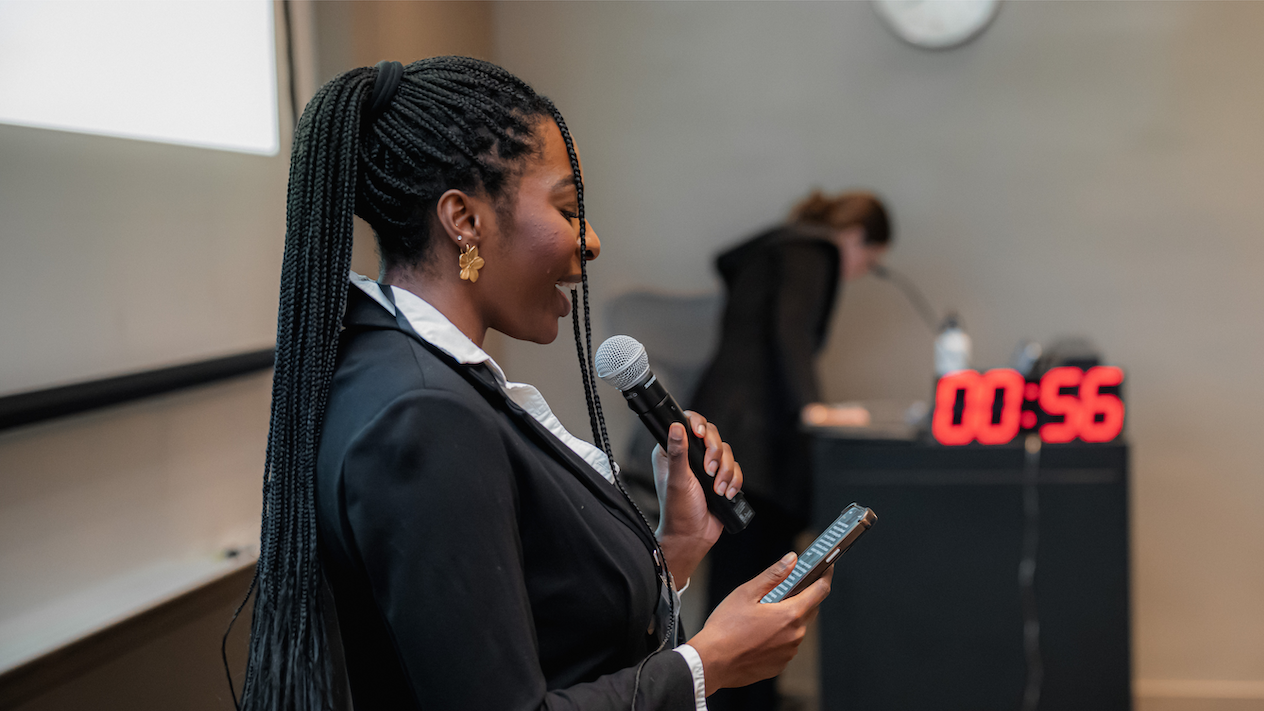
Fast Pitch is Columbia Engineering’s campus-wide annual elevator pitch competition where students and teams have 60 seconds to sell their business ideas to a panel of judges to win up to $5,000 for their idea. Teams are judged on their appeal, conciseness, and completeness.
From reluctant participant to returning champ and judge, Lucas Schuermann’s '20 journey to successful entrepreneur started with one Fast Pitch.
Currently VP of Engineering at Genesis Trading, in 2017 Schuermann cofounded Qu Capital, a quantitative hedge fund with powerful market research capabilities. What had begun a year before as an informal reading group with friends had evolved into an idea for a startup good enough to suddenly land him in front of major investors and venture capital firms downtown.
Luckily, Schuermann was ready for his big break. Having been a member of the Residential Incubator, or Res. Inc., which brings aspiring undergraduate entrepreneurs together to live and collaborate in the same dorm, and a frequent competitor at events like Fast Pitch and the Columbia Venture Competition, he’d been practicing for that moment from the moment he’d arrived in Morningside Heights.
But he never would have taken the first step without a few well-timed encouraging words from supporters like Columbia Entrepreneurship Director Ivy Schultz.
“To be honest, looking back I now think our entire idea was terrible,” says Schuermann of the proposed new social network he and neighbor Edward Yu ’18 (later Qu Capital’s cofounder) had dreamed up. “But Ivy said going through the motions of pitching would be fantastic practice. And she was right.”
Now in its ninth year, the School’s annual Fast Pitch competition has seasoned more than 300 alumni and students who have learned the ins and outs of creating startups and how to successfully pitch them to investors.
For Schuermann, that practice that quickly paid off: by his sophomore year, his team Laminar Dynamics reached the finals in the Columbia Venture Competition with a proposal to use streamlined long-range drones to transport time-sensitive medical supplies in areas with inhospitable terrain. The group later traveled to China to prototype their aircraft, and worked with several NGOs on bringing the idea to market.
As investors signed on at Qu Capital, Schuermann took a leave of absence from Columbia to oversee his rapidly growing management company and fund while leading a team building out systems and technical infrastructure. Key to everything he accomplished were contacts and connections made on campus, he notes. Over three quarters of his eventual colleagues were computer scientists, mathematicians, and statisticians from Columbia Engineering.
Earlier this year, Qu Capital was acquired by Genesis Trading, a subsidiary of Digital Currency Group (DCG), the largest investor in the blockchain space. In addition to serving as VP of Engineering, and leading a team continuing to develop sophisticated systems for trading, Schuermann has returned to Columbia Engineering to complete his undergraduate studies and mentor the next generation of rising entrepreneurs. He’s also been named Columbia Engineering’s Entrepreneur in Residence.
“As Entrepreneur in Residence, I’m essentially a jack-of-all-trades supporting the School’s entrepreneurship programs,” he says. “I’ve been lucky enough to go through the process of raising three capital rounds and finalizing an acquisition in the span of about two years. Since I recently went through the exact same opportunities as the students I mentor, I try to provide guidance and feedback drawing from the fantastic experiences I’ve had.”
That mentorship included returning as a judge at this year’s Fast Pitch, which brought together 35 early-stage student enterprises to make their best 60-second pitches for feedback and potential funding from a $5000 prize pool. This year, for the first time ever an entire engineering class—the Applied Physics Undergraduate Seminar on Entrepreneurship—revolved around tailoring innovation to market needs in order to launch viable tech start-ups. The course is taught by Professor Mike Mauel, who was among the crowd assembled at Davis Hall on November 21.
A team of Mauel’s students was among the undergraduate winners at night’s end: Quantum Data Defender, from James Borovilas ’20 and James Lee ’21, won second place and $650 for their proposed new method to better encrypt data by encoding it onto photons. Taking first and $1250 was a pitch from biomedical engineer and EMT Benjamin Greenfield ’20 for Dialetica, a small high-efficiency blood pump in development which can operate over days at a time to continuously remove excess fluid from human blood—promising to significantly reduce the need for dialysis. The endeavor grew out of R&D in Professor Ed Leonard’s lab. Additionally, Res. Inc. member Jared Gonzales ’23 earned the audience choice award and $100 for presenting CashClimate, a new financial management app that gamifies saving responsibly for young consumers.
Among the graduate winners, biomedical engineering PhD candidate Naveed Tavakol took first and $1500 for presenting InterOrgan, an "organ-on-a-chip" system utilizing patient-specific stem cells to model disease and advance drug development. He is part of a team of researchers from Professor Gordana Vunjak-Novakovic’s Laboratory for Stem Cells and Tissue Engineering. In second place, receiving $1000, was Basis Beauty from Columbia Business School MBA student Efi Turkson ’20BUS, who pitched a new multi-brand beauty retailer specifically catered to and personalized for consumers of color. Taking home third place and $500 was avoMD, a medical app from biomedical engineering master’s student Yiela Saperstein ’18BC MS’20 and her team. The interactive app personalizes medical guidelines and makes them conversational to help physicians consult with their patients at the point of care.
This year’s edition also debuted a new track, Urban Works India, devoted to innovations that will benefit residents of booming megacities in India and across the developing world. Organized in partnership with RMZ Foundation, the track will also be featured at the Venture Competition in the spring.
After every pitch, presenters took part in rapid-fire Q&A sessions with the diverse panel of judges, receiving invaluable tips and insights along the way to help hash out their proposals and hone their presentation skills.
“Fast Pitch is always invigorating,” Schuermann said. “Feeling the excitement, appreciating the amount of work that students put into their pitches, and seeing peers begin their own paths is an incredibly rewarding experience.”
Education and Community
Four teams– MOBY, ParkinPlay, Thimble, and The Vermont Recreational Center with On-Site Wastewater Treatment–walk us through their projects. (Video: Jane Nisselson)
We celebrated our graduates’ senior design projects. We partnered with the dental school to launch a new program in dental engineering. Along with our colleagues at Columbia Business School, we graduated the first cohort of MBAxMS students. The Columbia University Formula Racing team made an impressive showing at the national competition, and the Columbia Space Institute’s rocketry team brought home a gold (and set its own records) at the inaugural FAR-OUT competition in the Mojave Desert. Our faculty partnered with collaborators across disciplines to teach courses on the social implications of AI and the political impact of algorithms and machine learning. Researchers in the storied Carleton Laboratory worked with the city to restore the pumps in the Morningside Park pond.
Driving the Dialogue
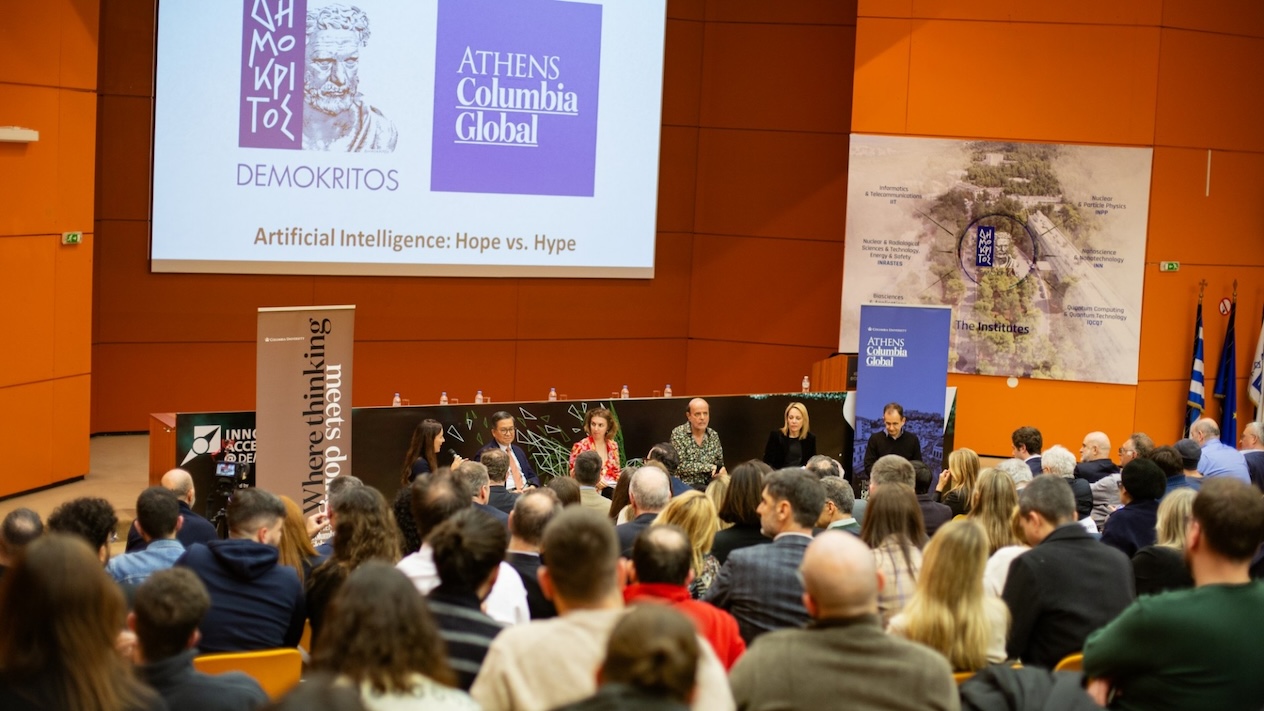
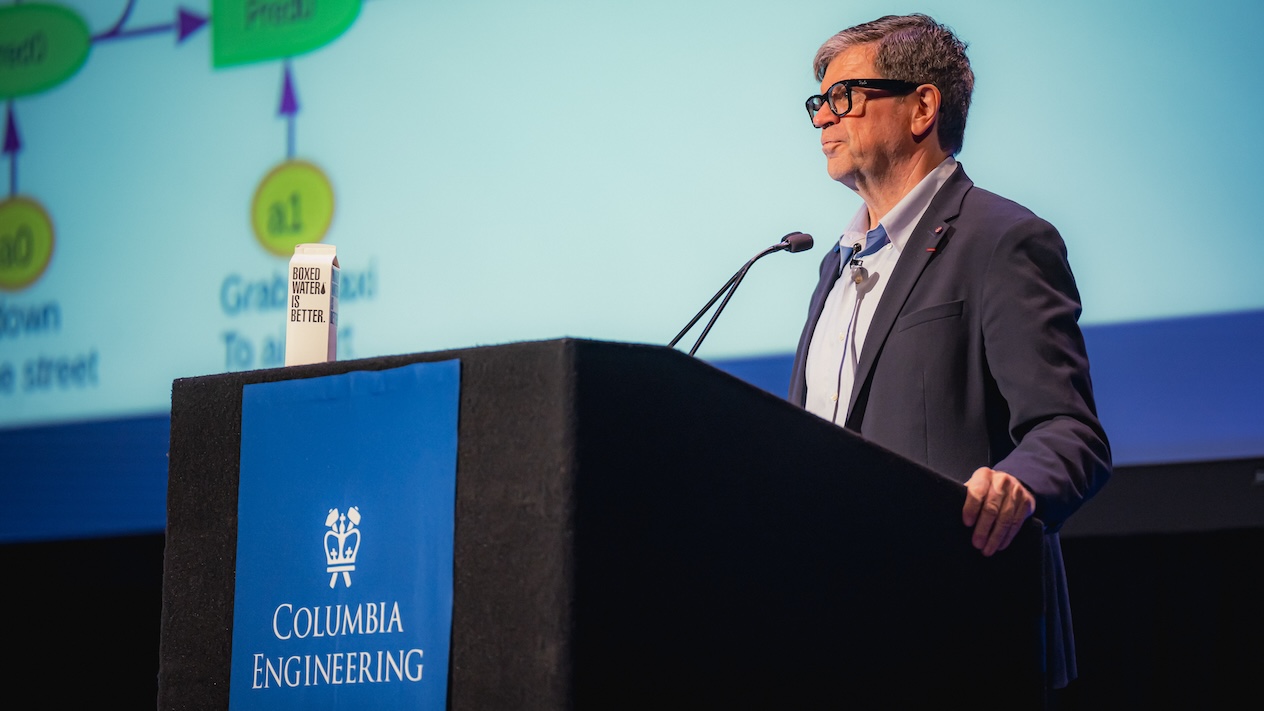
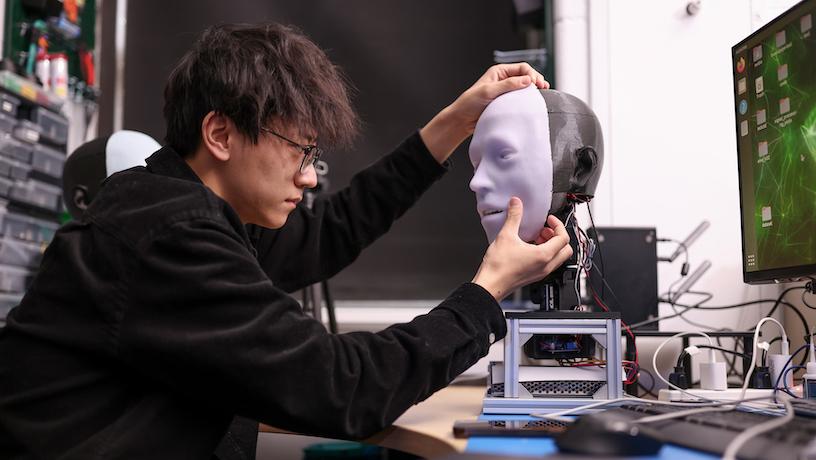
We launched The Lever, a limited-series newsletter featuring faculty perspectives on global challenges. The first series explored solutions for storing renewable energy. We also kicked off the Lecture Series in AI. In one of the first talks, the legendary deep-learning researcher Yann LeCun, who is Meta’s chief AI scientist, delivered a talk to more than 1,000 attendees. Media outlets across the world tapped our researchers’ expertise in articles and video on topics from digital twins in biomedical research to desalination technology and intelligent robots— and every aspect of AI. Kristen Myers and Christine Hendon challenged us to imagine how engineers can improve women’s health, and Pierre Gentine asked if AI could save the environment. Tal Danino dazzled readers with an art book featuring research inspired images from his lab.
Celebrating Faculty Excellence
Columbia Engineering celebrated the election of faculty members Jingguang Chen and Jeannette Wing to the National Academy of Engineering and congratulated Marco Giometto, Alex Urban, and Brian Smith on their NSF CAREER awards. We commended Gordana Vunjak-Novakovic on winning a Chan Zuckerberg Biohub New York Investigator Award. We were pleased to share that Oleg Gang was named a 2024 Vannevar Bush Fellow, that Ke Cheng received the Coulter Award, that Christos Papadimitriou and Michael Weinstein were named Simons Society Senior Fellows. We congratulated Vishal Misra on his appointment to vice dean of computing and artificial intelligence and John Kymissis on being named vice dean of infrastructure and innovation, and Kymissis' election to the National Academy of Inventors.
Fast Pitch Winners
Photos by Brandon Vallejo
University Leadership Series: Climate Change and the Transition to Net Zero
Climate Change and the Transition to Net Zero with Dean Boyce and Dean Costis Maglaras
To mitigate the effects of climate change, the world needs not only innovative technological solutions to reduce emissions, but economic and business incentives to ensure widespread global adoption and implementation.
This natural alignment between engineering and business in the fight against climate change was the inspiration behind a recent conversation on “Climate Change and the Transition to Net Zero,” hosted by the Columbia Global Centers and featuring Engineering School Dean Mary Boyce and Columbia Business School Dean Costis Maglaras. The discussion—which also included Safwan Masri, executive vice president for Global Centers and global development, and Julie Kornfeld, vice provost for academic programs—highlighted the collaborative, pan-disciplinary work taking place at Columbia around this era-defining issue, and looked forward to the future engineering, business, and policy breakthroughs needed to facilitate a transition to carbon neutrality.
Safwan Masri opened the discussion by underscoring the urgency with which scientists and policymakers must take up the challenge of addressing climate change. “We must acknowledge that we are actually talking about survival, for ourselves and for the planet,” he said, citing the growing incidence of severe drought, flooding, and natural disasters worldwide, as well as their harmful effects on global migration, food supply, and housing. “Where once we focused on sustainable practices, we now inquire about planning, design, and resilience--because this issue is no longer one we can confine to future generations. It has collapsed into one that is immediate,” he warned.
Both Dean Boyce and Dean Maglaras began by emphasizing that climate change is a core issue for both the Engineering and Business Schools, and that their students and faculty are naturally suited to tackle these issues. Citing the “Engineering for Humanity” ethos, Dean Boyce underscored that the Engineering School’s focus on climate solutions—from decarbonization to clean chemicals processing—derives from its guiding mission to produce a more sustainable, connected, healthy, secure, and creative world. Dean Maglaras, meanwhile, stressed that the Business School views climate change as one of the most important challenges facing this world—one that will transform virtually every industry and impact every Business student’s career path.
The sheer number of collaborations taking place at Columbia across academic disciplines is reflective of the truly interconnected nature of the challenges and solutions around climate change, Dean Boyce and Dean Maglaras emphasized. As an example, Dean Boyce noted how partnerships on climate modeling research have brought together physics- and chemistry-based researchers with computer science experts to produce artificial intelligence-powered predictions on our changing climate. That modeling, she said, is used to guide policymakers and business leaders looking to drive solutions. “As all of these pieces start to knit together, it creates more and more collaborations from one school to another to another.” The recently announced Climate School, she said, will act as a force multiplier to these existing collaborations by bringing together even more disparate climate initiatives across the broader University to dramatically accelerate their impact. And, deepening the Engineering and Business Schools’ commitment to interdisciplinary climate research, Dean Boyce highlighted a forthcoming degree program at Columbia that will combine a Master of Science in Engineering with an MBA and empower students to maximize their impact on sustainability studies.
Beyond collaborations at the University, driving climate solutions requires translating academic developments into real-world impact. “Producing and distributing innovative sustainable technologies at scale and at low cost is still a pending problem if we’re going to do it in a timely manner, in a way that is equitable, and in a way that the world’s population can absorb,” Dean Maglaras said. That’s where initiatives like Columbia Technology Ventures—which helps to transfer inventions from academic research to outside organizations—can play an integral role in transforming engineering ideas and technologies into new businesses. Dean Boyce also highlighted the Engineering School’s efforts to provide more support to “tough tech” by accelerating the licensing of intellectual property into start-up companies—or license it to existing companies—in order to help some of the school’s best innovations get off the ground.
In addition to this partnership between engineering and business to bring solutions to scale, widespread adoption of sustainable technology will also require bold commitments at the policy level, including transformative changes in regulatory frameworks. As an example, Dean Maglaras noted that the cost of producing solar energy has fallen by a factor of 100 in the last 20 years and by tenfold in the last ten years. “That happened because we had engineering breakthroughs and because there were incentives put down by governments, in Europe and then in the U.S., to support the installation,” he stressed. “We need to do that in other areas of climate change as well.”
Policies to provide greater support for engineering research, Dean Boyce and Dean Maglaras said, are also a scientific and economic imperative for the United States. Given the potential for job creation, investing in green infrastructure is “strategically important” for the U.S., Dean Malgaras said. “It’s smart policy for climate change, but it’s also smart policy domestically.” Another policy imperative is the need to bring down prices of sustainable technologies so that it becomes feasible to deploy them worldwide. “Policy at the global level will be key to facilitate that,” Dean Maglaras said.
This focus on ensuring academic breakthroughs are translated into real-world impact is one of the ways Columbia attracts students and faculty with a passion for social responsibility, the panel noted. “No matter what field a student is pursuing, there’s a sense of wanting to have a positive impact on society,” Dean Boyce said. In that regard, she highlighted an Engineering School initiative that produces decentralized solar energy grids to bring energy to developing parts of the world. “[This project] really brought together policy and business solutions to make this sustainable over the long-term in small villages,” she said. “We need to do this at a bigger scale….to bring people out of poverty.” But aside from working on readily deployable climate solutions, Dean Boyce said one of the most important ways students can prepare to have a long-term impact on climate change is by working on the scientific foundations that may one day lead to revolutionary technology. “Just as we were prepared globally to create these [COVID-19] vaccines because of all the foundational work on mRNA and lipid bilayers,” she said, students today can help lay the groundwork for future breakthroughs.
The Business School, Dean Maglaras said, also seeks to produce socially responsible business leaders who will “pursue economic opportunity with a transformative impact.” Take Ethan Brown (MBA ‘08), the founder of Beyond Meat, a plant-based meat substitute company valued at over $10 billion. Maglaras said Brown had a vision to attack what he viewed as climate change’s “cattle problem,” and ended up producing one of the most successful climate companies to have come out of Columbia. “We need hundreds of these socially-minded leaders to attack other questions” related to climate change, Dean Maglaras said.
The bottom line about the world’s transition to net zero, according to Dean Maglaras? “Solutions exist and are being developed daily, weekly, monthly in breakthroughs in academic and corporate labs. Capital exists in abundance to implement these solutions at scale. We should be optimistic, but we need to work.”