The 21st Century Cane for Walking Stability
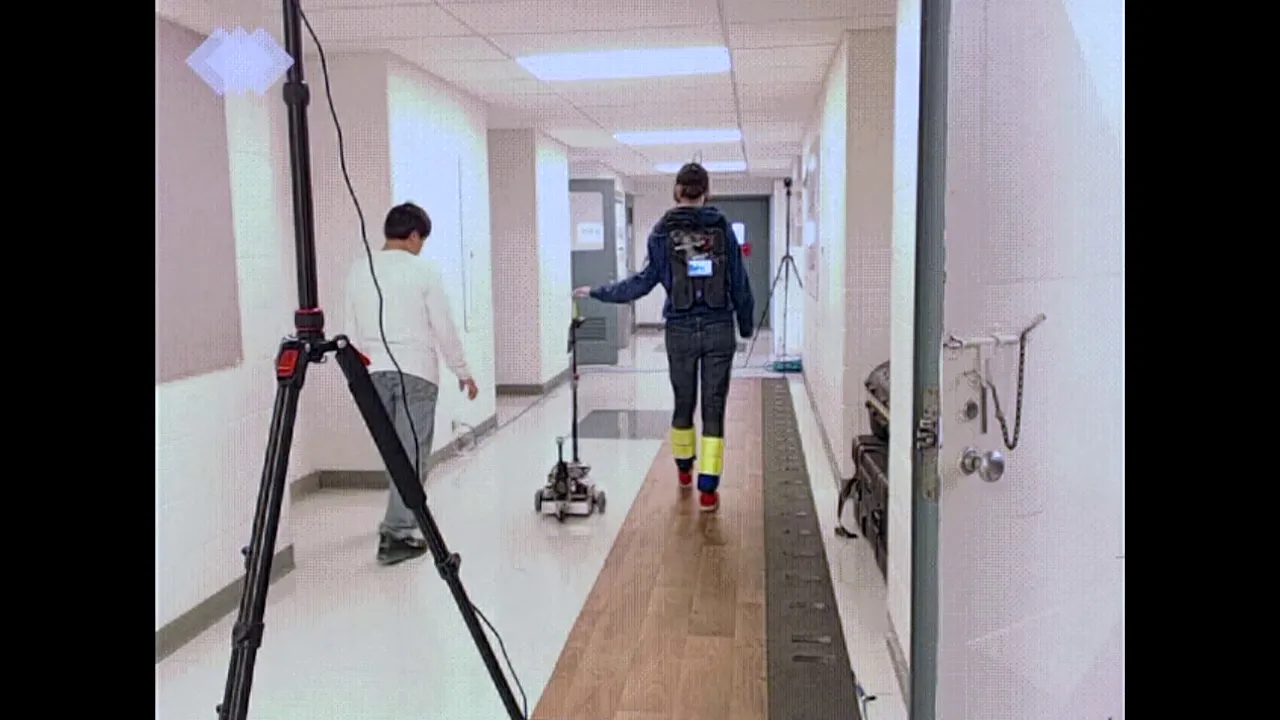
New York, NY—August 6, 2019—By adding electronics and computation technology to a simple cane that has been around since ancient times, a team of researchers at Columbia Engineering have transformed it into a 21st century robotic device that can provide light-touch assistance in walking to the aged and others with impaired mobility.
A team led by Sunil Agrawal, professor of mechanical engineering and of rehabilitation and regenerative medicine at Columbia Engineering, has demonstrated, for the first time, the benefit of using an autonomous robot that “walks” alongside a person to provide light-touch support, much as one might lightly touch a companion’s arm or sleeve to maintain balance while walking. Their study is published today in the IEEE Robotics and Automation Letters.
“Often, elderly people benefit from light hand-holding for support,” explained Agrawal, who is also a member of Columbia University’s Data Science Institute. “We have developed a robotic cane attached to a mobile robot that automatically tracks a walking person and moves alongside,” he continued. “The subjects walk on a mat instrumented with sensors while the mat records step length and walking rhythm, essentially the space and time parameters of walking, so that we can analyze a person’s gait and the effects of light touch on it.”
The light-touch robotic cane, called CANINE, acts as a cane-like mobile assistant. The device improves the individual’s proprioception, or self-awareness in space, during walking, which in turn improves stability and balance.
“This is a novel approach to providing assistance and feedback for individuals as they navigate their environment,” said Joel Stein, Simon Baruch Professor of Physical Medicine and Rehabilitation and chair of the department of rehabilitation and regenerative medicine at Columbia University Irving Medical Center, who co-authored the study with Agrawal. “This strategy has potential applications for a variety of conditions, especially individuals with gait disorders.”
To test this new device, the team fitted 12 healthy young people with virtual reality glasses that created a visual environment that shakes around the user—both side-to-side and forward-backward—to unbalance their walking gait. The subjects each walked 10 laps on the instrumented mat, both with and without the robotic cane, in conditions that tested walking with these visual perturbations. In all virtual environments, having the light-touch support of the robotic cane caused all subjects to narrow their strides. The narrower strides, which represent a decrease in the base of support and a smaller oscillation of the center of mass, indicate an increase in gait stability due to the light-touch contact.
“The next phase in our research will be to test this device on elderly individuals and those with balance and gait deficits to study how the robotic cane can improve their gait,” said Agrawal, who directs the Robotics and Rehabilitation (ROAR) Laboratory. “In addition, we will conduct new experiments with healthy individuals, where we will perturb their head-neck motion in addition to their vision to simulate vestibular deficits in people.”
While mobility impairments affect 4% of people aged 18 to 49, this number rises to 35% of those aged 75 to 80 years, diminishing self-sufficiency, independence, and quality of life. By 2050, it is estimated that there will be only five young people for every old person, as compared with seven or eight today.
“We will need other avenues of support for an aging population,” Agrawal noted. “This is one technology that has the potential to fill the gap in care fairly inexpensively.”
Columbia Engineering
Columbia Engineering, based in New York City, is one of the top engineering schools in the U.S. and one of the oldest in the nation. Also known as The Fu Foundation School of Engineering and Applied Science, the School expands knowledge and advances technology through the pioneering research of its more than 220 faculty, while educating undergraduate and graduate students in a collaborative environment to become leaders informed by a firm foundation in engineering. The School’s faculty are at the center of the University’s cross-disciplinary research, contributing to the Data Science Institute, Earth Institute, Zuckerman Mind Brain Behavior Institute, Precision Medicine Initiative, and the Columbia Nano Initiative. Guided by its strategic vision, “Columbia Engineering for Humanity,” the School aims to translate ideas into innovations that foster a sustainable, healthy, secure, connected, and creative humanity.
Journal
IEEE Robotics and Automation Letters
About the Study
The study is titled, “Effects of a person-following light-touch device during overground walking with visual perturbations in a virtual reality environment.”
The other contributors are Danielle M. Stramel (Columbia Engineering); Robert M. Carrera (Columbia University Irving Medical Center), Sam A. Rahok (Oyama National College of Technology/visiting CUIMC); Joel Stein (Columbia University Irving Medical Center) and Sunil Agrawal (Columbia Engineering).
The authors declare they have no competing financial interests.
Columbia Engineering 17.7K subscribers Multi-mobile Computing System for Combining and Sharing Devices

The M2 system integrates cameras, displays, microphones, speakers, sensors, and GPS to improve audio conferencing, media recording, and Wii-like gaming, and allow greater access for disabled users.
Among M2’s device “transformations” are fusing device data from multiple devices to provide a multi-headed display scenario for a better “big screen” viewing or gaming experience. By converting accelerometer sensor data to input touches, M2 can transform a smartphone into a Nintendo Wii-like remote to control a game on another system. Eye movements can also be turned into touchscreen input, a useful accessibility feature for disabled users who cannot use their hands.
For audio conferencing without having to use costly specialized equipment, M2 can be deployed on smartphones across a room to leverage their microphones from multiple vantage points, providing superior speaker-identifiable sound quality and noise cancellation. M2 can redirect a display to a camera so that stock camera apps can record a Netflix or YouTube video and can also enable panoramic video recording by fusing the camera inputs from two systems to create a wider sweeping view. One potentially popular application would let parents seated next to each other record their child's wide-angled school or sports performance.
“Doing all this without having to modify apps means that users can continue to use their favorite apps with an enhanced experience,” AlDuaij says. “M2 is a win-win—users don’t need to worry about which apps would support such functionality and developers don’t need to spend time and money to update their apps.”
Using M2 is simple—all a user would have to do is to download the M2 app from Google Play or Apple’s App Store. No other software is needed. One mobile system runs the unmodified app; the input and output from all systems is combined and shared to the app.
“Our M2 system is easy to use, runs efficiently, and scales well, especially compared to existing approaches,” Nieh notes. “We think that multi-mobile computing offers a broader, richer experience with the ability to combine multiple devices from multiple systems together in new ways.”
The Columbia team has started discussions with mobile OS vendors and phone manufacturers to incorporate M2 technologies into the next releases of their products. With a few minor modifications to current systems, mobile OS vendors can make multi-mobile computing broadly available to everyone.
Columbia Engineering
Columbia Engineering, based in New York City, is one of the top engineering schools in the U.S. and one of the oldest in the nation. Also known as The Fu Foundation School of Engineering and Applied Science, the School expands knowledge and advances technology through the pioneering research of its more than 220 faculty, while educating undergraduate and graduate students in a collaborative environment to become leaders informed by a firm foundation in engineering. The School’s faculty are at the center of the University’s cross-disciplinary research, contributing to the Data Science Institute, Earth Institute, Zuckerman Mind Brain Behavior Institute, Precision Medicine Initiative, and the Columbia Nano Initiative. Guided by its strategic vision, “Columbia Engineering for Humanity,” the School aims to translate ideas into innovations that foster a sustainable, healthy, secure, connected, and creative humanity.
About the Study
The study is titled “Heterogeneous Multi-Mobile Computing.”
Authors are: Naser AlDuaij, Alexander Van’t Hof, and Jason Nieh, Department of Computer Science, Columbia Engineering.
This work was supported in part by a Google Research Award, and NSF grants CNS-1717801 and CNS-1563555.
The authors declare no financial or other conflicts of interest.
New York, NY—May 17, 2019—Semiconductors, which are the basic building blocks of transistors, microprocessors, lasers, and LEDs, have driven advances in computing, memory, communications, and lighting technologies since the mid-20th century. Recently discovered two-dimensional (2D) materials, which feature many superlative properties, have the potential to advance these technologies, but creating 2D devices with both good electrical contacts and stable performance has proved challenging.
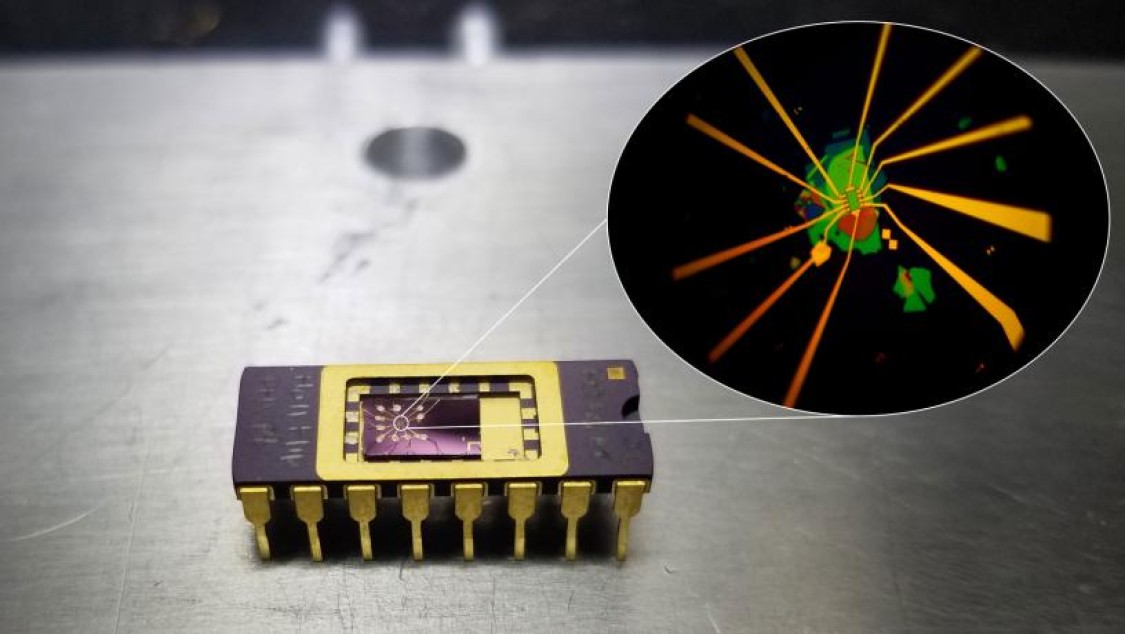
Researchers at Columbia Engineering report that they have demonstrated a nearly ideal transistor made from a two-dimensional material stack—with only a two-atom-thick semiconducting layer—by developing a completely clean and damage-free fabrication process. Their method shows vastly improved performance compared to 2D semiconductors fabricated with a conventional process, and could provide a scalable platform for creating ultra-clean devices in the future. The study was published today in Nature Electronics.
“Making devices out of 2D materials is a messy business,” says James Teherani, assistant professor of electrical engineering. “Devices vary wildly from run to run and often degrade so fast that you see performance diminish while you’re still measuring them.”
Having grown tired of the inconsistent results, Teherani’s team set out to develop a better way to make stable devices. “So,” he explains, “we decided to separate the pristine device from the dirty fabrication processes that lead to variability.”
As shown in this new study, Teherani and his colleagues developed a two-step, ultra-clean nanofabrication process that separates the “messy” steps of fabrication—those that involve “dirty” metallization, chemicals, and polymers used to form electrical connections to the device—from the active semiconductor layer. Once they complete the messy fabrication, they could pick up the contacts and transfer them onto the clean active device layer, preserving the integrity of both layers.
“The thinness of these semiconductors is a blessing and a curse,” says Teherani. “While the thinness allows them to be transparent and to be picked up and placed wherever you want them, the thinness also means there's nearly zero volume—the device is almost entirely surface. Because of this, any surface dirt or contamination will really degrade a device.”
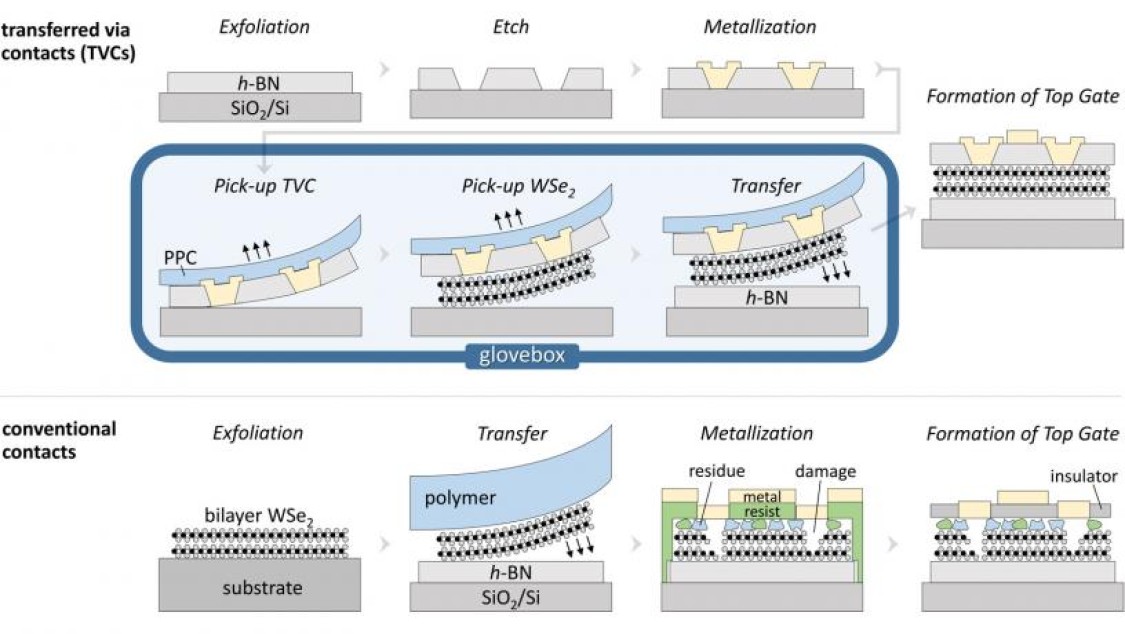
Currently, most devices are not encapsulated with a layer that protects the surface and contacts from contamination during fabrication. Teherani’s team showed that their method can now not only protect the semiconductor layer so that they don't see performance degradation over time, but it can also yield high performance devices.
Teherani collaborated with Jim Hone, Wang Fong-Jen Professor of Mechanical Engineering, making use of the fabrication and analysis facilities of the Columbia Nano Initiative and the National Science Foundation-funded Materials Research Science and Engineering Center at Columbia. The team made the transferred contacts from metal embedded in insulating hexagonal boron nitride (h-BN) outside a glovebox and then dry-transferred the contact layer onto the 2D semiconductor, which was kept pristine inside a nitrogen glovebox. This process prevents direct-metallization-induced damage while simultaneously providing encapsulation to protect the device.
Video on the differences between 2D and 3D material

Video on the step-by-step nanofabrication of 2D material stacks
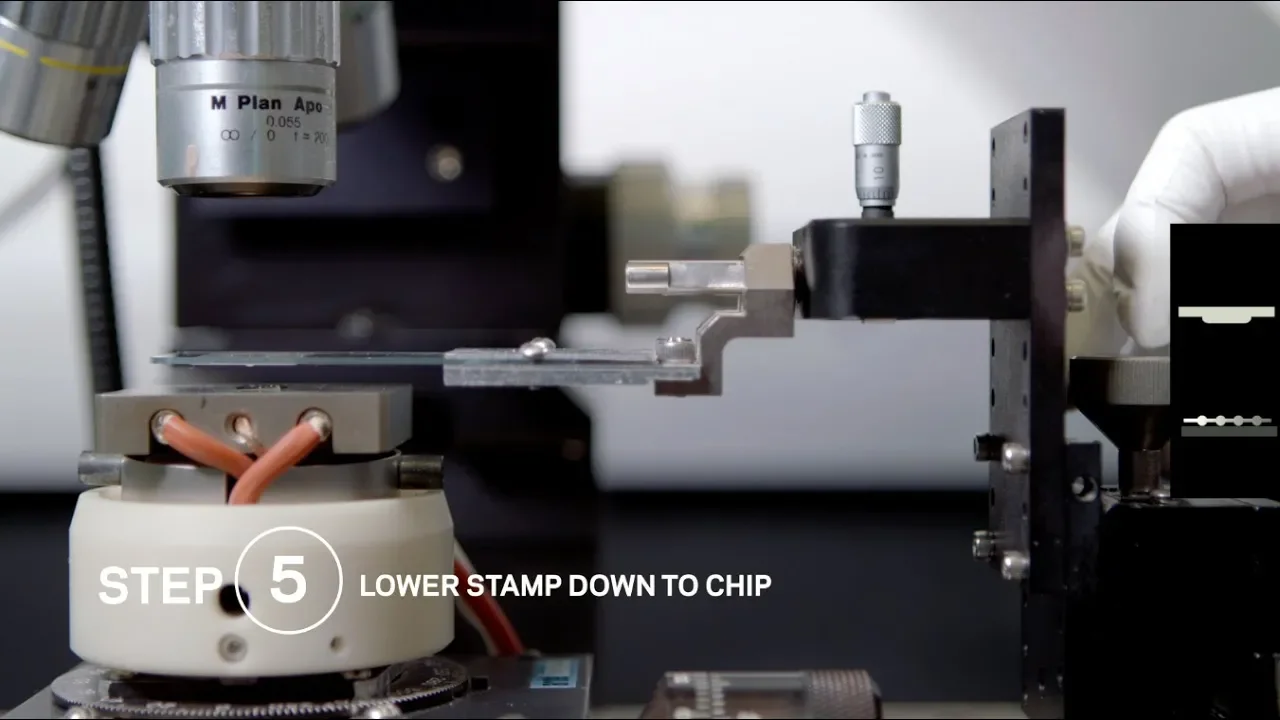
Now that the researchers have developed a stable, repeatable process, they are using the platform to make devices that can move out of the lab into real-world engineering problems.
“The development of high performance 2D devices requires advances in the semiconductor materials from which they are made,” Teherani adds. “More precise tools like ours will enable us to build more complex structures with potentially greater functionality and better performance.”
Columbia Engineering
Columbia Engineering, based in New York City, is one of the top engineering schools in the U.S. and one of the oldest in the nation. Also known as The Fu Foundation School of Engineering and Applied Science, the School expands knowledge and advances technology through the pioneering research of its more than 220 faculty, while educating undergraduate and graduate students in a collaborative environment to become leaders informed by a firm foundation in engineering. The School’s faculty are at the center of the University’s cross-disciplinary research, contributing to the Data Science Institute, Earth Institute, Zuckerman Mind Brain Behavior Institute, Precision Medicine Initiative, and the Columbia Nano Initiative. Guided by its strategic vision, “Columbia Engineering for Humanity,” the School aims to translate ideas into innovations that foster a sustainable, healthy, secure, connected, and creative humanity.
Block Chain
Securing Block Chain


Blockchain is changing the way we do business, but its greatest asset—a transparent, shared platform—is currently its greatest weakness. While banks and businesses have built up a $100 billion market in the space over the past two years, the technology has also been the target of adversarial attacks resulting in devastating financial losses.
Ronghui Gu, assistant professor of computer science, is researching a new tool with the potential to address such vulnerabilities while helping blockchain scale up for greater adoption: smart contracts. Unlike traditional contracts that rely on the observance of each party and impose penalties for noncompliance, “smart” contracts incorporate digital code that executes contracts automatically.
“We are trying to design a new language to write contracts,” says Gu. “When developers write contracts using this language, it will be easier to use and remove potential errors from the very beginning.”
Smart contracts promise to eliminate the costs and delays due to human intervention that are associated with traditional contracts—from business agreements to securing a mortgage. But they also give rise to security challenges of their own.
“Blockchain is about trust,” says Gu. “Smart contracts are more vulnerable than traditional contracts, both because their code is open source and because they lack a centralized controller who can immediately implement fixes.”
Key to improving their reliability will be to unearth bugs in the code that could be exploited by hackers. Gu was recently awarded a grant from the new Columbia-IBM Center for Blockchain and Data Transparency to do just that. He brings his background in formal verification techniques, using mathematical methods to prove software reliability, along with augmented algorithms that can address blockchain’s immense proof space—a distributed system very different from traditional software. With time, he hopes methods to make smart contracts more trustworthy will help more organizations and individuals transfer value with greater transparency.
Lead Photo Caption: Ronghui Gu
Lead Photo Images by Timothy Lee Photographers | Image courtesy of Ronghui Gu
New York, NY—April 22, 2019—The grand challenge to improve energy storage and increase battery life, while ensuring safe operation, is becoming evermore critical as we become increasingly reliant on this energy source for everything from portable devices to electric vehicles. A Columbia Engineering team led by Yuan Yang, assistant professor of materials science and engineering, announced today that they have developed a new method for safely prolonging battery life by inserting a nano-coating of boron nitride (BN) to stabilize solid electrolytes in lithium metal batteries. Their findings are outlined in a new study published by Joule.
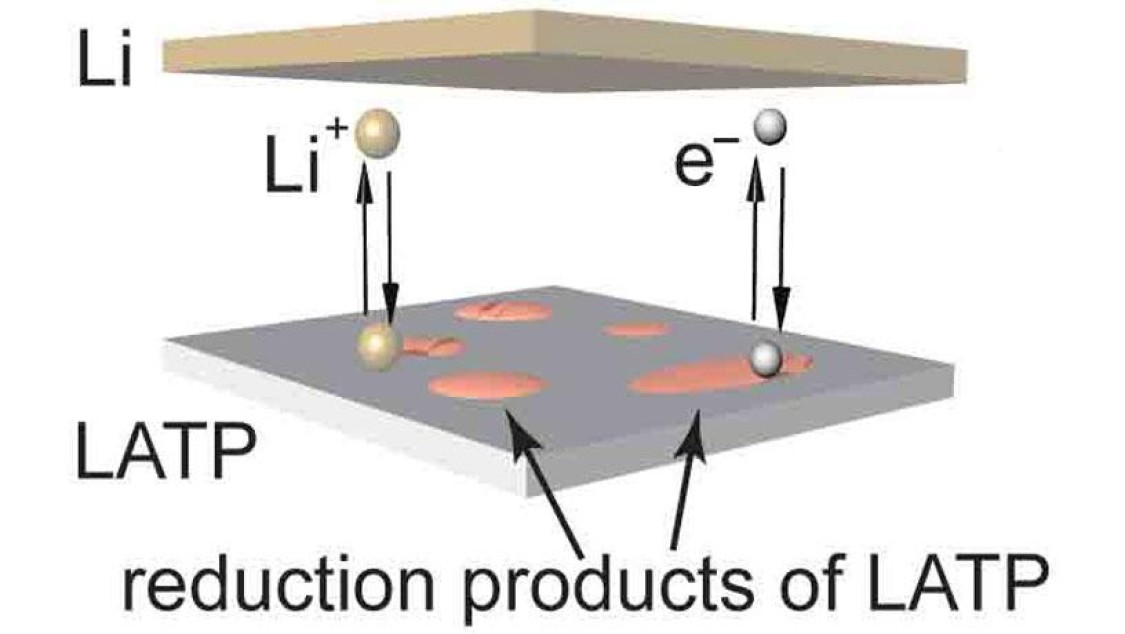
While conventional lithium ion (Li-ion) batteries are currently widely used in daily life, they have low energy density, resulting in shorter battery life, and, because of the highly flammable liquid electrolyte inside them, they can short out and even catch fire. Energy density could be improved by using lithium metal to replace the graphite anode used in Li-ion batteries: lithium metal’s theoretical capacity for the amount of charge it can deliver is almost 10 times higher than that of graphite. But during lithium plating, dendrites often form and, if they penetrate the membrane separator in the middle of the battery, they can create short-circuits, raising concerns about battery safety.
“We decided to focus on solid, ceramic electrolytes. They show great promise in improving both safety and energy density, as compared with conventional, flammable electrolytes in Li-ion batteries,” says Yang. “We are particularly interested in rechargeable solid-state lithium batteries because they are promising candidates for next-generation energy storage.”
Most solid electrolytes are ceramic, and therefore non-flammable, eliminating safety concerns. In addition, solid ceramic electrolytes have a high mechanical strength that can actually suppress lithium dendrite growth, making lithium metal a coating option for battery anodes. However, most solid electrolytes are unstable against Li—they can be easily corroded by lithium metal and cannot be used in batteries.
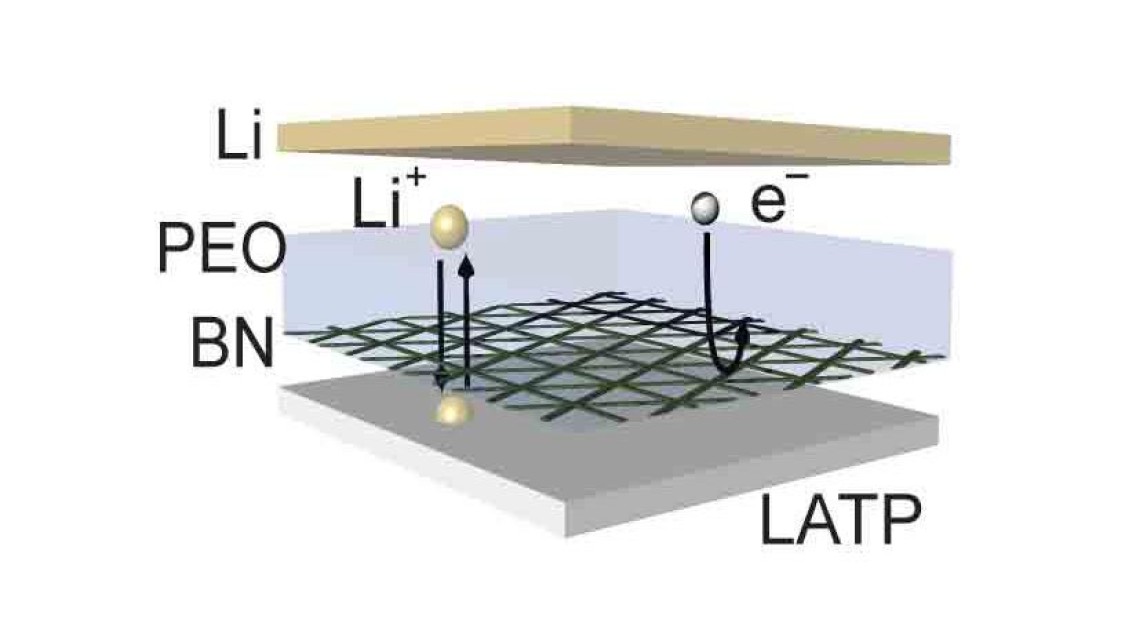
“Lithium metal is indispensable for enhancing energy density and so it’s critical that we be able to use it as the anode for solid electrolytes,” says Qian Cheng, the paper’s lead author and a postdoctoral research scientist in the department of applied physics and applied mathematics who works in Yang's group. “To adapt these unstable solid electrolytes for real-life applications, we needed to develop a chemically and mechanically stable interface to protect these solid electrolytes against the lithium anode. It is essential that the interface not only be highly electronically insulating, but also ionically conducting in order to transport lithium ions. Plus, this interface has to be super-thin to avoid lowering the energy density of batteries.”
To address these challenges, the team worked with colleagues at Brookhaven National Lab and the City University of New York. They deposited 5~10 nm boron nitride (BN) nano-film as a protective layer to isolate the electrical contact between lithium metal and the ionic conductor (the solid electrolyte), along with a trace quantity of polymer or liquid electrolyte to infiltrate the electrode/electrolyte interface. They selected BN as a protective layer because it is chemically and mechanically stable with lithium metal, providing a high degree of electronic insulation. They designed the BN layer to have intrinsic defects, through which lithium ions can pass through, allowing it to serve as an excellent separator. In addition, BN can be readily prepared by chemical vapor deposition to form large-scale (~dm level), atomically thin scale (~nm level), and continuous films.
“While earlier studies used polymeric protection layers as thick as 200 µm, our BN protective film, at only 5~10 nm thick, is record-thin—at the limit of such protection layers—without lowering the energy density of batteries,” Cheng says. “It’s the perfect material to function as a barrier that prevents the invasion of lithium metal to solid electrolyte. Like a bullet-proof vest, we’ve developed a lithium-metal-proof ‘vest’ for unstable solid electrolytes and, with that innovation, achieved long-cycling lifetime lithium metal batteries.”
The researchers are now extending their method to a broad range of unstable solid electrolytes and further optimizing the interface. They expect to fabricate solid-state batteries with high performance and long-cycle lifetimes.
Columbia Engineering
Columbia Engineering, based in New York City, is one of the top engineering schools in the U.S. and one of the oldest in the nation. Also known as The Fu Foundation School of Engineering and Applied Science, the School expands knowledge and advances technology through the pioneering research of its more than 220 faculty, while educating undergraduate and graduate students in a collaborative environment to become leaders informed by a firm foundation in engineering. The School’s faculty are at the center of the University’s cross-disciplinary research, contributing to the Data Science Institute, Earth Institute, Zuckerman Mind Brain Behavior Institute, Precision Medicine Initiative, and the Columbia Nano Initiative. Guided by its strategic vision, “Columbia Engineering for Humanity,” the School aims to translate ideas into innovations that foster a sustainable, healthy, secure, connected, and creative humanity.
About the Study
The study is titled “Stabilizing Solid Electrolyte-Anode Interface in Li-Metal Batteries by Boron Nitride-Based Nanocomposite Coating.”
Authors are: Qian Cheng,1; Aijun Li,1,3,; Na Li,2; Kai Yan,4; Shuang Li,2; Amirali Zangiabadi,1; Tai-De Li,5; Wenlong Huang,1; Alex Ceng Li,1; Tianwei Jin,1; Qingquan Song,1; Weiheng Xu,1; Nan Ni,1; Haowei Zhai,1; Martin Dontigny,6; Karim Zaghib,6; Xiuyun Chuan,3; Dong Su,2; and Yuan Yang1,8.
1 Program of Materials Science and Engineering, Department of Applied Physics and Applied Mathematics, Columbia Engineering
2 Brookhaven National Laboratory
3 Key Laboratory of Orogenic Belts and Crustal Evolution, School of Earth and Space Sciences, Peking University, Beijing
4 Amprius Inc., California
5 CUNY-Advanced Science Research Center, New York
6Centre of Excellence in Transportation Electrification and Energy Storage (CETEES), Hydro-Quebec, Canada
The study was supported by the Air Force Office of Scientific Research (FA9550-18-1-0410) and Research Corporation for Science Advancement (Award #26293), and the NSF MRSEC program through Columbia in the Center for Precision Assembly of Superstratic and Superatomic Solids (DMR-1420634).
The authors declare no conflict of interest.