In a pandemic, quick at-home testing is essential not just for isolating cases but also for compiling big picture data. When COVID-19 struck, however, all the common rapid testing formats were laborious to use and tough for non-specialists to interpret. So Professor Sam Sia, an expert in point-of-care diagnostics and therapeutics, decided to pivot his research to address the crisis. Sia’s lab has spent the past few months developing simple tools that yield nearly instant results—a prime example of how his group designs miniature medical devices for major impact.
How would you sum up the big idea animating your research?
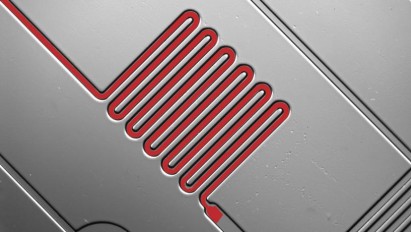
Miniaturizing devices will transform medicine the way microelectronics has transformed communication. That could mean anything from developing quick and inexpensive blood tests that can be deployed anywhere, anytime to designing tiny, implantable tech for continuously monitoring and treating patients.
On the testing front, my group, alongside a startup company Rover Diagnostics, has been working hard on a new rapid COVID-19 test based on reverse transcription polymerase chain reaction (RT-PCR). We are now participating in the National Institutes of Health "Rapid Acceleration of Diagnostics" initiative to refine and validate the system.
In terms of implantable tech, we focus on devising miniaturized devices that are biocompatible and controlled wirelessly in the body to monitor people’s health and treat various conditions.
Microfluidic Diagnostic Chip
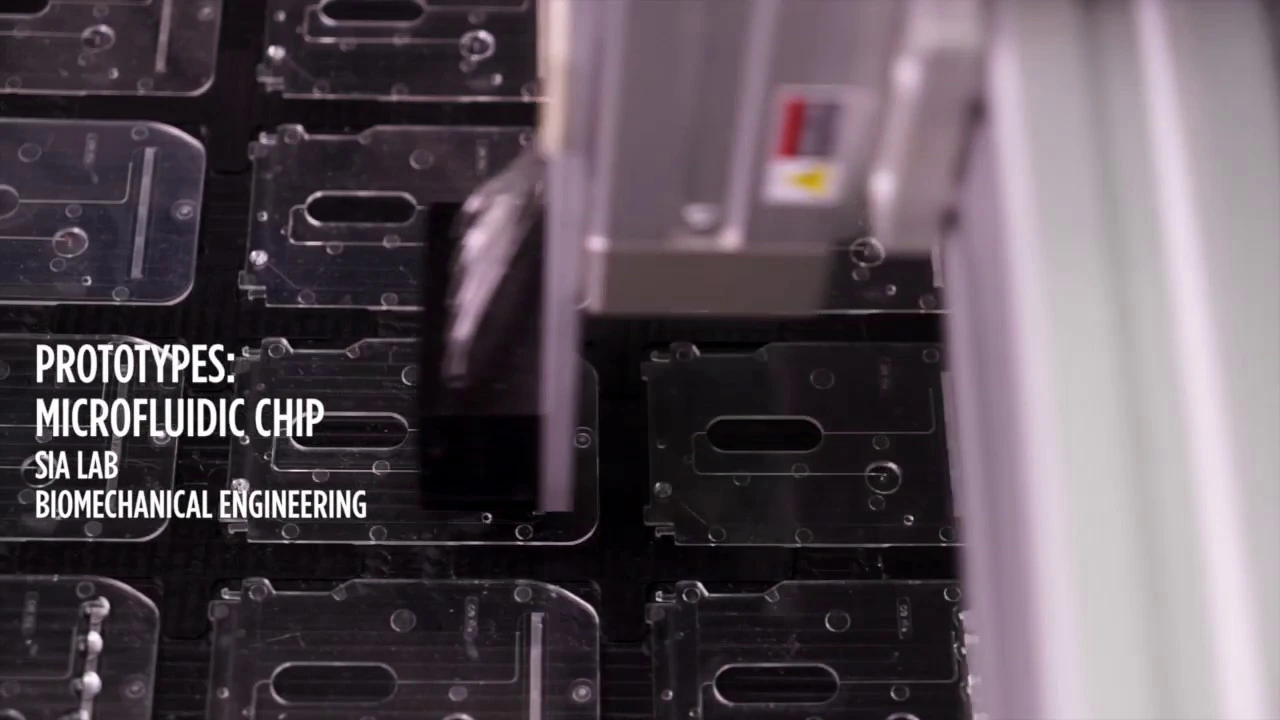
Robotically Assisted Preparation of a Microfluidic Diagnostic
Your group has had a lot of success miniaturizing devices by using microfluidics, which manipulates minute amounts of liquids to conduct precise experiments. This field has only been around since about the 1990s. What most captures your imagination about the promise of this rapidly emerging technology?
Medicine in the past has been approached biochemically, but through microfluidics—which are cheap to build and easy to transport—there’s a huge opportunity for devices to dramatically improve diagnostics and therapeutics, especially in low-resource field settings around the world. Take the Lyme disease test we developed earlier this year. This test uses a microfluidic chip to create the first point-of-care device that can diagnose Lyme in under 15 minutes.
These are the kinds of tools we want to put into the hands of practitioners. In my lab, we work closely with clinical doctors and combine insights from biology, chemistry, medicine, data science, and consumer electronics to design low-cost, integrated devices that are field ready.
What are some things happening in your lab right now you're particularly excited about?
In the realm of diagnostics, the combination of wearable devices and data analytics is moving from theory to practice; I’m excited that we’re situated right at the intersection of this impending transformation. There’s two projects in particular that I think are good illustrations of our approach here. In relation to COVID-19, we’ve been concentrating on making rapid test formats easier to use at home in part through a mobile app leveraging computer vision and machine learning to interpret test images and provide individualized guidance. We’re also collaborating with Professor Ken Shepard on a DARPA-funded project to develop an “active” bandage using implanted components and machine learning to help the body heal its wounds faster.
“We wanted to scientifically demonstrate how robotic TruST can be used to deliver an intense activity-based postural and reaching training to improve the functional sitting abilities of children with CP and trunk control problems”, says Victor Santamaria, a physical therapist and associate researcher scientist in Agrawal’s Robotics and Rehabilitation Laboratory, and first author of the paper.
Recent developments in robotic equipment have enabled clinicians to address engagement, repetition, and intensity for their patients to practice task-oriented movements in CP. A team led by Agrawal, together with other researchers at Teacher’s College and the Columbia University Irving Medical Center, recently won a five-year National Institutes of Health R01 award (#1R01 HD101903-01) to conduct a randomized clinical trial.
The project—"Improving seated postural control and upper extremity function in bilateral CP with a robotic Trunk-Support-Trainer (TruST)"—will involve up to 80 children with poor trunk control. Some will use the TruST robotic rehabilitation while others will try conventional rehabilitation. This new NIH study will compare the efficacy of the motorized TruST to engage children in play-oriented practice while advancing their skill progression with static trunk support.
“Our new NIH project is a randomized clinical trial with a large sample size to study the efficacy of TruST-intervention as a unique therapeutic solution to promote seated functional abilities in children with bilateral CP,” Agrawal adds
Columbia Engineering
Columbia Engineering, based in New York City, is one of the top engineering schools in the U.S. and one of the oldest in the nation. Also known as The Fu Foundation School of Engineering and Applied Science, the School expands knowledge and advances technology through the pioneering research of its more than 220 faculty, while educating undergraduate and graduate students in a collaborative environment to become leaders informed by a firm foundation in engineering. The School’s faculty are at the center of the University’s cross-disciplinary research, contributing to the Data Science Institute, Earth Institute, Zuckerman Mind Brain Behavior Institute, Precision Medicine Initiative, and the Columbia Nano Initiative. Guided by its strategic vision, “Columbia Engineering for Humanity,” the School aims to translate ideas into innovations that foster a sustainable, healthy, secure, connected, and creative humanity.
ABOUT THE STUDY
The study is titled “Promoting Functional and Independent Sitting in Children with Cerebral Palsy Using the Robotic Trunk Support Trainer.”
Authors are: Victor Santamaria, Moiz Khan, Tatiana Luna, Jiyeon Kang, Joseph Dutkowsky, Andrew Gordon, and Sunil Agrawal, Department of Mechanical Engineering, Columbia Engineering.
The pilot study was partially funded by the Langer Foundation as administered by The Order of Malta. The authors declare no financial or other conflicts of interest.
Research Images
Electolite modulates degradation of battery


“Specifically, we found that potassium ions mitigate the formation of undesirable chemical compounds that deposit on the surface of lithium metal and prevent lithium ion transport during battery charging and discharging, ultimately limiting microstructural growth,” says the team’s PI Lauren Marbella, assistant professor of chemical engineering.
Her team’s discovery that alkali metal additives suppress the growth of non-conductive compounds on the surface of lithium metal differs from traditional electrolyte manipulation approaches, which have focused on depositing conductive polymers on the metal’s surface. The work is one of the first in-depth characterizations of the surface chemistry of lithium metal using NMR, and demonstrates the power of this technique to design new electrolytes for lithium metal. Marbella’s results were complemented with density functional theory (DFT) calculations performed by collaborators in the Viswanathan group in mechanical engineering at Carnegie Mellon University.
Next time Generation Lithium Batteries
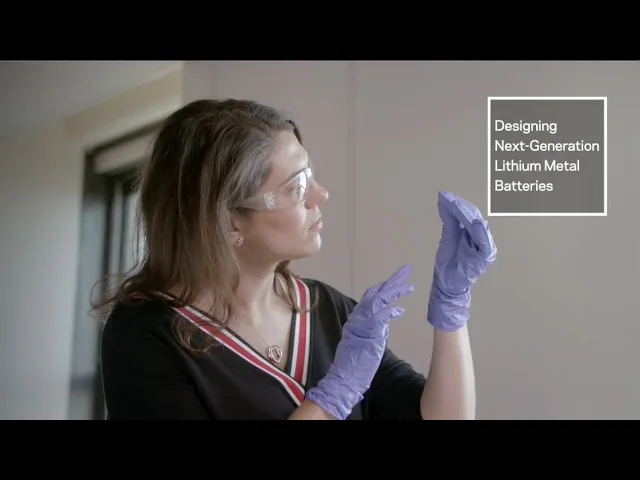
Columbia chemical engineers find that alkali metal additives can prevent lithium microstructure proliferation during battery use; discovery could optimize electrolyte design for stable lithium metal batteries and enable lightweight, low-cost, long-lasting energy storage for EVs, houses, and more.
“Commercial electrolytes are a cocktail of carefully selected molecules,” Marbella notes. “Using NMR and computer simulations, we can finally understand how these unique electrolyte formulations improve lithium metal battery performance at the molecular level. This insight ultimately gives researchers the tools they need to optimize electrolyte design and enable stable lithium metal batteries.”
The team is now testing alkali metal additives that stop the formation of deleterious surface layers in combination with more traditional additives that encourage the growth of conductive layers on lithium metal. They are also actively using NMR to directly measure the rate of lithium transport through this layer.
Columbia Engineering
Columbia Engineering, based in New York City, is one of the top engineering schools in the U.S. and one of the oldest in the nation. Also known as The Fu Foundation School of Engineering and Applied Science, the School expands knowledge and advances technology through the pioneering research of its more than 220 faculty, while educating undergraduate and graduate students in a collaborative environment to become leaders informed by a firm foundation in engineering. The School’s faculty are at the center of the University’s cross-disciplinary research, contributing to the Data Science Institute, Earth Institute, Zuckerman Mind Brain Behavior Institute, Precision Medicine Initiative, and the Columbia Nano Initiative. Guided by its strategic vision, “Columbia Engineering for Humanity,” the School aims to translate ideas into innovations that foster a sustainable, healthy, secure, connected, and creative humanity.
ABOUT THE STUDY
The study is titled “Leveraging Cation Identity to Engineer Solid Electrolyte Interphases for Rechargeable Lithium Metal Anodes.” Authors are: Richard May 1; Yumin Zhang 1; Steven R. Denny 1; Venkatasubramanian Viswanathan 2,3; Lauren E. Marbella 1
- Department of Chemical Engineering, Columbia Engineering
- Department of Materials Science and Engineering, Carnegie Mellon University
- Department of Mechanical Engineering, Carnegie Mellon
The study was funded by the Alfred P. Sloan Foundation through a Scialog: Advanced Energy Storage Collaborative Innovation Award (2019-11419, LEM and VV). Richard May is supported by the U.S. Department of Defense through the National Defense Science & Engineering Graduate Fellowship Program.
The authors declare no competing interests.
Portable Knitted Antennas
Why knitting?
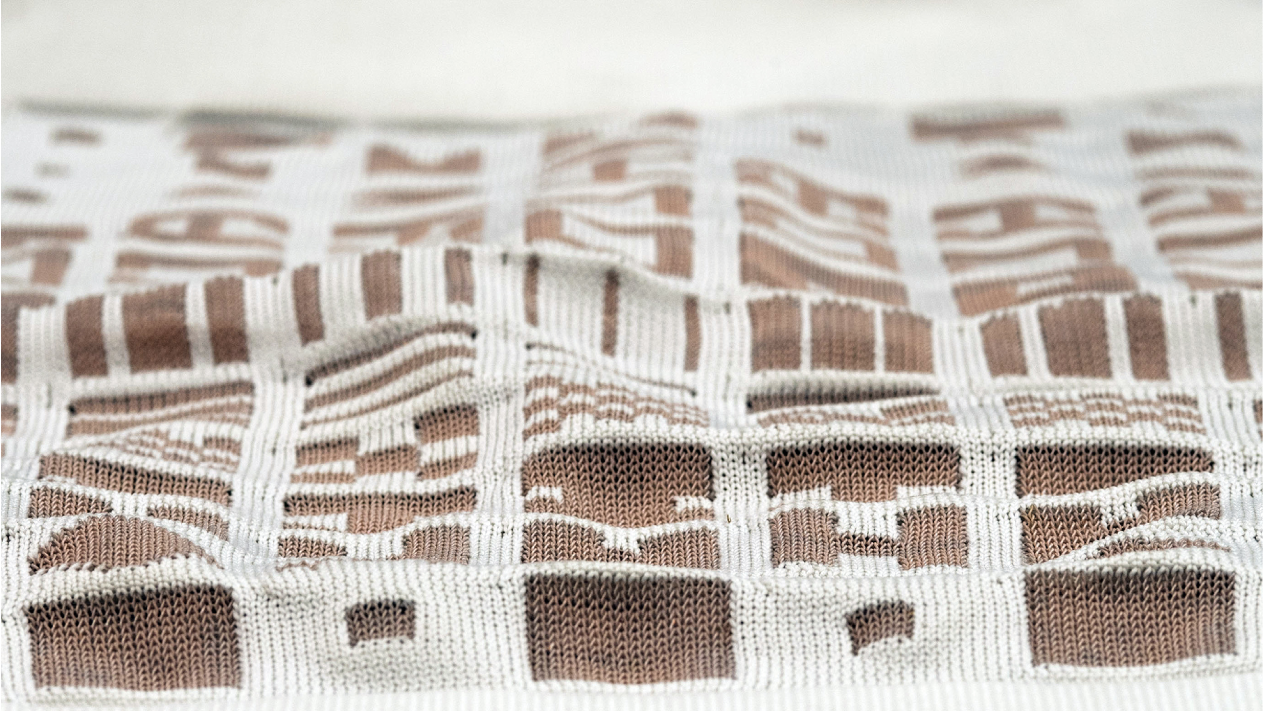
Most RF antennas, particularly highly directional array antennas like reflectarrays are planar, rigid devices. While these devices will likely always remain state-of-the-art in terms of pure performance metrics, they are often large, heavy, and unwieldy and can be expensive to manufacture. Researchers have been investigating ways to produce smaller, more flexible antennas, including inkjet printing or screen-printing directly on textiles, and embroidery. But these techniques are quasi-additive approaches in which a conductive material is added to an existing textile instead of being integrated into the textile during the fabrication process of the textile itself, introducing problems such as delamination, slip, or cracking of the metallic region, as well as issues of production scalability.
Yu’s group realized that what they needed to create was a high-throughput, inexpensive technique that directly integrates flat array antennas onto textiles. So they decided to study knitting and weaving, which, while being the most common approaches for fabricating patterned textiles, have not been explored as a way to produce complex array antennas with engineered electromagnetic responses.

A Fair Isle approach
The researchers took a novel approach to fabricating flexible, lightweight centimeter-wavelength metasurfaces. They leveraged an old-school colorwork knitting technique called float-jacquard knitting (think Fair Isle sweaters) and used commercially available metallic and dielectric yarns with existing knitting machinery to produce two prototype reflectarray devices, a metasurface lens (metalens) and a vortex-beam generating device. In the float-jacquard knitting technique, two or more types of yarn are used to produce a pattern: a yarn is floated loose beneath the fabric when not used and transferred back to the frontside as needed to create the desired pattern.
By integrating the textile fabrication and antenna patterning into a single process, the team streamlined the fabrication process and alleviated common defects in fabric-based antennas. The group is the first to adapt flat-knitting techniques to incorporate antennas directly during the fabric production procedure – integrated fabrication – and able to do it at low cost and high yield on an industrial scale. For example, each of the prototype metasurfaces with a footprint of approximately one square meter was knit within 45 minutes. In addition, the flat-knit fabric devices withstood repeated washing and stretching on a frame.
“The float-jacquard knitting technique used for making our textile metasurfaces is exactly the same technique that my mother used to make sweaters for me. I still remember a purple sweater I wore as a kid that had a row of white cats across the chest; I remember that when I inspected the inner side of the sweater, I saw white parallel yarns – the floats,” said Yu, a pioneer in researching nanophotonic devices like metasurfaces.
He noted that these complex RF antennas can be readily produced by existing infrastructure: “We can leverage the very old and very well-established knitting industry to fulfill some of the needs of modern telecommunications. The facile and scalable nature of the fabrication approach means these devices could be inexpensive, ultra-lightweight, flexible variants of sophisticated radio-frequency communications antennas.”
The results
The researchers showed experimentally that when the metalens operates as a receiving antenna, it focuses an incident centimeter-wave into a tight (diffraction-limited) focal spot, and that when it operates as a transmitting antenna, it converts the divergent emission from a horn antenna (a common RF source) into a wave with planar wavefront – a highly directional beam.
They also demonstrated that more complex wavefront shaping tasks can be accomplished: the vortex-beam generating metasurface produces a vortex beam – a beam with a corkscrew-shaped wavefront. Because of the peculiar wavefront, the vortex beam can carry an independent channel of information, thus a vortex beam and a beam with planar wavefront used together can make a communications channel twice as efficient.
Next steps
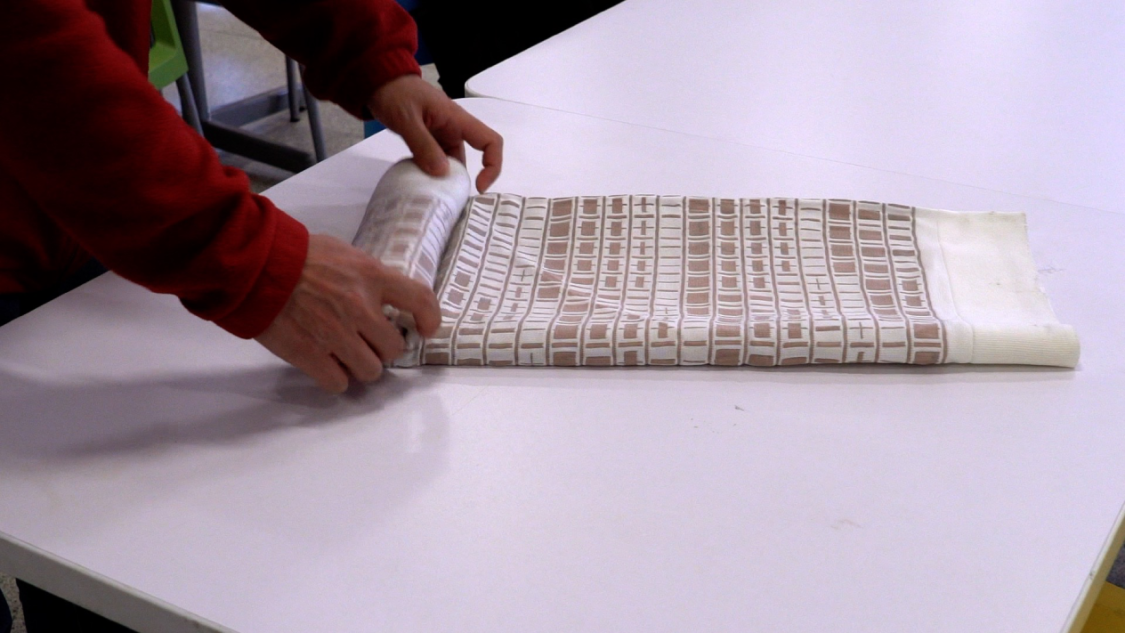
In future efforts, the researchers will explore modern knitting techniques – there are at least a dozen varieties – and knitting machines to realize more complex multi-functional designs – fabrics with combined designer electromagnetic, electronic, and mechanical responses. This could be used to engineer hinge points or folds, and electronic circuits into a fabric, which could be actuated to further facilitate stowage and deployment or even switch between different electromagnetic functionalities.
The scalability of flat knitting ranks highly among all techniques used to produce flexible or rigid RF metasurfaces and reflectarrays: commercial flat-knitting machines are capable of producing textiles up to two meters in width and with no limitation in the length direction. The researchers will explore this advantage to create high-gain antennas with apertures several meters in diameter yet lightweight and stowable to be carried by satellites to communicate across vast distances.
“It’s important to stress that these devices were fabricated using commercially available off-the-shelf yarns and leveraging established fabrication techniques,” Yu said. “I am almost certain that communities of knitters can come up with ingenious ways to integrate aesthetics and functionality into a sweater – a sweater that can double as a WiFi signal booster.”
Media Credit: Jane Nisselson
About the Study
Journal: Advanced Materials
Title: Flat-Knit, Flexible, Textile Metasurfaces
Authors: Michael J. Carter1,2, Leah Resneck3, Younes Ra'di4,5, Nanfang Yu1
- Department of Applied Physics and Applied Mathematics, Columbia Engineering
- Materials and Manufacturing Directorate, Air Force Research Laboratory, Wright-Patterson AFB
- Zeis Textiles Extension, Wilson College of Textiles, North Carolina State University
- Advanced Science Research Center, City University of New York
- Department of Electrical Engineering and Computer Science, Syracuse University
Funding: The study was supported by the Science, Mathematics, and Research for Transformation (SMART) Scholarship of the US Department of Defense award to Michael Carter, and National Science Foundation grant (ECCS-2004685), awarded to Nanfang Yu. Measurements were carried out in mm-Wave Characterization Lab at the Advanced Science Research Center, the City University of New York. Devices were fabricated in the Knitting Lab (part of the Zeis Textiles Extension) at the Wilson College of Textiles, North Carolina State University
The authors have filed a provisional application for a patent with Columbia Technology Ventures based on the work reported in this article.