Herrera-Perez Video
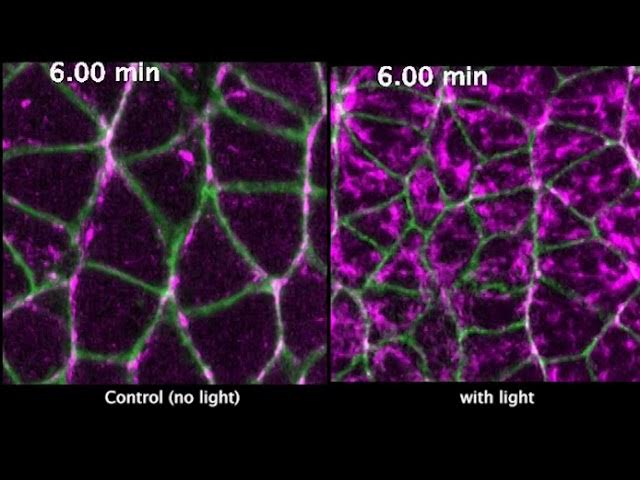
Optogenetic control of the force-generating myosin II motor protein (magenta) inside cells (green) during tissue development. Changes in myosin activity in the video at right are rapidly triggered by blue light. Compare to video at left of a normal tissue.
"The fact that we can override an existing force pattern is important, because the set of instructions or steps that an embryo follows during development is very robust, and to perturb them, we usually need methods like genetic mutations or drug injections," Herrera-Perez said. "Achieving such perturbations using optogenetics and light opens up a pathway to flexibly target cellular forces at the precise location and time point we want during development."
Specifically, the researchers studied the process of axis elongation in the fruit fly, where a tissue narrows in one direction and extends along the other direction to rapidly elongate the head-to-tail axis of the embryo. "A similar process occurs in humans as well," Herrera-Perez said. "We showed that modifying the mechanical forces in the tissue affects the way cells behave, for example, how they change shape and how they pack themselves into the tissue. This is helping us to understand how the tissue changes shape and elongates so rapidly and efficiently during normal development."
"The next step is to use these optogenetic tools both to explore how mechanical forces help regulate tissue development in the embryo and to control the mechanics and shape of tissues cultured in the laboratory for a wide range of applications in engineering, biology, and medicine," Kasza said.
Columbia Engineering
Columbia Engineering, based in New York City, is one of the top engineering schools in the U.S. and one of the oldest in the nation. Also known as The Fu Foundation School of Engineering and Applied Science, the School expands knowledge and advances technology through the pioneering research of its more than 220 faculty, while educating undergraduate and graduate students in a collaborative environment to become leaders informed by a firm foundation in engineering. The School’s faculty are at the center of the University’s cross-disciplinary research, contributing to the Data Science Institute, Earth Institute, Zuckerman Mind Brain Behavior Institute, Precision Medicine Initiative, and the Columbia Nano Initiative. Guided by its strategic vision, “Columbia Engineering for Humanity,” the School aims to translate ideas into innovations that foster a sustainable, healthy, secure, connected, and creative humanity.
ABOUT THE STUDY
The study is titled "Using optogenetics to link myosin patterns to contractile cell behaviors during convergent extension."
The study appeared in Biophysical Journal on July 20, 2021.
Authors are: R. Marisol Herrera-Perez, Christian Cupo, Cole Allan, Annie Lin, and Karen E. Kasza.
Department of Mechanical Engineering, Columbia Engineering
This work was supported by NSF Civil, Mechanical, and Manufacturing Innovation Grant 1751841. Karen E. Kasza holds a Career Award at the Scientific Interface from the Burroughs Wellcome Fund, a Clare Boothe Luce Professorship, and a Packard Fellowship.
Robots that Cook: precision cooking with multiwavelength lasers
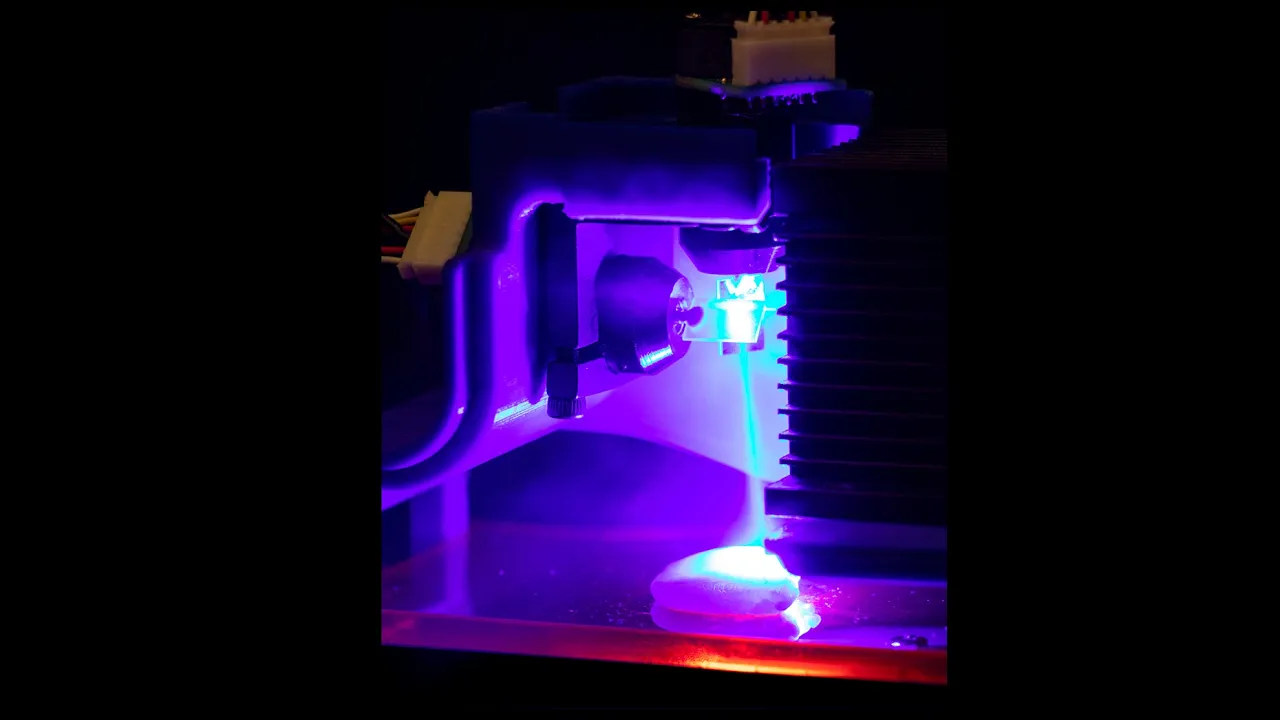
Precision Cooking with Multiavelength Lasers: temperature data

“In fact, our two blind taste-testers preferred laser-cooked meat to the conventionally cooked samples, which shows promise for this burgeoning technology,” Blutinger said.
While Lipson and Blutinger are excited about the possibilities of this new technology, whose hardware and software components are fairly low-tech, they note that there is not yet a sustainable ecosystem to support it. Lipson states that “what we still don’t have is what we call ‘Food CAD,’ sort of the Photoshop of food. We need a high level software that enables people who are not programmers or software developers to design the foods they want. And then we need a place where people can share digital recipes, like we share music.”
Still, says Blutinger, “Food is something that we all interact with and personalize on a daily basis--it seems only natural to infuse software into our cooking to make meal creation more customizable.”
Columbia Engineering
Columbia Engineering, based in New York City, is one of the top engineering schools in the U.S. and one of the oldest in the nation. Also known as The Fu Foundation School of Engineering and Applied Science, the School expands knowledge and advances technology through the research of its more than 220 faculty, while educating undergraduate and graduate students in a collaborative environment to become leaders informed by a firm foundation in engineering. School’s faculty are at the center of the University’s cross-disciplinary research, contributing to the Data Science Institute, Earth Institute, Zuckerman Mind Brain Behavior Institute, Precision Medicine Initiative, and the Columbia Nanμmo Initiative. Guided by its strategic vision, “Columbia Engineering for Humanity,” the School aims to translate ideas into innovations that foster a sustainable, healthy, secure, connected, and creative humanity.
Lead Photo Caption: Concept rendering of a digital cooking appliance that boasts dozens of ingredients and a precise cooking laser to assemble and cook meals using digital recipes.
Lead Photo Credit: Jonathan Blutinger/Columbia Engineering
ABOUT THE STUDY
The paper is titled “Precision Cooking for Printed Foods via Multi-wavelength Lasers.”
Journal: npj Science of Food
Authors are: Jonathan Blutinger, Alissa Tsai, Erika Storvick, Gabriel Seymour, Elise Liu, Noa Samarelli, Shravan Karthik, Yoran Meijers, and Hod Lipson, Departments of Mechanical Engineering and Computer Science, Columbia Engineering.
This work was supported in part by Columbia University’s SEAS Interdisciplinary Research Seed (SIRS) funding program and by NSF NRI Award #1925157.
The authors declare no financial or other conflicts of interest.