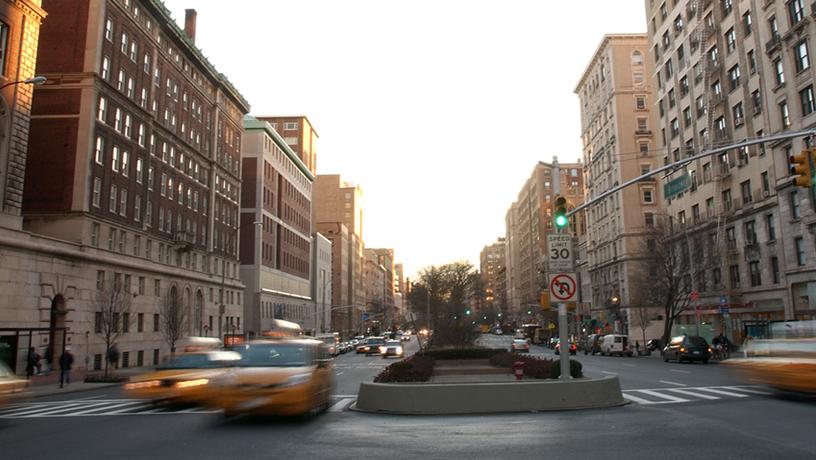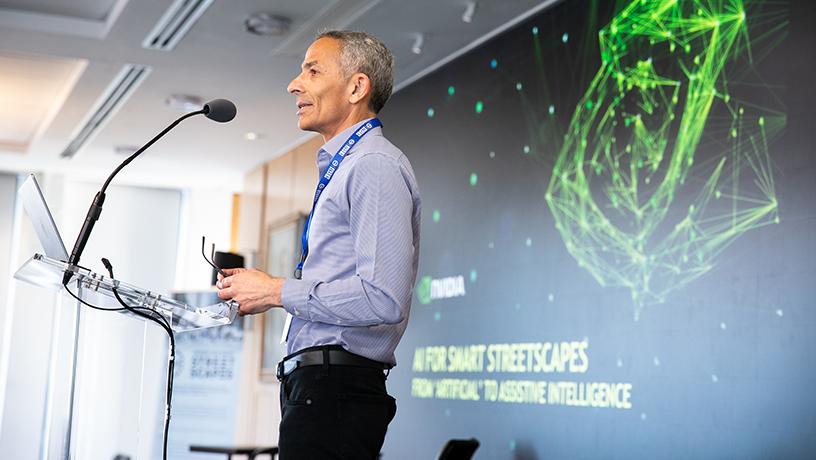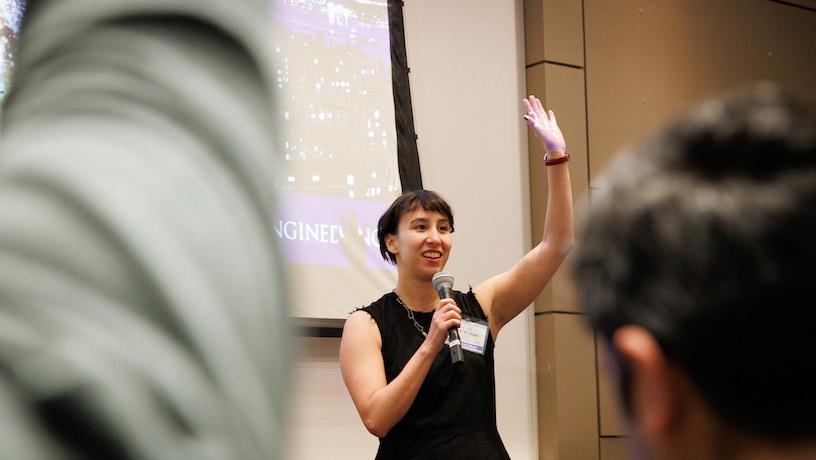
Lead Photo Caption: CS3 hosts a co-design workshop to explore smart streetscapes. 

Lead Photo Credit: Jane Nisselson

Fresh from their win at the Millard Chan Tech Challenge, the team behind MilkShaker demonstrated a practical and science-backed solution to prevent mastitis, providing professional level care without sacrificing time or requiring special training. Another group of seniors in the Department of Mechanical Engineering showcased a prototype for the CareCruiser, a wheelchair-to-stroller attachment designed to give wheelchair-using parents and caregivers greater independence when navigating with strollers and carseats.

Several projects also tackled infrastructure design, including a civil engineering and engineering mechanics team that unveiled Rethinking Resilience. The project envisions a new sustainable, flood-resilient train station to replace the existing Ardsley-on-Hudson station along the MTA’s Metro-North Hudson Line. 

And in the gaming arena, a team from the Department of Electrical Engineering demonstrated their physical tank game using modified remote-controlled cars. By reconfiguring the electronics of remote-controlled cars, the team enabled Bluetooth-based control of both the motors and onboard lasers. Players score by hitting opposing cars with laser pulses, while any car that gets hit is temporarily disabled with a five-second freeze penalty.

Dean Shih-Fu Chang greeted the students and commended them on their year-long efforts. “You all have started with an idea and brought it to life. That’s what engineers do! We bring ideas to life . . . Today’s showcase truly represents our Engineering for Humanity vision. This is a milestone in your Columbia experience and one I hope you remember for years to come.”

Each year, Columbia Engineering seniors work on a capstone project, aka Senior Design. They are challenged to solve real-world problems with innovative solutions, rooted in their foundational math, science and engineering courses. 

Here’s a look at some of the students and their innovations at Senior Design Expo 2025. 


Masthead Caption: A student tries on LenScribe, a compact set of 3D-printed glasses designed for audio input, speech processing, and visual display

Masthead Credit: Timothy Lee/Columbia Engineering

Recognizing the importance of open conversations about career journeys, Columbia Engineering Dean Shih-Fu Chang and Columbia University Interim President Katrina Armstrong, both joined the event; Dean Chang gave introductory remarks and President Armstrong kicked off the discussion and shared her own experience as a woman in STEM. 

Armstrong talked about her unconventional career path– from studying architecture as an undergraduate to completing medical school and ultimately rising through the ranks in higher education in leadership roles at the University of Pennsylvania, Harvard, and now, at Columbia. She encouraged attendees to regularly check in with themselves, emphasizing the importance of making changes before reaching burnout. She also highlighted the value of finding what works for each individual. She shared a personal anecdote about how she became known for letting her kids sleep in their school clothes instead of pajamas—a simple adjustment that made hectic mornings a little easier.

“The best advice I ever received was to be yourself because you're not going to change who you are,” Armstrong said. “And if you try to be somebody else, you're going to be so much less effective than just being who you are.”

Building connections

The second half of the event consisted of breakout sessions between small groups of students and women faculty members from across Columbia. With cups of coffee in hand, students and professors–women in STEM– exchanged stories, laughter, and insights. 

A common theme professors shared with students was the importance of advocating for yourself and pursuing what you're passionate about. University Professor and Mikati Foundation Professor of Biomedical Engineering Gordana Vunjak-Novakovic emphasized that when you truly love what you do, it never feels like work—even when challenges arise. Christine Hendon, associate professor of electrical engineering, encouraged students to believe in themselves, even when others doubt their ideas. 

"If someone says it won’t work, figure it out, run some simulations, test for tolerance analysis, and if it looks feasible—go for it," Hendon said. "When you finally get to the point where it works, it’s the best feeling ever.”

In this relaxed setting, conversations flowed and what started as casual chats soon turned into meaningful discussions about careers, research, and personal experiences. 

“This event showcases the magic of Columbia,” said Githika, “and how there is a community that wants to not just collaborate with each other, but grow with each other.”


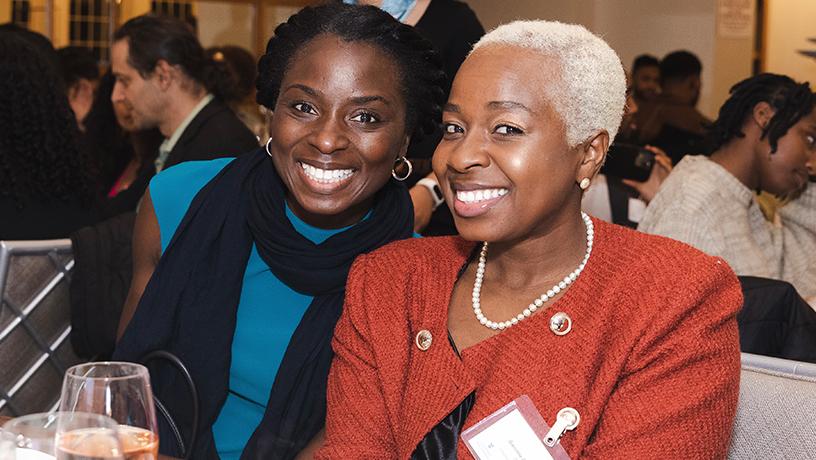
Lead Photo Caption: Columbia faculty, students and staff gathered in Carleton Commons March 7 for a special networking opportunity for women in STEM. 
Lead Photo Credit: Diane Bondareff/Columbia University

What was your initial reaction when you arrived at Ground Zero?

When I went down to the site after September 11, I just felt utter awe at two buildings of this size coming down–seeing the destruction and pile of debris that was down there, and knowing that there was a significant loss of human life at the site and the surrounding neighborhoods.

How did your experience at Ground Zero impact you personally and professionally in the years that followed?

In terms of impacting my life personally, I lost quite a few friends on that day. One former employee from Leslie E. Robertson was actually killed during the attacks of 9/11, plus a lot of the workers from the Port Authority who we worked with at the World Trade Center. I had quite a few friends who worked for various companies in the towers who lost their lives on 9/11 as well.

Professionally, it really changed my career trajectory. I had worked in the design end of structural engineering up until that point. For 10 months I was down at Ground Zero working six days a week, and it really moved my career in structural engineering from a design aspect to a forensic engineering standpoint, investigating causes of building collapses, fires, structural issues in buildings, and so forth. 

I still work in this area today, conducting forensic investigations on all sorts of buildings and projects around the country and around the world. 

What did structural engineers learn from 9/11? 

Structural engineers after 9/11 learned quite a few things. 

First, when designing new structures, we have learned to look more closely at progressive collapse. There were many revisions in codes, both international and around the U.S. 

Examples such as having more hardened fireproofing, meaning the fireproofing adherence to the structural steel. In terms of egress, it is important to make sure stairs are separated on extremely tall structures above a certain height. 

Better communication systems were also set within high-rise buildings–training of personnel and occupants within these buildings for evacuations is vital. This ensures there would be an orderly, expeditious evacuation of the structure if something were to occur. Also, including a service elevator dedicated to fire personnel on structures above a certain height is now a requirement. 

These are just examples of probably 20 to 30 different modifications and recommendations that were made for engineers and architects when designing high-rise structures following 9/11.

What do you hope viewers will walk away knowing and understanding after watching this film? 

I hope that people who watch this film get an understanding of what structural engineers did down at the site. There are a lot of documentaries and stories that describe the view of first responders, firefighters, and victims, what they did and how they helped that day. 

What I hope people learn from this is that there were structural engineers and architects at Ground Zero who assisted first responders in stabilizing structures, recovering victims, as well as finding survivors. 


Lead Photo Caption: Alumnus James Feuerborn during a talk at the Feb. 17 film screening of “Engineers at Ground Zero”

Lead Photo Credit: Timothy Lee

Image

Zhengbo Zou

Assistant Professor of Civil Engineering and Engineering Mechanics, Dept Civil Eng & Eng Mechanics

Subscribe to Civil Engineering and Engineering Mechanics