Image
collins
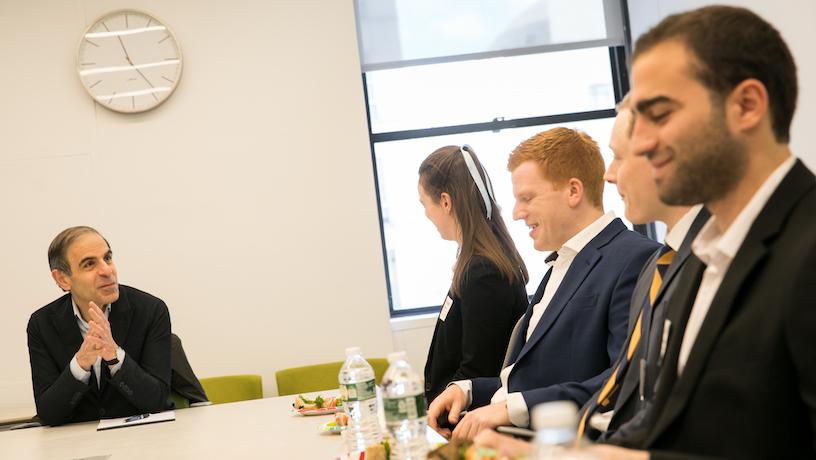
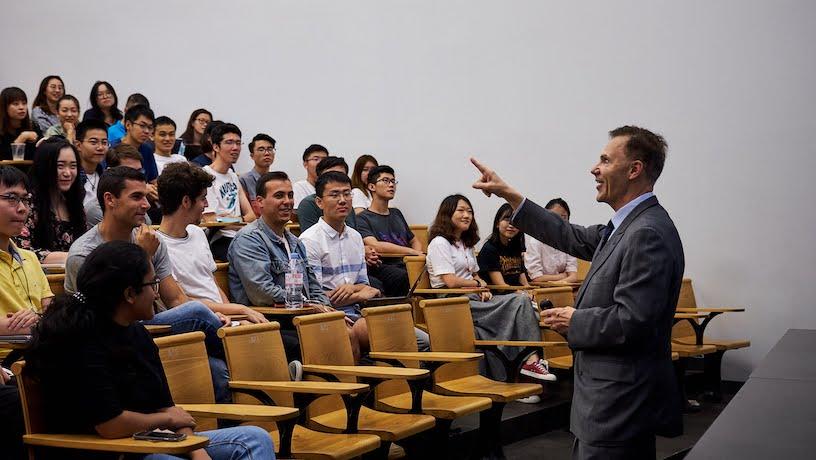
Computer Science Professor Michael Collins spoke about advances in natural language processing.

More than a thousand attendees packed into Lerner Hall for Columbia’s fourth annual Data Science Day, eager to hear from experts from across the university who are transforming disciplines and industries through thoughtfully applied data. Columbia Engineering faculty showcased innovative research ranging from blockchain security to extracting speech from brainwaves, while professors from the Law School, Journalism School, School of International and Public Affairs, Medical Center, and more discussed work in areas like protecting data security, understanding online radicalization, and improving patient outcomes.

Image
smith-1600-final
Brad Smith, president and chief legal officer at Microsoft, delivered the keynote address.

In lightning talks throughout the April 3 daylong summit, affiliates of Columbia’s Data Science Institute (DSI) shared their work applying machine learning to an impressive variety of challenges. In a panel moderated by Professor Garud Iyengar, chair of Columbia Engineering’s Industrial Engineering and Operations Research (IEOR) department, electrical engineering Professor Nima Mesgarani discussed his ground-breaking work in brain-computer interfaces and acoustic signal processing. Recently, he managed to reconstruct intelligible speech from brain activity—a potential game-changer for those who’ve lost the ability to speak—and is also addressing the “cocktail party problem” in hearing aids, which currently amplify more audio than listeners wish to hear.

Among a panel moderated by Professor Shipra Agrawal of IEOR were computer science Professors Michael Collins and Tim Roughgarden. Collins walked the audience through his research in natural language processing and speech recognition, highlighting dramatic improvements thanks to new neural methods, while Roughgarden talked about his investigations of online automated auction reserve pricing, an area with vast implications for sponsored search results. In another panel, fellow computer science faculty member Ronghui Gu discussed his work using mathematical methods to improve the security and reliability of blockchain technology.

Image
wing-1600-final
Jeannette Wing, Avanessians Director of the Data Science Institute, discussed the group's mission to leverage "data for good."

Amid all the potential of cutting-edge data science, there are also potential pitfalls, argued the day’s keynote speaker Brad Smith ’84LAW, president and chief legal officer of Microsoft. Unchecked, “mass surveillance at an unprecedented scale” could quickly turn societies Orwellian, he said, unless nations institute rigorous new legal standards to protect privacy, promote transparency, and ensure accountability.

“We are the first generation of people in the history of this planet to give machines this kind of power,” Smith said. “We’re basing our lives on all of this technology, we’re basing our societies on all of this technology, so more than ever the world needs to be able to trust this technology… Ultimately, we need a global conversation about these issues.”

Image
data-science-day-qa
Each panel at the event included lively Q&As.

Later, attendees explored dozens of demos and posters from students and faculty, ranging from full-duplex wireless enabling simultaneous transmission and reception to software analyzing indices to predict outcomes of complex global events such as Brexit. A research team from computer science Professor Steven Feiner’s Computer Graphics and User Interfaces Lab was voted best demo for their augmented/virtual reality system that allows multiple users to explore an immersive computer-generated 3D urban model of New York City.

“This new system is about multiple users collaborating in either AR or VR as they explore, organize, and share data associated with an urban environment in the context of that environment,” said Carmine Elvezio, a researcher in Feiner’s lab. “We place users in a virtual scale model where they see tweets, Yelp reviews, and NYC 311 complaints relative to the locations from which they are generated.”

Introducing proceedings, Avanessians Director of the Data Science Institute and computer science Professor Jeannette Wing noted that the collective’s overarching mission is “to use data for good.”

“Data Science Day is our moment to showcase our pioneering research and celebrate our engagements with industry,” she said.

Image
050319_truong-big-data-vector
Purchasing probabilities for two randomly chosen products among 10,000 randomly chosen consumers, showing high levels of differentiation in preferences.

Algorithms driving recommendation systems and scheduling services have become all but ubiquitous—but designing these indispensable tools to function well in an ever-evolving landscape is extremely challenging.

Van-Anh Truong, associate professor of industrial engineering and operations research, is an expert in designing optimization algorithms for e-commerce and health care, two arenas grappling with huge amounts of data and very high levels of uncertainty.

“Matching people to goods and services in real time is challenging even when most of the variables are known,” says Truong. “When the customer as well as the provider side is uncertain, which is increasingly common, the problem is even harder.”

Truong’s algorithms self-correct to make transactions faster and more effective. She has repeatedly collaborated with Columbia University Irving Medical Center to address uncertainty in health care. In this realm, every unpredictable event—such as a patient falling critically ill—begets an uncertain quantity of demand and competition for doctors or treatments. A recent study shows her algorithms for matching patients with available treatment slots in the presence of such uncertainty could reduce no-shows and cancellations at a pediatric hospital from 33 percent to 9 percent.

Meanwhile, in the highly competitive environment of global e-commerce, implementing the right equations is essential for maximizing revenue. Here, algorithms must simultaneously juggle prices, popularity, inventory, and other factors, with customers’ preferences for cost and quality. Sellers must also reach customers with highly personalized offers in time windows when they’re most likely to purchase, without overtaxing their attention—a delicate balance Truong tackled in her collaboration with Alibaba, the Chinese online commerce company. She also devises methods for combating “popularity bias,” in order to connect users with solutions best suited to them individually.

“I wanted to do math with a purpose, so this is the ideal area for me,” she says.

Adds Zhou, also a co-lead author, "Our simulation model is not only general, in that it can be adapted to any number of elevators, floors, and general traffic patterns, but it also takes into account potential issues in implementation such as the impact of limited lobby space--It’s very flexible."

While these initial approaches offer simple, low-tech solutions, the team is also looking at more advanced elevator systems that would enable them to embed AI technologies to more efficiently and safely manage elevators. They are developing algorithms for moving elevators that can depend on the global state of the system, which can be measured via sensors in the elevators and waiting areas.

“We’ve simulated for different building types and calibrated data from a large New York City building,” says Stein, who is also the Associate Director of Research at the Data Science Institute. “Our proposed interventions will be useful to any high-rise building managers who are formulating reopening plans. We’re excited to be part of engineering a speedy recovery for New York City and locations around the world with a vertical transportation solution.”

For more information on implementation, building operators and facility managers can email:
[email protected].

###

Columbia Engineering

Columbia Engineering, based in New York City, is one of the top engineering schools in the U.S. and one of the oldest in the nation. Also known as The Fu Foundation School of Engineering and Applied Science, the School expands knowledge and advances technology through the pioneering research of its more than 220 faculty, while educating undergraduate and graduate students in a collaborative environment to become leaders informed by a firm foundation in engineering. The School’s faculty are at the center of the University’s cross-disciplinary research, contributing to the Data Science Institute, Earth Institute, Zuckerman Mind Brain Behavior Institute, Precision Medicine Initiative, and the Columbia Nano Initiative. Guided by its strategic vision, “Columbia Engineering for Humanity,” the School aims to translate ideas into innovations that foster a sustainable, healthy, secure, connected, and creative humanity.


Photo and Video Credit: Kindea Labs for Columbia Engineering

About The Study

The study is titled “Queuing Safely for Elevator Systems Amidst a Pandemic.”

Authors are: Sai Mali Ananthanarayanan, Adam Elmachtoub, Clifford Stein, and Yeqing Zhou (all Department of Industrial Engineering and Operations Research, Columbia Engineering), and Charles C. Branas (Mailman School of Public Health).

The study was supported by an $85,000 award under Columbia Engineering’s “Urban Living Tech Innovations” initiative to develop technology innovations for urban living in the face of COVID-19. Adam Elmachtoub and Yeqing Zhou were also supported by National Science Foundation CMMI-1944428. Cliff Stein and Sai Mali Ananthanarayanan were also supported by National Science Foundation CCF-1714818.

The authors declare no financial or other conflicts of interest.

Links

Paper: https://onlinelibrary.wiley.com/doi/10.1111/poms.13686
DOI: 10.1111/poms.13686
https://www.youtube.com/watch?v=5KvX7_WNGFw
http://engineering.columbia.edu/
https://ieor.columbia.edu/
https://datascience.columbia.edu/
https://www.publichealth.columbia.edu/

Subscribe to Industrial Engineering and Operations Research