Lead Photo Credit: Columbia University ROAM Lab
The SpikeATac research featured was led by Engineering doctoral students Eric Chang and Peter Ballentine, with Zhanpeng He spearheading the reinforcement learning fine-tuning that enabled motor learning on the sensor. Kai Jiang, Hua-Hsuan Liang, and William Hong Qin Wang also made key contributions to that effort. Do-Gon Kim led the parallel gripper integration and fast-grasping experiments, while the multifingered robot hand used throughout the study was designed and built by Joaquin Palacios, with Pedro Piacenza developing the mechatronics and firmware.
Scenes from CEEC’s 2025 Symposium
Photos by Brandon Vallejo
Over the course of the day, speakers and panelists examined three core themes: scalable electrochemical technologies in real-world settings, the optimal operation of electrochemical devices, and strategies to reduce dependence on critical materials while securing resilient supply chains.
Each session featured a keynote address outlining the state of the field and its most promising frontiers, followed by panel discussions that tackled the practical and technical barriers to scaling up new systems. In keeping with CEEC’s mission to train the next generation of electrochemical engineers, PhD students concluded each session with brief presentations highlighting research conducted in collaboration with CEEC’s industrial partners. In parallel to the talks, CEEC’s 65 PhD students and postdocs curated a poster session, inviting attendees to dive deeper into their research across energy storage, conversion, and materials innovation.
Lead Photo Caption: Dan Steingart, CEEC Director and Stanley-Thompson Professor of Chemical Metallurgy
Lead Photo Credit: Brandon Vallejo/Columbia Engineering
Highlights from the Innovation Forum
Credit: Sirin Samman/Columbia Engineering
Fostering connections
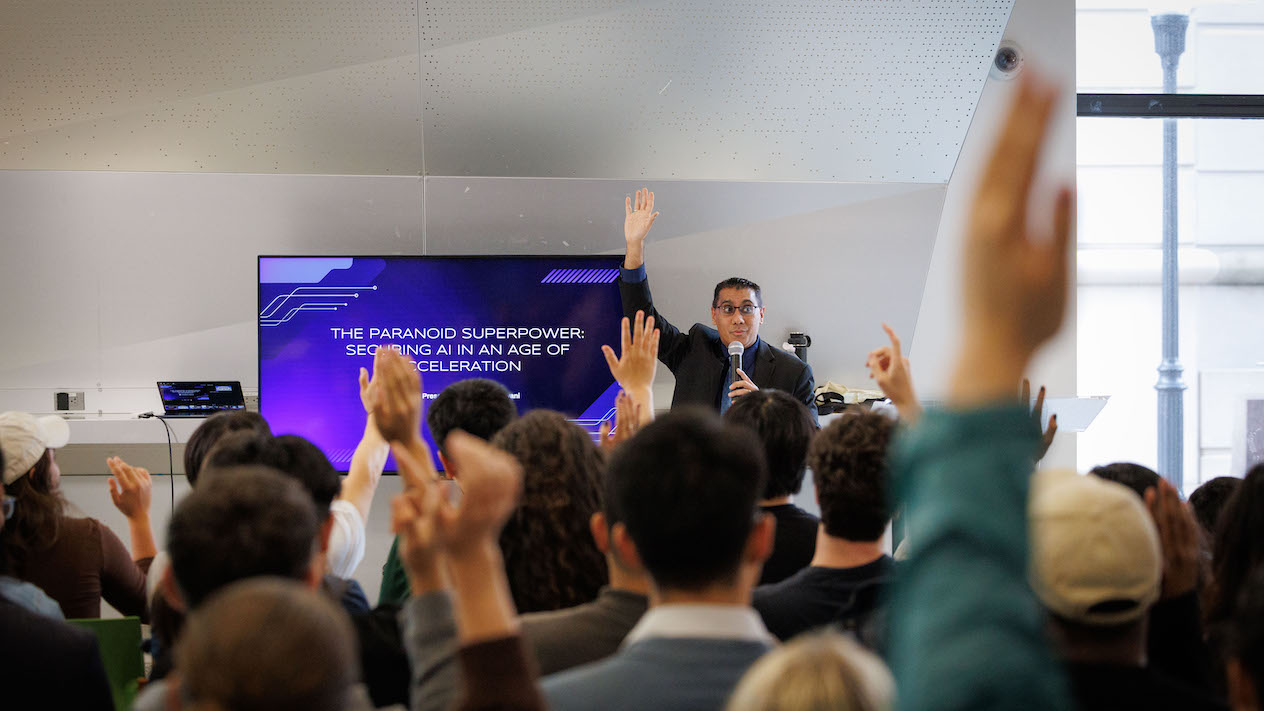
To close the forum, Daswani encouraged students to draw on the strength of their peers and alumni networks throughout their entrepreneurial journey. He advised, “Perhaps some of the people that you interact with here at Columbia will be confidants in your path in life.”
For Daswani, “paying it forward” is more than just speaking with students – it also includes creating new opportunities for them. With his former classmate, Gaurav "Gary" Makhija, he is establishing the Daswani and Makhija Scholarship Fund to support an undergraduate student in computer science during their time at Columbia. Inspired by their own experiences, the pair wanted to give back and help the next generation of engineers.
Daswani hopes this motivates fellow alumni to help current and future students thrive. “As a Columbia alum, one of the things that I've experienced is a lot of support from other alums who have helped me make an impact in the world after completing my undergraduate degree,” he said. “One of the reasons that it's really important for the alumni community to come together is to help the current generation of students create all kinds of impact that they may not be able to do without our support.”
Lead Photo Caption: Neil Daswani BS'96 speaks at Innovation Forum
Lead Photo Credit: Sirin Samman/Columbia Engineering
Gotham Foundry Launches in Style
Photos by Chris Taggart/Columbia Engineering
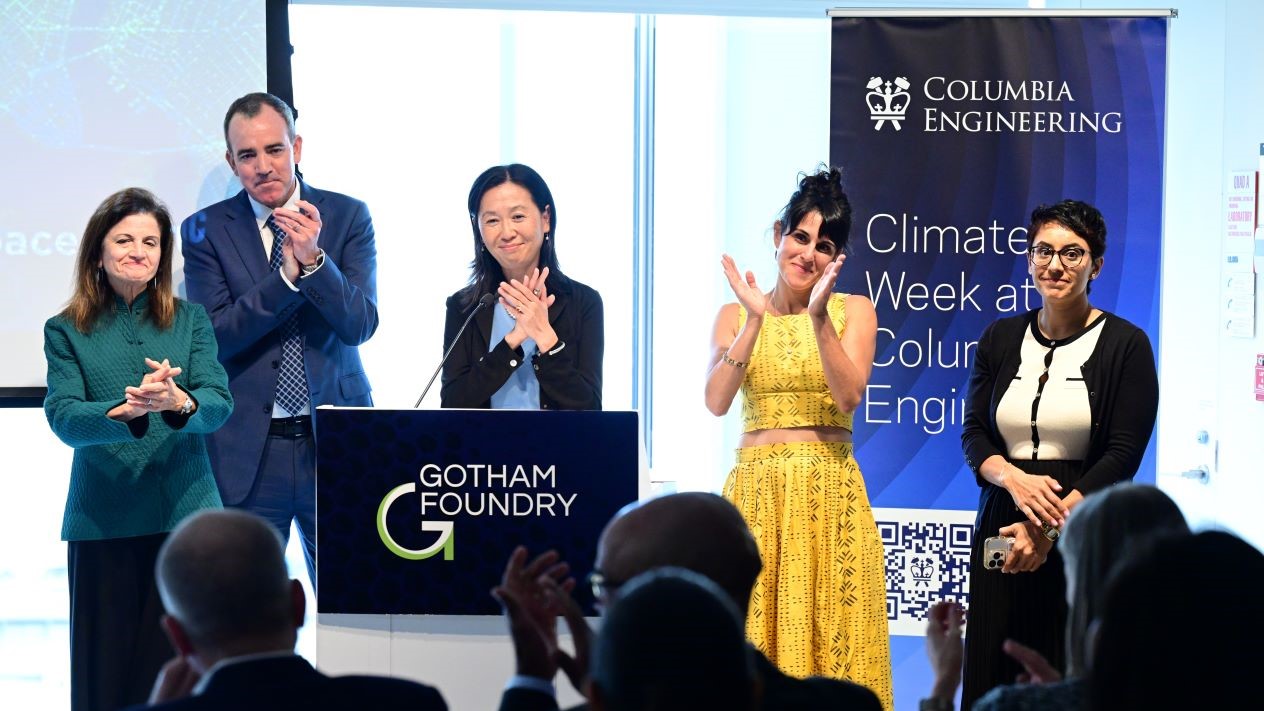
At Gotham Foundry’s Sept. 22 launch event, leaders from across New York City gathered at Columbia’s Jerome L. Greene Science Center for the exciting debut, which included a biomaterials exhibition, a fashion show of bio-derived designs, and remarks from Gotham Foundry Director Helen Lu; Columbia University Provost Angela Olinto; Andrew Kimball, CEO of NYCEDC; Adolfo Carrión, Deputy Mayor for Housing, Economic Development and Workforce; Dr. Joyce F. Brown, president, FIT; Rosemarie Wesson, associate vice chancellor and university vice provost for Research at CUNY; and Neena Chakrabarti, PhD, who spoke on behalf of Genspace; as well as Janet Rodriguez, founder and CEO of SoHarlem.
Community partners from Harlem Biospace and Communitas America were also in attendance, along with faculty from the Gotham Foundry Materials Innovation Team, a transdisciplinary network of engineering and science faculty at Columbia, CUNY, and FIT.
The featured materials exhibit, “Regenerative Vision,” showcased the work of more than 30 start-ups and research teams, demonstrating the transformative power of regenerative materials and green manufacturing approach in the industries Gotham Foundry will initially target: fashion textiles, construction, and healthcare. The event closed with young designers from SoHarlem, an incubator for cultural industries, sporting green fashions they had created as part of their entrepreneurship program with legendary designer Dapper Dan.
Gotham Foundry is initially located at Harlem Biospace at the Mink building in West Harlem. Its permanent home will be in a new Columbia Engineering building on the Manhattanville campus—currently in planning, and set to break ground in 2027 and open in 2030.
“We are thrilled to launch the Gotham Foundry with our partners and the support of the NYCEDC, led by Professor Helen Lu, a true pioneer in regenerative materials,” said Shih-Fu Chang, Dean of Columbia Engineering. “We are looking forward to creating a leading hub for biofabrication and the circular economy as part of a growing innovation ecosystem in Upper Manhattan, bringing together our own history of breakthrough research in sustainability with other academic researchers, industry innovators, and community partners in job training and education.”
“A bold vision for our future is that all human-made products emulate nature’s circular life cycle by demonstrating desired performance and being fully regenerative or degradable at the end of service. Establishment of Gotham Foundry is a major step in fulfilling this vision,” said Lu. “We are so grateful to the NYCEDC for supporting this project and our partners for their ongoing collaboration and commitment. We are eager to seize this opportunity to build a more sustainable future through the promise of novel regenerative materials, while boosting the city’s economy and training a skilled future manufacturing workforce.”
Today, the global market for sustainable materials is valued at $358 billion and is expected to grow to $800 billion by 2032. Advancing innovation in sustainable and biomaterials has the potential to transform key industries that drive New York City's economy, from fashion and construction to plastics and medical supplies. Researchers at Columbia and partner institutions will collectively share their knowledge and rich expertise to bring new materials innovations to industry and consumers. Gotham Foundry will serve as an ecosystem for innovation to fuel a green economy, not just for R&D but to cultivate startups, for education, training, and workforce development, and to become the centralized space open to creators and designers who seek access to a state-of-the-art facility and its resources.
Through its tightly integrated consortium, Gotham Foundry is redefining how infrastructure and commercialization efforts are coordinated. Gotham Foundry will leverage existing infrastructure at Harlem Biospace (for biofabrication and biocharacterization, technical consult, materials library, and training programs), ASRC (for advanced and complex materials characterization), FIT (for fashion prototyping, production, and design), and Genspace (for workforce training).
The new hub is expected to generate $5.12 billion in economic output over the next three decades and will create career opportunities for New Yorkers, including through workforce training programs for entrepreneurs and students. It is supported by LifeSci NYC, the city’s $1 billion initiative to create 40,000 jobs over the next 10 to 15 years, and puts into action the city’s Green Economy Action Plan, a vision that integrates economic and talent development in this space. Gotham Foundry will leverage Columba’s established partnerships with its surrounding community to create opportunities for students and job seekers interested in learning skills for the green economy and to empower the next generation of scientists, engineers, and entrepreneurs.
Lead Photo Caption: From left to right: Kate Ascher, co-director of Gotham Foundry (GF) and professor of practice of urban development at Columbia; Rein Ulijn, co-director of GF and founding director of the CUNY ASRC Nanoscience Initiative; Helen Lu, director of GF and Percy K. and Vida L.W. Hudson Professor of Biomedical Engineering; Theanne Schiros, co-director of GF and associate professor at FIT; and Neena Chakrabarti, board member at Genspace.
Lead Photo Credit: Chris Taggart/Columbia Engineering
Columbia Students Go Full Throttle with LOX Rocket
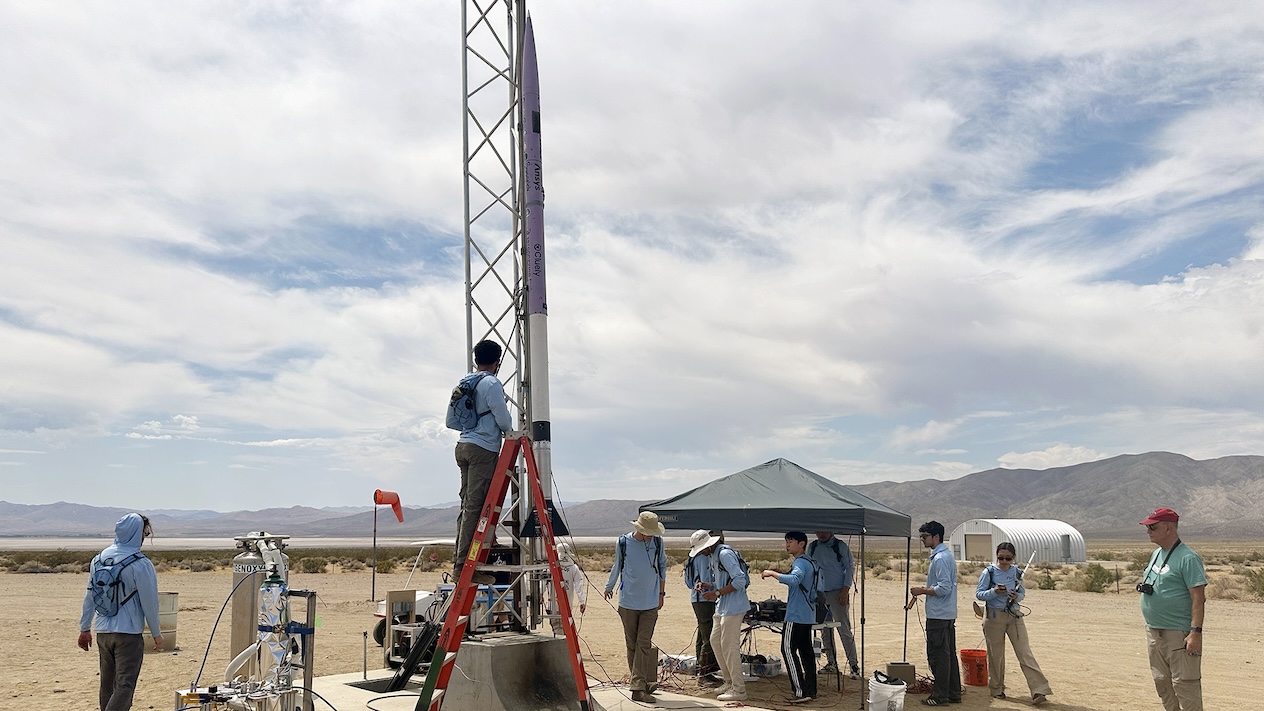
Blast off! CSI Rockets team successfully launch its hybrid rocket using liquid oxygen. Credit: Courtesy of CSI
The successful launch capped off a yearslong effort by nearly 60 undergraduates to design, build, and test the rocket. The project came to fruition at the FAR-OUT 2024-2025 competition, where the rocket reached its target altitude for the first time in team history and achieved full recovery. The team shared video clips of the launch with Columbia Engineering faculty and supporters.
“This is an incredible achievement,” said Hod Lipson, James and Sally Scapa Professor of Innovation and chair of the Department of Mechanical Engineering. “It shows how our engineering education has accelerated from textbooks and lectures to record-breaking experiential learning. This is literally the next generation of rocket scientists.”
“It made my day to see our student team launch this newly designed rocket,” said Shih-Fu Chang, Dean of Columbia Engineering.
Now in its third consecutive year of successful launches, CSI Rockets has become a proving ground for student-led aerospace work. With this milestone behind them, the team is already planning its next move.
“We’re excited for what the next generation will accomplish,” said Sheehan. “This is just the beginning.”
Getting to the Launchpad
The CSI Rockets team is composed entirely of undergraduate students, drawing from a wide range of disciplines and schools across Columbia University. While the group is rooted in engineering, it includes students from Columbia College, Columbia Engineering, and Barnard.
While most teams at FAR-OUT work on the same rocket for two or three years, the Columbia team builds a new rocket each year.
“We do something different with the rocket every year,” said CSI Rockets co-lead Valentina Fichera, who graduated in 2025 with a degree in mechanical engineering. “Everyone was on board with transitioning to liquid oxygen — it forced us to push ourselves.”
This year’s team included about 60 members, with 19 traveling to the desert for the launch. Those undergraduate students were spread across specialized teams focused on propulsion, electronics, airframe, payload, and the combustion chamber.
Inside the Rocket
CSI Rockets had previously relied on nitrous oxide hybrid systems. But this year, the team switched to a liquid oxygen hybrid, which is a far more technically demanding system typically used in larger-scale commercial rockets. Few student teams even attempt liquid oxygen hybrids.
“We all wanted that experience,” Fichera said.
“Liquid oxygen exists in a cryogenic state,” explained Sheehan. “So everything from storage to pressurization becomes more complex. We had to overhaul our entire propulsion system.” The team used gaseous nitrogen to pressurize the liquid oxygen and built new components to manage the system safely and effectively.
“We designed for a target apogee of 6,500 feet and reached nearly 5,700. It was our most accurate launch yet,” Fichera said. The launch itself came on the second-to-last window on the final day of the event, after multiple early-morning attempts.
Fichera and Sheehan, who have interned at leading aerospace companies like Firefly and SpaceX, are pursuing engineering positions in industry.
“We spent a lot of time working on the rocket this year,” Fichera said with a laugh.
CSI team members who attended the FAR-OUT rocketry competition:
- Michael Sheehan ’26SEAS (Team Co-Lead)
- Skylar Bogdanowitsch ’26SEAS (Team Co-Lead)
- Valentina Marini Fichera ’25SEAS (Team Co-Lead)
- Jorge Casas '23CC (Team Co-Lead)
- Aadam Awad ’26SEAS (Fluids Co-Lead)
- Vayu Singhal ’26SEAS (Fluids Co-Lead)
- Isabella Singleton ’27SEAS (Airframe Lead)
- Theo Lack ’26SEAS (Rising Fluids Co-Lead)
- Angela De Labra ’27SEAS (Rising Airframe Co-Lead)
- Alex Chen ’25SEAS (Electronics Co-Lead)
- Ania Krzyżańska ’25SEAS (Electronics Co-Lead)
- Tieqiong Zhang ’25SEAS (Electronics Co-Lead)
- Aruzhan Abil ’28CC (Rising Electronics Co-Lead)
- Joss Clegg ’28SEAS (Rising Electronics Co-Lead)
- Christopher Acosta ’25SEAS (Propulsion Combustion Chamber Co-Lead)
- Tingmeng Wang ’27SEAS (Propulsion Combustion Chamber Co-Lead)
- Raisa Effress ’27Barnard (Propulsion Combustion Chamber Co-Lead)
- Naomi Dreicer Liberman ’27SEAS (Rising Propulsion Combustion Chamber Co-Lead)
- Maria Cuevas ’26CC (Payload Co-Lead)
- Siroun Johnson ’26SEAS (Payload Co-Lead)
Lead Photo Credit: Courtesy of Columbia Space Initiative
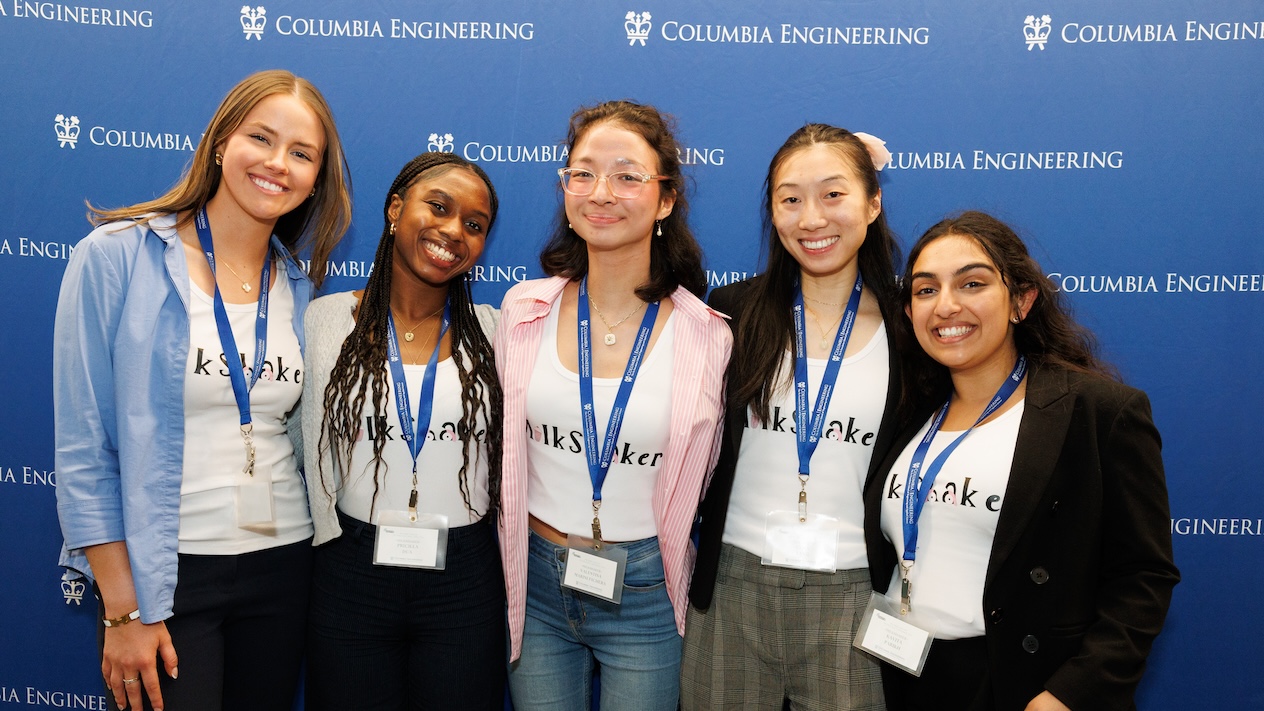
Fresh from their win at the Millard Chan Tech Challenge, the team behind MilkShaker demonstrated a practical and science-backed solution to prevent mastitis, providing professional level care without sacrificing time or requiring special training. Another group of seniors in the Department of Mechanical Engineering showcased a prototype for the CareCruiser, a wheelchair-to-stroller attachment designed to give wheelchair-using parents and caregivers greater independence when navigating with strollers and carseats.
Several projects also tackled infrastructure design, including a civil engineering and engineering mechanics team that unveiled Rethinking Resilience. The project envisions a new sustainable, flood-resilient train station to replace the existing Ardsley-on-Hudson station along the MTA’s Metro-North Hudson Line.
And in the gaming arena, a team from the Department of Electrical Engineering demonstrated their physical tank game using modified remote-controlled cars. By reconfiguring the electronics of remote-controlled cars, the team enabled Bluetooth-based control of both the motors and onboard lasers. Players score by hitting opposing cars with laser pulses, while any car that gets hit is temporarily disabled with a five-second freeze penalty.
Dean Shih-Fu Chang greeted the students and commended them on their year-long efforts. “You all have started with an idea and brought it to life. That’s what engineers do! We bring ideas to life . . . Today’s showcase truly represents our Engineering for Humanity vision. This is a milestone in your Columbia experience and one I hope you remember for years to come.”
Each year, Columbia Engineering seniors work on a capstone project, aka Senior Design. They are challenged to solve real-world problems with innovative solutions, rooted in their foundational math, science and engineering courses.
Here’s a look at some of the students and their innovations at Senior Design Expo 2025.
Scenes from Senior Design Expo ‘25
Credit: Timothy Lee/Columbia Engineering
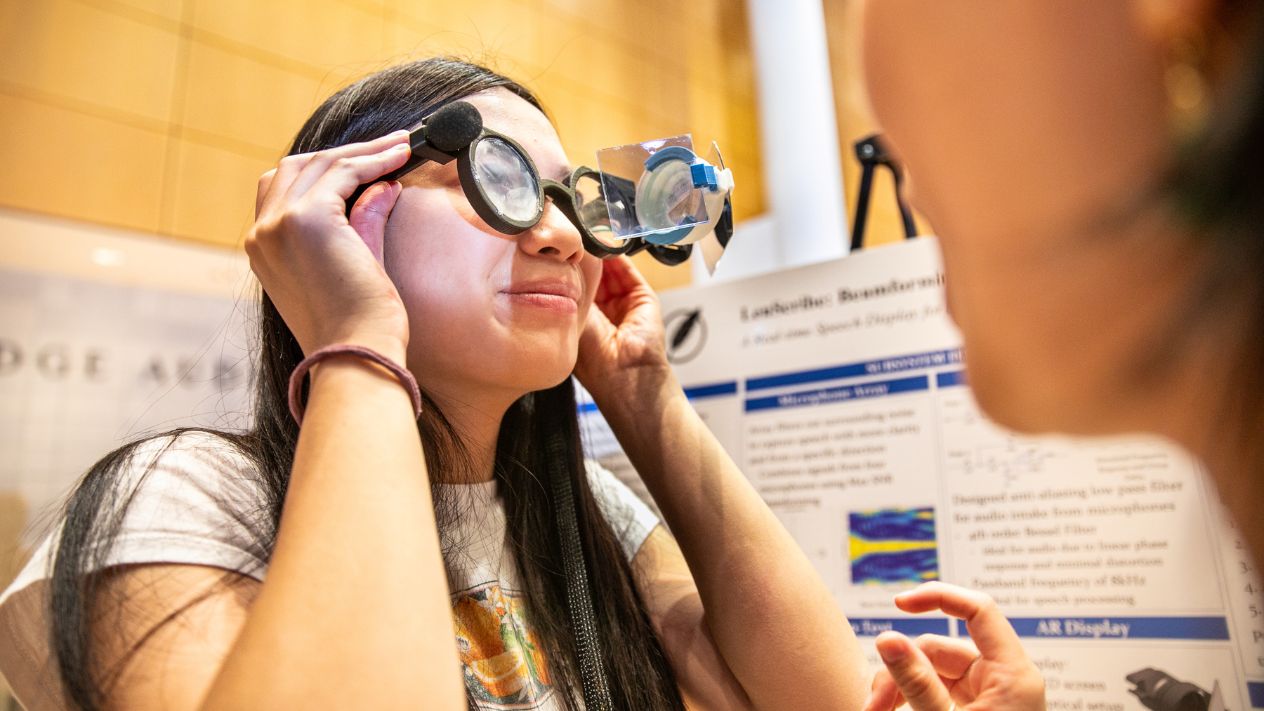
Masthead Caption: A student tries on LenScribe, a compact set of 3D-printed glasses designed for audio input, speech processing, and visual display
Masthead Credit: Timothy Lee/Columbia Engineering