Intubating patients might appear deceptively simple, but the procedure can intimidate even experienced medical personnel. It’s a delicate multistep process and the stakes are high—failure to properly insert the tube can result in hypoxia, hypertension, or even death.

InTouch, a new intubation guidance system developed by recent Columbia Engineering graduates, recently garnered a major prize and recognition by the National Institutes of Health for its ability to make the experience more painless for all concerned.

“Our premise was to make a device that could make non-experts into experts,” said Amy Wu ‘19.

To prototype their “smart” laryngoscope blade, Wu and fellow biomedical engineers Samuel Castro ’19, Mary Gana ’19, Miriam Saffern ’19, and Xiaomeng Xian ’19 collaborated with anesthesiologists at the Columbia University Irving Medical Center. Equipped with force sensors, the device provides health care workers real-time feedback and guidance.

The group originally created the technology as a senior capstone project; in initial clinical testing with attending anesthesiologists they managed to detect—and help correct—nearly 90% of incorrect intubations. Their ingenuity went on to earn them first place and $20,000 in the Design by Biomedical Undergraduate Teams (DEBUT) Challenge co-sponsored by the National Institute of Biomedical Imaging and Bioengineering, part of the National Institutes of Health (NIH), and VentureWell, a non-profit geared at advancing student and faculty innovators and entrepreneurs. Just six teams were recognized from more than fifty contenders hailing from across the United States.

“We are very grateful for this recognition from the NIH,” Wu said. “It’s encouraged our team to think more seriously about what we can possibly do. Our first step has been applying for a patent for our device, and we hope to collaborate more with the Medical Center to further improve our device and gather more nuanced clinical data.”

The idea for InTouch was born in a class taught by Aaron Kyle, senior lecturer in engineering design in the biomedical engineering department. Kyle mentored the team as they developed and iterated their product throughout the year. Kyle’s two-semester course challenges seniors to take a comprehensive approach to tackling open-ended biomedical problems, from brainstorming prospective solutions and building prototypes to conducting customer discovery and assessing the commercial landscape—all with an eye to formulating potentially viable business strategies.

“Intubation is a serious issue that there hasn’t really been a great solution for,” said Kyle, who’s previously advised several teams working on the problem. “As InTouch developed their prototype, they incorporated some automation and a machine learning algorithm. They’ve really created a very elegant and effective solution.”

Key to InTouch’s success was also feedback from Professor Peter Yim ’02 and others at the Medical Center, from whom the students got an inside look at the most urgent challenges of intubation and most acute clinical needs. They first showcased their product at the Senior Design Expo this past spring, along with DEBUT honorable mentions Rachel Mintz ‘19, Stehpanie Rager ‘19, Kelly Ryu ’19 and Mia Saade ’19, creators of the Hera Bra, a device for detecting subclinical mastitis.

 “I think for many of us who choose to study engineering, we do so in the hope of being able to apply what we learn in the classroom to help somebody in the real world,” Wu said. “It was an incredible opportunity to start making that happen in our Senior Design class, and also to be able to work in this fashion with our professors in biomedical engineering and physicians at the Medical Center.”


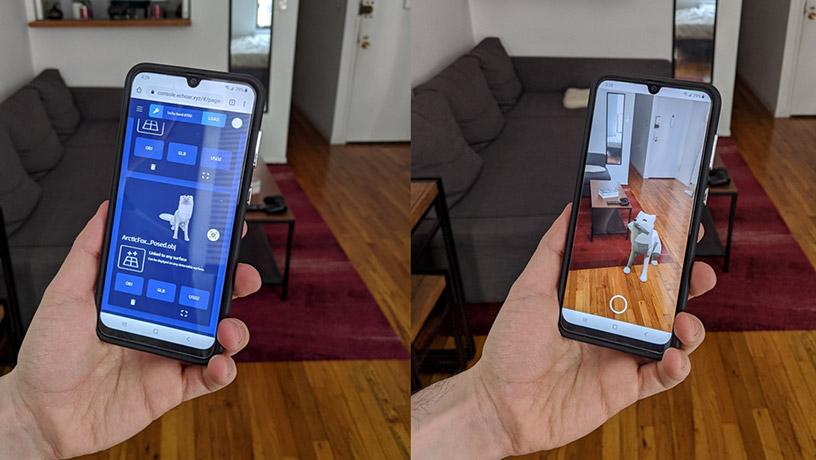
Among M2’s device “transformations” are fusing device data from multiple devices to provide a multi-headed display scenario for a better “big screen” viewing or gaming experience. By converting accelerometer sensor data to input touches, M2 can transform a smartphone into a Nintendo Wii-like remote to control a game on another system. Eye movements can also be turned into touchscreen input, a useful accessibility feature for disabled users who cannot use their hands.

For audio conferencing without having to use costly specialized equipment, M2 can be deployed on smartphones across a room to leverage their microphones from multiple vantage points, providing superior speaker-identifiable sound quality and noise cancellation. M2 can redirect a display to a camera so that stock camera apps can record a Netflix or YouTube video and can also enable panoramic video recording by fusing the camera inputs from two systems to create a wider sweeping view. One potentially popular application would let parents seated next to each other record their child's wide-angled school or sports performance.

“Doing all this without having to modify apps means that users can continue to use their favorite apps with an enhanced experience,” AlDuaij says. “M2 is a win-win—users don’t need to worry about which apps would support such functionality and developers don’t need to spend time and money to update their apps.”

Using M2 is simple—all a user would have to do is to download the M2 app from Google Play or Apple’s App Store. No other software is needed. One mobile system runs the unmodified app; the input and output from all systems is combined and shared to the app.

“Our M2 system is easy to use, runs efficiently, and scales well, especially compared to existing approaches,” Nieh notes. “We think that multi-mobile computing offers a broader, richer experience with the ability to combine multiple devices from multiple systems together in new ways.”

The Columbia team has started discussions with mobile OS vendors and phone manufacturers to incorporate M2 technologies into the next releases of their products. With a few minor modifications to current systems, mobile OS vendors can make multi-mobile computing broadly available to everyone.

Columbia Engineering

Columbia Engineering, based in New York City, is one of the top engineering schools in the U.S. and one of the oldest in the nation. Also known as The Fu Foundation School of Engineering and Applied Science, the School expands knowledge and advances technology through the pioneering research of its more than 220 faculty, while educating undergraduate and graduate students in a collaborative environment to become leaders informed by a firm foundation in engineering. The School’s faculty are at the center of the University’s cross-disciplinary research, contributing to the Data Science Institute, Earth Institute, Zuckerman Mind Brain Behavior Institute, Precision Medicine Initiative, and the Columbia Nano Initiative. Guided by its strategic vision, “Columbia Engineering for Humanity,” the School aims to translate ideas into innovations that foster a sustainable, healthy, secure, connected, and creative humanity.

About the Study

The study is titled “Heterogeneous Multi-Mobile Computing.”

Authors are: Naser AlDuaij, Alexander Van’t Hof, and Jason Nieh, Department of Computer Science, Columbia Engineering.

This work was supported in part by a Google Research Award, and NSF grants CNS-1717801 and CNS-1563555.

The authors declare no financial or other conflicts of interest.

Blockchain is changing the way we do business, but its greatest asset—a transparent, shared platform—is currently its greatest weakness. While banks and businesses have built up a $100 billion market in the space over the past two years, the technology has also been the target of adversarial attacks resulting in devastating financial losses.

Ronghui Gu, assistant professor of computer science, is researching a new tool with the potential to address such vulnerabilities while helping blockchain scale up for greater adoption: smart contracts. Unlike traditional contracts that rely on the observance of each party and impose penalties for noncompliance, “smart” contracts incorporate digital code that executes contracts automatically.

“We are trying to design a new language to write contracts,” says Gu. “When developers write contracts using this language, it will be easier to use and remove potential errors from the very beginning.”

Smart contracts promise to eliminate the costs and delays due to human intervention that are associated with traditional contracts—from business agreements to securing a mortgage. But they also give rise to security challenges of their own.

“Blockchain is about trust,” says Gu. “Smart contracts are more vulnerable than traditional contracts, both because their code is open source and because they lack a centralized controller who can immediately implement fixes.”

Key to improving their reliability will be to unearth bugs in the code that could be exploited by hackers. Gu was recently awarded a grant from the new Columbia-IBM Center for Blockchain and Data Transparency to do just that. He brings his background in formal verification techniques, using mathematical methods to prove software reliability, along with augmented algorithms that can address blockchain’s immense proof space—a distributed system very different from traditional software. With time, he hopes methods to make smart contracts more trustworthy will help more organizations and individuals transfer value with greater transparency.


Lead Photo Caption: Ronghui Gu

Lead Photo Images by Timothy Lee Photographers | Image courtesy of Ronghui Gu

Subscribe to Innovation, Design & Entrepreneurship