View the Full Talk

Lead Photo Caption: Danqi Chen, assistant professor of computer science at Princeton, delivered the AI Lecture at Columbia on Dec. 6.
Related
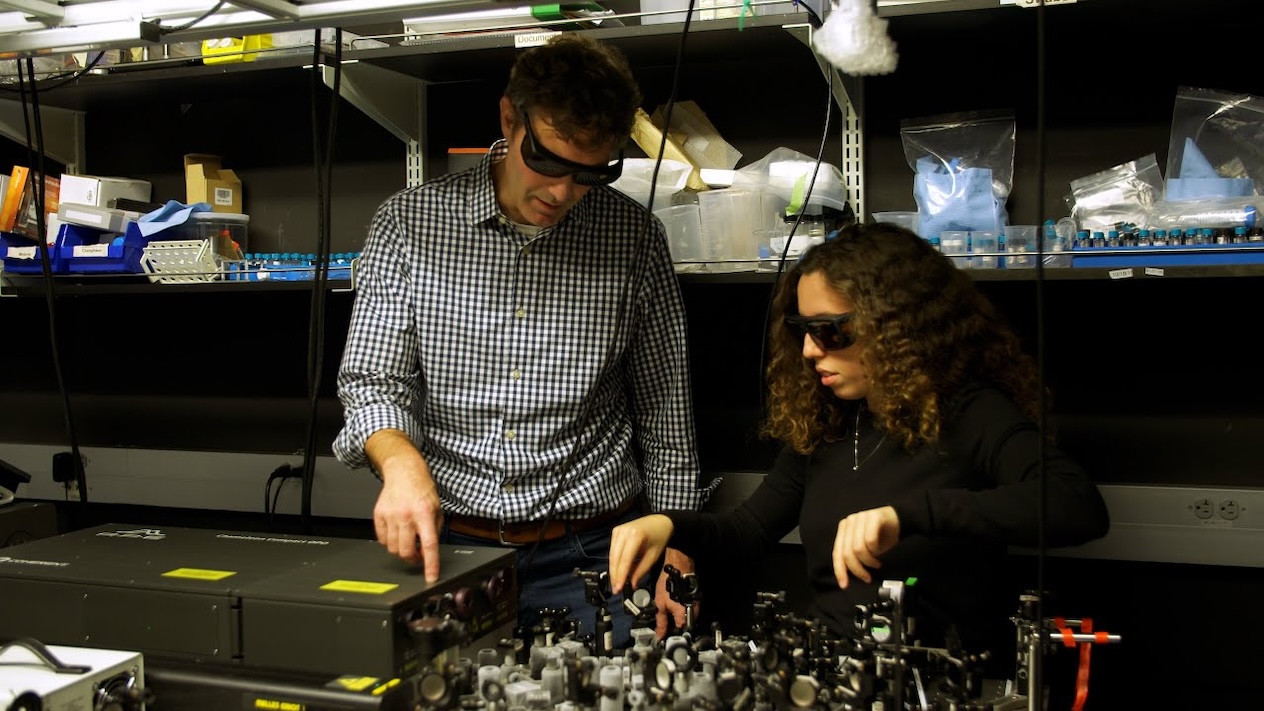
The Schuck Lab: Light-matter Interactions at Nanoscale. Video Credit: Jane Nisselson
About the Study
Journal: Nature
Title: “Infrared nanosensors of piconewton to micronewton forces.”
Authors: Natalie Fardian-Melamed1*, Artiom Skripka2,3, Benedikt Ursprung1, Changhwan Lee1, Thomas P. Darlington1, Ayelet Teitelboim2, Xiao Qi2, Maoji Wang4, Jordan M. Gerton4, Bruce E. Cohen2,5, Emory M. Chan2, P. James Schuck1
- Department of Mechanical Engineering, Columbia University
- The Molecular Foundry, Lawrence Berkeley National Laboratory
- Nanomaterials for Bioimaging Group, Departamento de Física de Materiales, Facultad de Ciencias, Universidad Autόnoma de Madrid
- Department of Physics and Astronomy, University of Utah
- Division of Molecular Biophysics and Integrated Bioimaging, Lawrence Berkeley National Laboratory,
Acknowledgments: N.F.-M. gratefully acknowledges support from the European Union's Horizon 2020 research and innovation program under the Marie Skłodowska-Curie grant agreement No. 893439, the US Department of State Fulbright Scholarship Program, the Zuckerman-CHE STEM Leadership Program, the Israel Scholarship Education Foundation (ISEF) International Fellowship Program, and the Weizmann Institute’s Women’s Postdoctoral Career Development Award. B.U. and P.J.S. acknowledge support by the National Science Foundation under grant no. CHE-2203510. A.S. acknowledges the support from the European Union's Horizon 2020 research and innovation program under the Marie Skłodowska-Curie grant agreement No. 895809 (MONOCLE). Work at the Molecular Foundry was supported by the Office of Science, Office of Basic Energy Sciences, of the US Department of Energy under contract number DE-AC02-05CH11231. X.Q., B.E.C., and E.M.C. were supported in part by the Defense Advanced Research Projects Agency (DARPA) ENVision program under contract HR0011257070, and C.L. and P.J.S. under DARPA ENVision contract HR00112220006. T.P.D. and P.J.S. also acknowledge support for the scan-probe measurements from Programmable Quantum Materials, an Energy Frontier Research Center funded by the US DOE, Office of Science, Basic Energy Sciences (BES), under award DE-SC0019443.
The authors declare no financial or other conflicts of interest.
Columbia and Tau have been longtime partners. The two have collaborated through Preindl, a leader in designing next-generation power converters, and his Motor Drives and Power Electronics Laboratory (MPlab) to design modern power electronic converters and motor drive solutions that are not only high-performance, but also scalable.
Their groundbreaking collaborative work has been recognized across academia and industry for pioneering the field of software-defined power conversion, dating back in part to Preindl’s NSF CAREER Award. The collaboration has been celebrated through a number of awards including Autotech Breakthrough’s V2X and V2I Innovation of the Year Awards, Fast Company World Changing Ideas recognition, and Fast Company’s Best Workplace for Innovators (2023, 2024). The Center provides a platform to further advance their work together at a new scale.
“Our vision is to ‘electrify humanity,’” Preindl said. “Our Center will build advanced energy conversion technologies that enable electrification of energy systems and scale electrification at unprecedented levels.”
Focus of the Center
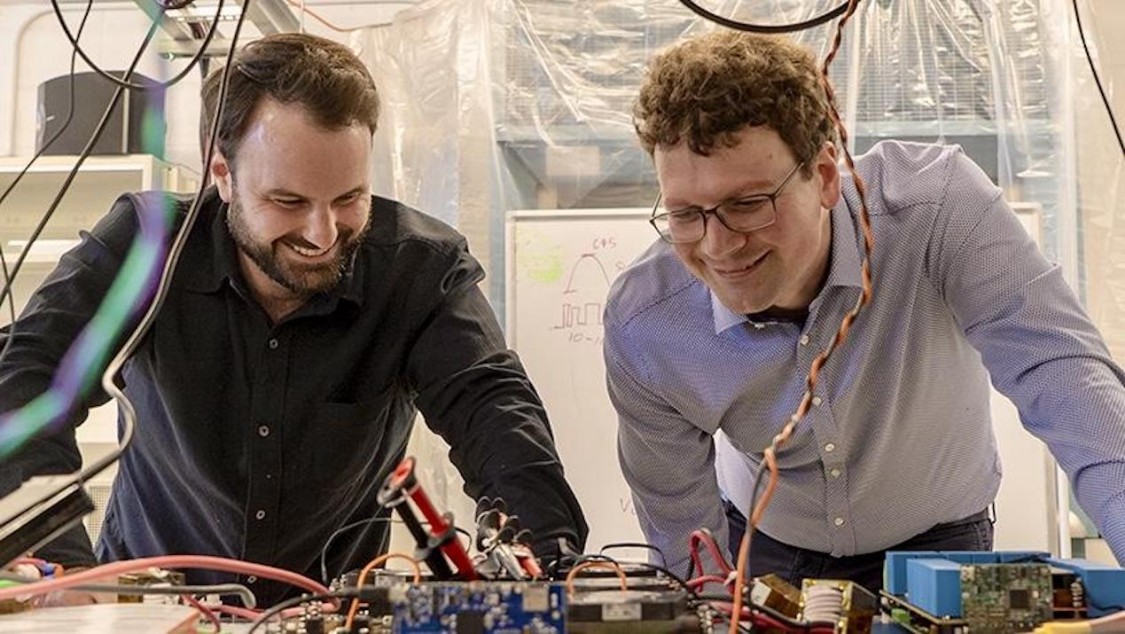
The Center will focus on research in electric energy conversion and leverage advanced power electronics, novel topologies for power converters, modern and distributed control, and machine learning/artificial intelligence to enable reliable and resilient solutions that facilitate a circular economy. In doing so, researchers are also actively working to limit the use of materials adversely affecting the environment, such as rare earth elements or critical minerals.
The Center will engineer solutions for sustainable electric transportation and energy systems. Target applications include electric drivetrains, propulsion systems, and electric supply infrastructure; distributed energy resources such as renewable energy and battery storage for the electric grid; and emerging electric loads including data centers and heating electrification.
The Center also intends to support the translation of outcomes to industrial applications to maximize the impact through strategic technology development and transfer.
Finally, the Center plans to support the training of highly qualified engineers and scientists in the field and provide mentorship and career development for students and researchers engaging with the Center.
“We are excited to deepen our partnership with both Columbia and Dr. Preindl through the founding of the Center alongside Tau,” said Wesley Pennington, Tau’s founder and CEO. “We have an established and celebrated history of leading research and innovation together with the university and look forward to deepening our collaboration to further accelerate the electrification of the world. The Center of Advanced Electrification in collaboration with Tau Motors will provide a larger platform to continue to invent, develop, translate, and deploy technologies that accelerate the energy transition, as well as train and build future leaders to extend our mission as we solve some of the world’s most pressing challenges.”
Future Center activities
The Center team is already planning a broad range of activities rooted in scientific innovation and technical advancement of the field. In addition to research and innovation activities, the Center is developing programs including the organization of an annual symposium to foster technical discussions and interactions between faculty and industry. They are also developing a seminar series with invited external speakers, as well as student activities, such as recruiting events.