Columbia and Tau have been longtime partners. The two have collaborated through Preindl, a leader in designing next-generation power converters, and his Motor Drives and Power Electronics Laboratory (MPlab) to design modern power electronic converters and motor drive solutions that are not only high-performance, but also scalable.
Their groundbreaking collaborative work has been recognized across academia and industry for pioneering the field of software-defined power conversion, dating back in part to Preindl’s NSF CAREER Award. The collaboration has been celebrated through a number of awards including Autotech Breakthrough’s V2X and V2I Innovation of the Year Awards, Fast Company World Changing Ideas recognition, and Fast Company’s Best Workplace for Innovators (2023, 2024). The Center provides a platform to further advance their work together at a new scale.
“Our vision is to ‘electrify humanity,’” Preindl said. “Our Center will build advanced energy conversion technologies that enable electrification of energy systems and scale electrification at unprecedented levels.”
Focus of the Center
The Center will focus on research in electric energy conversion and leverage advanced power electronics, novel topologies for power converters, modern and distributed control, and machine learning/artificial intelligence to enable reliable and resilient solutions that facilitate a circular economy. In doing so, researchers are also actively working to limit the use of materials adversely affecting the environment, such as rare earth elements or critical minerals.
The Center will engineer solutions for sustainable electric transportation and energy systems. Target applications include electric drivetrains, propulsion systems, and electric supply infrastructure; distributed energy resources such as renewable energy and battery storage for the electric grid; and emerging electric loads including data centers and heating electrification.
The Center also intends to support the translation of outcomes to industrial applications to maximize the impact through strategic technology development and transfer.
Finally, the Center plans to support the training of highly qualified engineers and scientists in the field and provide mentorship and career development for students and researchers engaging with the Center.
“We are excited to deepen our partnership with both Columbia and Dr. Preindl through the founding of the Center alongside Tau,” said Wesley Pennington, Tau’s founder and CEO. “We have an established and celebrated history of leading research and innovation together with the university and look forward to deepening our collaboration to further accelerate the electrification of the world. The Center of Advanced Electrification in collaboration with Tau Motors will provide a larger platform to continue to invent, develop, translate, and deploy technologies that accelerate the energy transition, as well as train and build future leaders to extend our mission as we solve some of the world’s most pressing challenges.”
Future Center activities
The Center team is already planning a broad range of activities rooted in scientific innovation and technical advancement of the field. In addition to research and innovation activities, the Center is developing programs including the organization of an annual symposium to foster technical discussions and interactions between faculty and industry. They are also developing a seminar series with invited external speakers, as well as student activities, such as recruiting events.
Education and Community
Four teams– MOBY, ParkinPlay, Thimble, and The Vermont Recreational Center with On-Site Wastewater Treatment–walk us through their projects. (Video: Jane Nisselson)
We celebrated our graduates’ senior design projects. We partnered with the dental school to launch a new program in dental engineering. Along with our colleagues at Columbia Business School, we graduated the first cohort of MBAxMS students. The Columbia University Formula Racing team made an impressive showing at the national competition, and the Columbia Space Institute’s rocketry team brought home a gold (and set its own records) at the inaugural FAR-OUT competition in the Mojave Desert. Our faculty partnered with collaborators across disciplines to teach courses on the social implications of AI and the political impact of algorithms and machine learning. Researchers in the storied Carleton Laboratory worked with the city to restore the pumps in the Morningside Park pond.
Driving the Dialogue
We launched The Lever, a limited-series newsletter featuring faculty perspectives on global challenges. The first series explored solutions for storing renewable energy. We also kicked off the Lecture Series in AI. In one of the first talks, the legendary deep-learning researcher Yann LeCun, who is Meta’s chief AI scientist, delivered a talk to more than 1,000 attendees. Media outlets across the world tapped our researchers’ expertise in articles and video on topics from digital twins in biomedical research to desalination technology and intelligent robots— and every aspect of AI. Kristen Myers and Christine Hendon challenged us to imagine how engineers can improve women’s health, and Pierre Gentine asked if AI could save the environment. Tal Danino dazzled readers with an art book featuring research inspired images from his lab.
Celebrating Faculty Excellence
Columbia Engineering celebrated the election of faculty members Jingguang Chen and Jeannette Wing to the National Academy of Engineering and congratulated Marco Giometto, Alex Urban, and Brian Smith on their NSF CAREER awards. We commended Gordana Vunjak-Novakovic on winning a Chan Zuckerberg Biohub New York Investigator Award. We were pleased to share that Oleg Gang was named a 2024 Vannevar Bush Fellow, that Ke Cheng received the Coulter Award, that Christos Papadimitriou and Michael Weinstein were named Simons Society Senior Fellows. We congratulated Vishal Misra on his appointment to vice dean of computing and artificial intelligence and John Kymissis on being named vice dean of infrastructure and innovation, and Kymissis' election to the National Academy of Inventors.
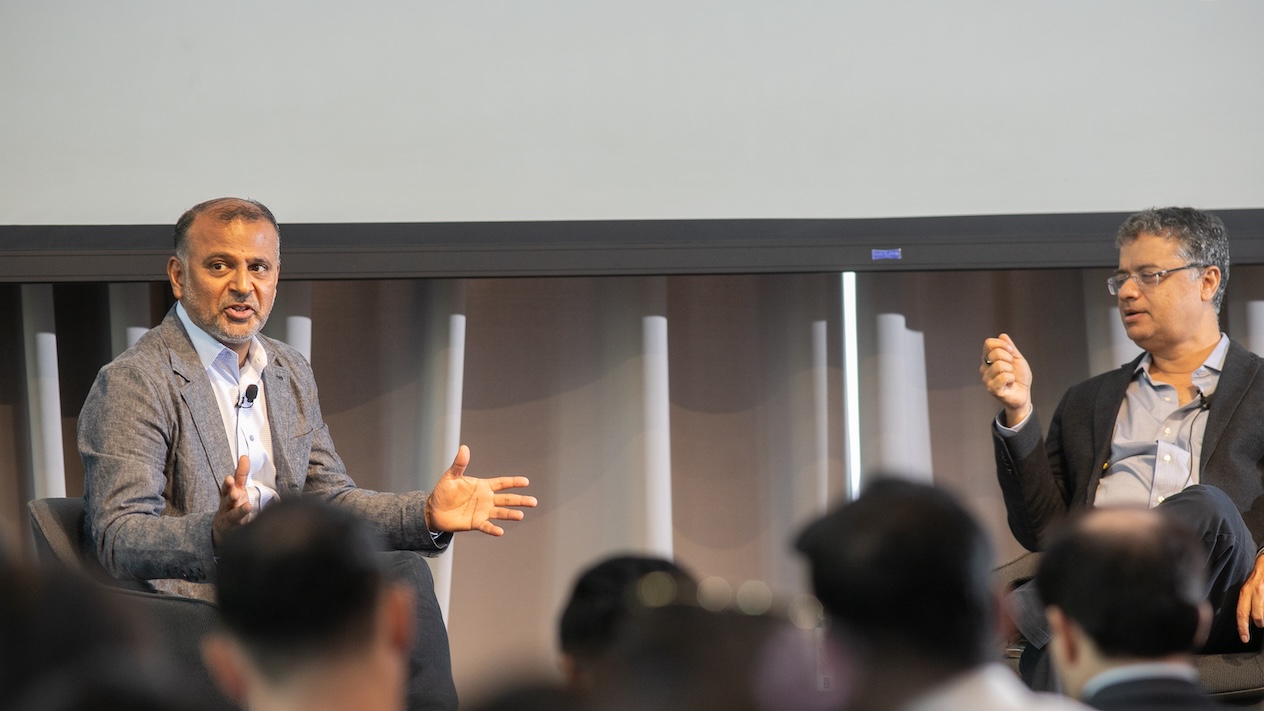
Lecture Series in AI: Pierre Gentine on Climate Modeling
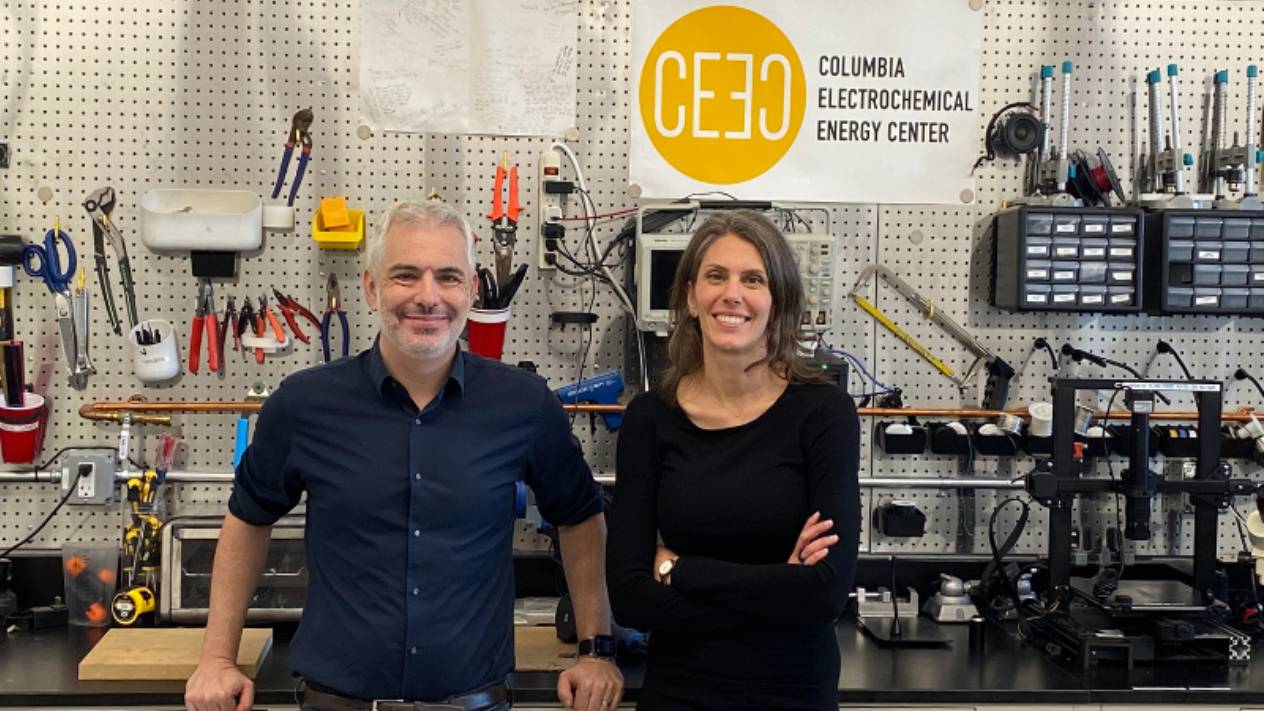
Photo Caption: Dan Steingart (left) and Lauren Marbella are co-leading a research team as part of the DOE's Energy Storage Research Alliance (ESRA), focused on addressing the nation’s most pressing battery challenges. Credit: Courtesy of CEEC