How the AI Program Works
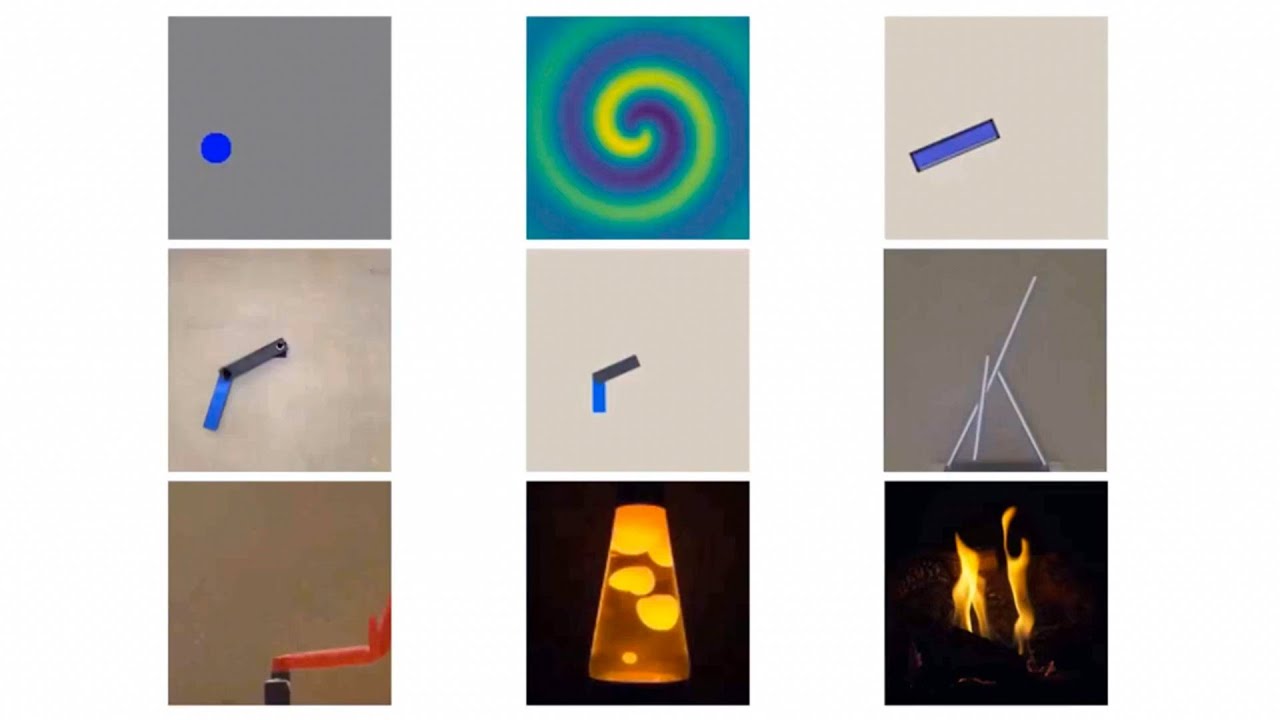
Boyuan Chen explains how a new AI program observed physical phenomena and uncovered relevant variables—a necessary precursor to any physics theory. Credit: Boyuan Chen/Columbia Engineering
After validating a number of other physical systems with known solutions, the researchers fed videos of systems for which they did not know the explicit answer. The first videos featured an “air dancer” undulating in front of a local used car lot. After a few hours of analysis, the program returned 8 variables. A video of a Lava lamp also produced 8 eight variables. They then fed a video clip of flames from a holiday fireplace loop, and the program returned 24 variables.
A particularly interesting question was whether the set of variable was unique for every system, or whether a different set was produced each time the program was restarted. “I always wondered, if we ever met an intelligent alien race, would they have discovered the same physics laws as we have, or might they describe the universe in a different way?” said Lipson. “Perhaps some phenomena seem enigmatically complex because we are trying to understand them using the wrong set of variables.” In the experiments, the number of variables was the same each time the AI restarted, but the specific variables were different each time. So yes, there are alternative ways to describe the universe and it is quite possible that our choices aren’t perfect.
The researchers believe that this sort of AI can help scientists uncover complex phenomena for which theoretical understanding is not keeping pace with the deluge of data—areas ranging from biology to cosmology. “While we used video data in this work, any kind of array data source could be used—radar arrays, or DNA arrays, for example,” explained Kuang Huang PhD ’22, who coauthored the paper.
The work is part of Lipson and Fu Foundation Professor of Mathematics Qiang Du’s decades-long interest in creating algorithms that can distill data into scientific laws. Past software systems, such as Lipson and Michael Schmidt’s Eureqa software, could distill freeform physical laws from experimental data, but only if the variables were identified in advance. But what if the variables are yet unknown?
Can AI discover new physics?

Hod Lipson explains how the AI program was able to discover new physical variables. Credit: Hod Lipson/Columbia Engineering
Lipson, who is also the James and Sally Scapa Professor of Innovation, argues that scientists may be misinterpreting or failing to understand many phenomena simply because they don’t have a good set of variables to describe the phenomena. “For millennia, people knew about objects moving quickly or slowly, but it was only when the notion of velocity and acceleration was formally quantified that Newton could discover his famous law of motion F=MA,” Lipson noted. Variables describing temperature and pressure needed to be identified before laws of thermodynamics could be formalized, and so on for every corner of the scientific world. The variables are a precursor to any theory. “What other laws are we missing simply because we don’t have the variables?” asked Du, who co-led the work.
The paper was also co-authored by Sunand Raghupathi and Ishaan Chandratreya, who helped collect the data for the experiments. Since July 1, 2022, Boyuan Chen has been an assistant professor at Duke University. The work is part of a joint University of Washington, Columbia, and Harvard NSF AI institute for dynamical systems, aimed to accelerate scientific discovery using AI.
About the study
Journal: Nature Computational Science
Title: Discovering State Variables Hidden in Experimental Data.
Authors: Boyuan Chen, Kuang Huang, Sunand Raghupathi, Ishaan Chandratreya, Qiang Du, Hod Lipson
The study was supported by NSF AI Institute for Dynamical Systems 2112085, DARPA MTO Lifelong Learning Machines (L2M) Program W911NF-21-2-0071, and NSF NRI Award 1925157, NSF DMS 1937254, NSF DMS 2012562, NSF CCF 1704833, DE SC0022317, and DOE ASCR DE SC0022317.
COI: The authors declare no financial or other conflicts of interest.
About the Study
Conference: USENIX Symposium on Operating Systems Design and Implementation (OSDI '22), July 11-13, 2022, Carlsbad, CA
Title: Design and Verification of the Arm Confidential Compute Architecture
Authors: Xupeng Li, Xuheng Li, Christoffer Dall, Ronghui Gu, Jason Nieh, Yousuf Sait, and Gareth Stockwell.
This work was supported in part by Arm, OPPO, an Amazon Research Award, a Guggenheim Fellowship, DARPA contract N66001-21-C-4018, and NSF grants CCF-1918400, CNS-2052947, and CCF-2124080.
COI: Ronghui Gu is the founder of and has an equity interest in CertiK. The other authors declare no financial or other conflicts of interest.
About the Study
Journal: SIGMOD '22: Proceedings of the 2022 International Conference on Management of Data
Title: Reptile: Aggregation-level Explanations for Hierarchical Data
Authors: Zezhou Huang, Eugene Wu
The study was supported by NSF 1845638, 1740305, 2008295, 2106197, 2103794, Columbia SIRS.
COI: The authors declare no financial or other conflicts of interest.
About the Study
Journal: Light: Science & Applications
Title: Multifunctional Resonant Wavefront-Shaping Meta-Optics Based on Multilayer and Multi-Perturbation Nonlocal Metasurfaces
Authors: Stephanie C. Malek1, Adam C. Overvig1,2, Andrea Alu2,3, Nanfang Yu1*
- Department of Applied Physics and Applied Mathematics, Columbia University, New York, NY 10027, USA.
- Photonics Initiative, Advanced Science Research Center, City University of New York, New York, NY 10031
- Physics Program, Graduate Center, City University of New York, New York, NY 10016
FUNDING: The study was supported by the National Science Foundation (grant no. QII-TAQS-1936359 and no. ECCS-2004685) and the Air Force Office of Scientific Research (grant no. FA9550-14-1-0389 and no. FA9550-16-1-0322). S.C.M. acknowledges support from the NSF Graduate Research Fellowship Program (grant no. DGE-1644869). A.C.O. acknowledges support from the NSF IGERT program (grant no. DGE-1069240).
COI: The authors declare no financial or other conflicts of interest. The authors have filed a provisional patent on the device technology reported in this paper and a couple earlier theoretical papers.