In the new study, the researchers instead developed a way for robots to autonomously model their own 3D shapes using a single regular 2D camera. This breakthrough was driven by three brain-mimicking AI systems known as deep neural networks. These inferred 3D motion from 2D video, enabling the robot to understand and adapt to its own movements. The new system could also identify alterations to the bodies of the robots, such as a bend in an arm, and help them adjust their motions to recover from this simulated damage.

Such adaptability might prove useful in a variety of real-world applications. For example, "imagine a robot vacuum or a personal assistant bot that notices its arm is bent after bumping into furniture," Hu says. "Instead of breaking down or needing repair, it watches itself, adjusts how it moves, and keeps working. This could make home robots more reliable—no constant reprogramming required."

Another scenario might involve a robot arm getting knocked out of alignment at a car factory. "Instead of halting production, it could watch itself, tweak its movements, and get back to welding—cutting downtime and costs," Hu says. "This adaptability could make manufacturing more resilient."

As we hand over more critical functions to robots, from manufacturing to medical care, we need these robots to be more resilient. “We humans cannot afford to constantly baby these robots, repair broken parts and adjust performance. Robots need to learn to take care of themselves, if they are going to become truly useful,” says Lipson. “That’s why self-modeling is so important.”

The ability demonstrated in this study is the latest in a series of projects that the Columbia team has released over the past two decades, where robots are learning to become better at self-modeling using cameras and other sensors. 

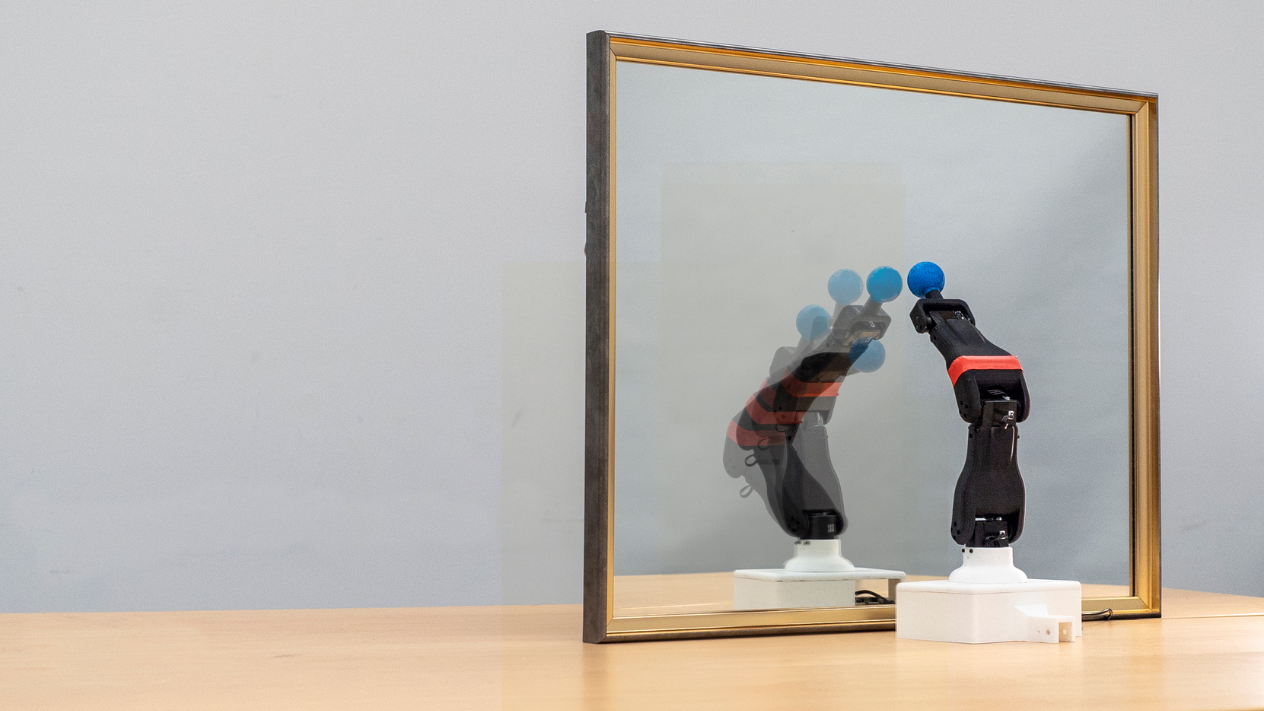
In 2006, the research team’s robots were able to use observations to only create simple stick-figure-like simulations of themselves. About a decade ago, robots began creating higher fidelity models using multiple cameras. In this study, the robot was able to create a comprehensive kinematic model of itself using just a short video clip from a single regular camera, akin to looking in the mirror. The researchers call this newfound ability “Kinematic Self-Awareness.” 

“We humans are intuitively aware of our body; we can imagine ourselves in the future and visualize the consequences of our actions well before we perform those actions in reality,” explains Lipson. “Ultimately, we would like to imbue robots with a similar ability to imagine themselves, because once you can imagine yourself in the future, there is no limit to what you can do.”

The researchers detailed their findings February 25 in the journal Nature Machine Intelligence.


Lead Photo Description: A robot observes its reflection in a mirror, learning its own morphology and kinematics for autonomous self-simulation. The process highlights the intersection of vision-based learning and robotics, where the robot refines its movements and predicts its spatial motion through self-observation. 

Credit: Jane Nisselson/Columbia Engineering 


About The Study

Journal: Nature Machine Intelligence

Title: Teaching Robots to Build Simulations of Themselves

Authors: Yuhang Hu 1, Jiong Lin 1, and Hod Lipson 1, 2

Affiliations:

1 Creative Machines Laboratory, Mechanical Engineering Department, Columbia University, New York, NY 10027, USA

2 Data Science Institute, Columbia University, New York, NY, 10027, USA

DOI: 10.1038/s42256-025-01006-w

Funding/Acknowledgements: This work was supported in part by the U.S. National Science Foundation (NSF) AI Institute for Dynamical Systems (DynamicsAI.org), grant 2112085.

All the authors declare that they have no competing interests.

Subscribe to Press Release