Vishal Misra
CUbiC Annual Review 2026 Highlights
Student achievements
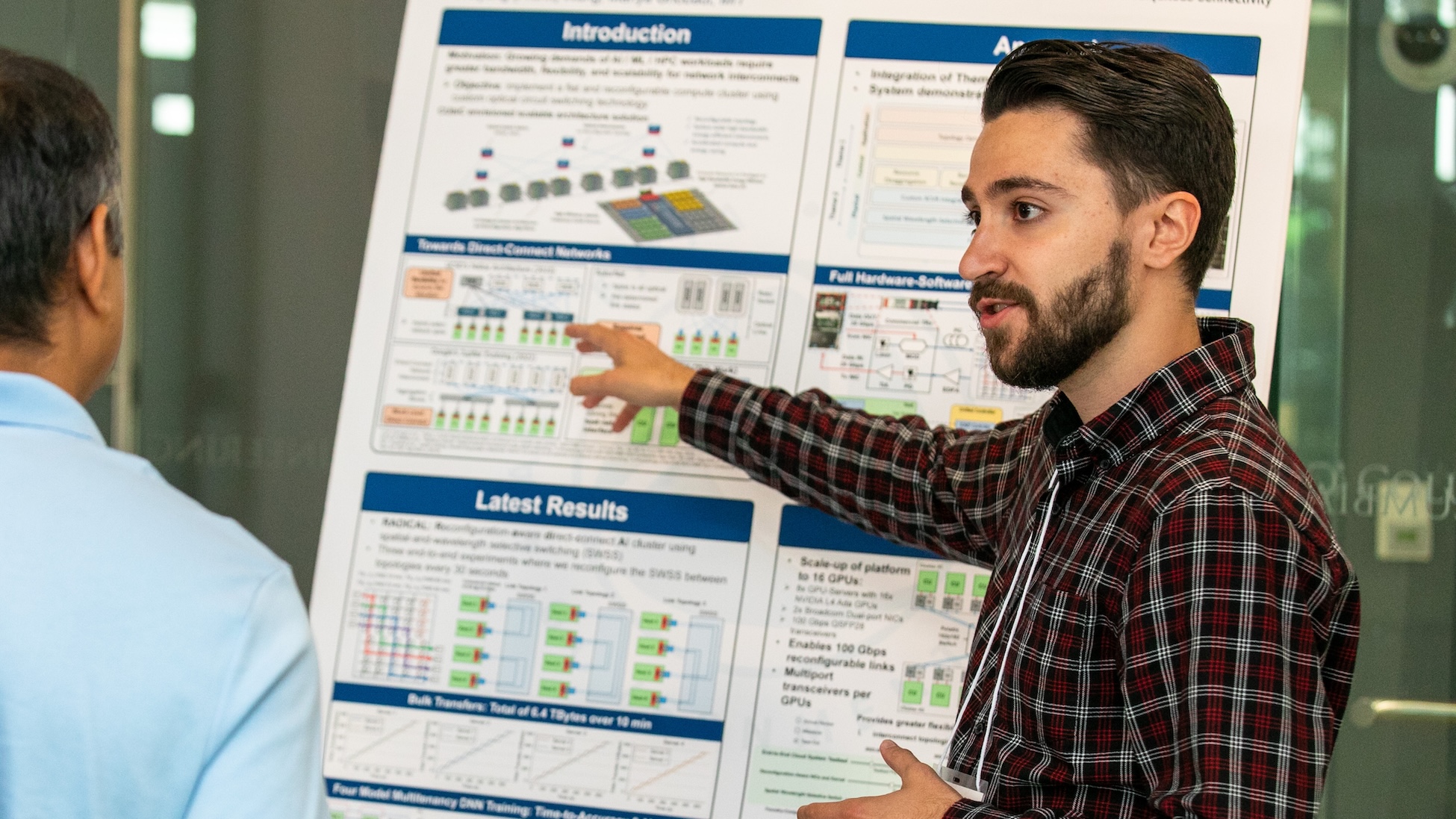
The annual review also commemorated the student research being done across the three themes of CUbiC. Theme 1 is research that takes a systems-level approach to improving bandwidth and connectivity.
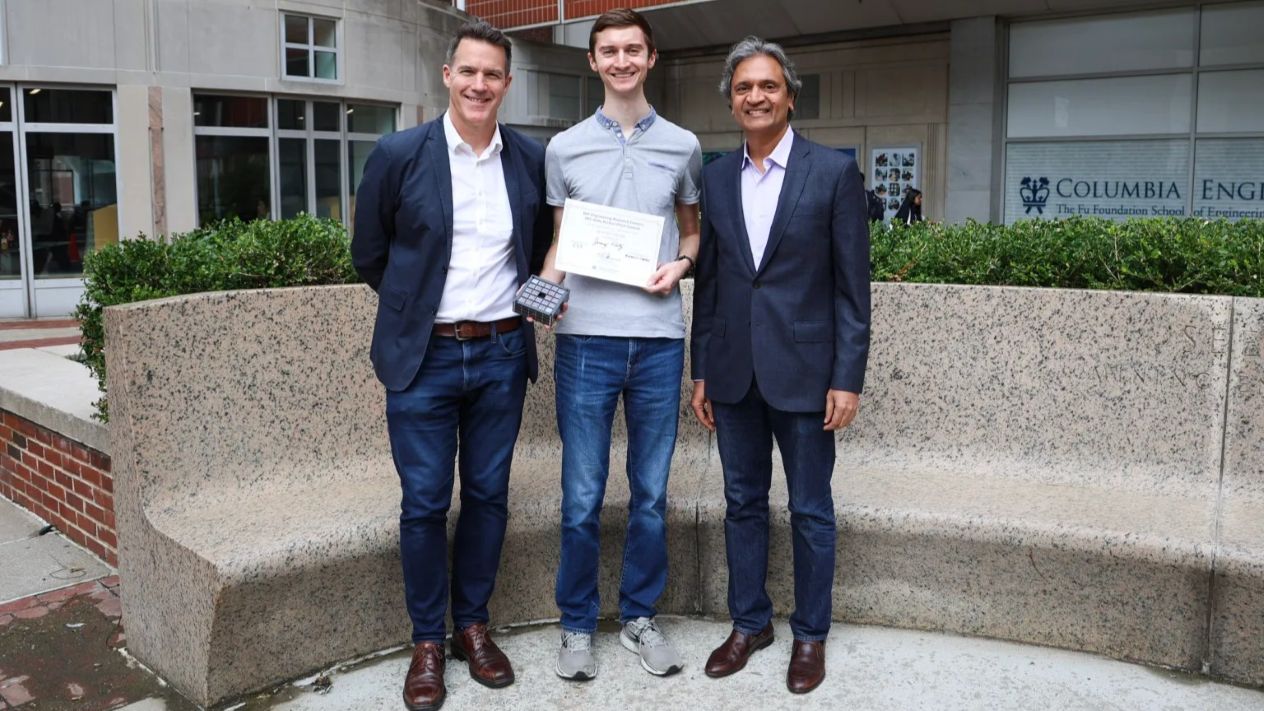
The first award went to Michael Cullen, a fifth-year PhD student at Columbia. He’s been working with CUbiC since the start of the center on the incorporation of photonics to improve bandwidth for AI training systems. His project tested photonic and electronic architectures to test how the two could work together in a simulated environment.
“We can leverage the best of our photonic design and marry it with the best of other circuit designs and achieve really nice results in hybridized communications,” said Cullen.
Anriban Banik, a third-year PhD student from UC Santa Barbara, took home the next award for Theme 1. Banik worked on a framework to improve millimeter-wave radar networks, a system that uses electromagnetic waves to map spaces.
“We wanted to utilize multiple views and introduce multiple radars so we can scale up to a huge network,” he said. Banik’s research leveraged techniques including real-time processing and one-shot fusion to improve calibration of the radar networks.
CUbiC’s second theme is improving bandwidth by developing more efficient electric and photonic links. The first award went to Yunping Wang, a PhD student from UC Berkeley. His project tested a new photonic chiplet for high-bandwidth connectivity with a host system.
Omar Bekdache, a third-year PhD student from the University of Illinois, also won the award for Theme 2. He tested a new framework for compute connectivity. “My biggest takeaway was the set of new insights that emerged from our COCO working group discussions and experiments, such as modeling the COCO fabric and recognizing that compute energy often dominates connectivity energy,” Bekdache said.
The third theme for CUbiC research is improving wireless connectivity, including developing the technology that could lead to next-generation wireless networks.
Jurui Qi, a PhD student from UC San Diego, won an award for Theme 3. He presented a hybrid reconfigurable intelligent surface (RIS). Qi describes his hybrid RIS as a “hardware platform for future communications.” This technology could be used in future 6G networks, and Qi reported promising results indicating that his hybrid RIS could enable real-time device localization.
The second award for Theme 3 went to Nagesh Patle, a fifth-year PhD student at UC Berkeley. His project was tackling limits in power delivery for eventual use in data centers.
“We can shrink the inductors, make our transients really fast, and increase our efficiency,” he said. “The trade-off, of course, is higher cost and more complexity.” Patle proposed a hybrid switch capacitor that could deliver high voltage in a design only a few millimeters tall.
The CUbiC annual review concluded after the awards ceremony. In the next year, the team of researchers, students, and industry partners will continue to develop the connectivity solutions. At the conclusion of her opening remarks, Bergman summed up the last year of CUbiC. “We’ve delivered,” she said. “We've delivered these immensely energy-efficient, bandwidth-dense connectivity solutions at the system level. We have this new technology now.”