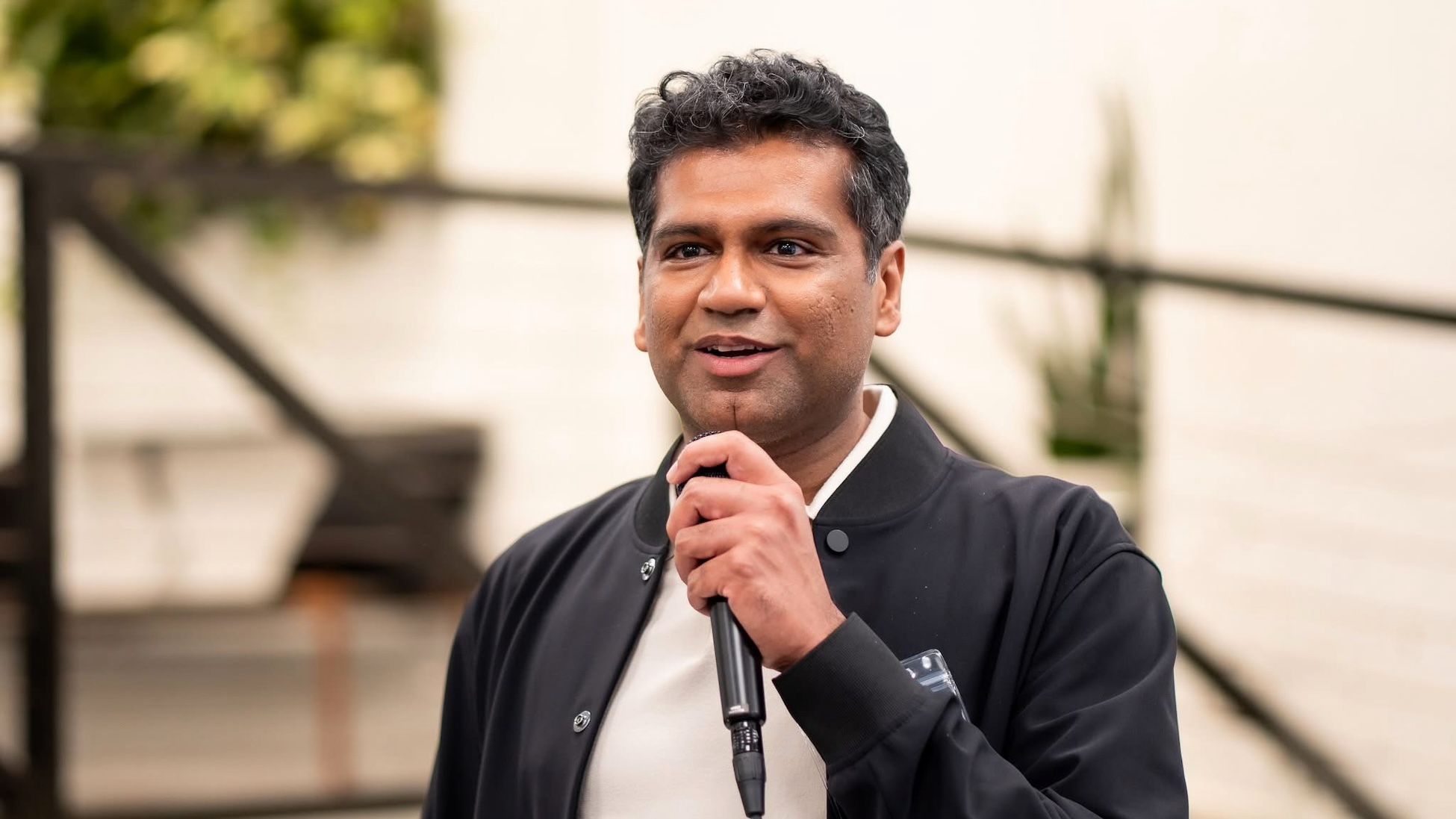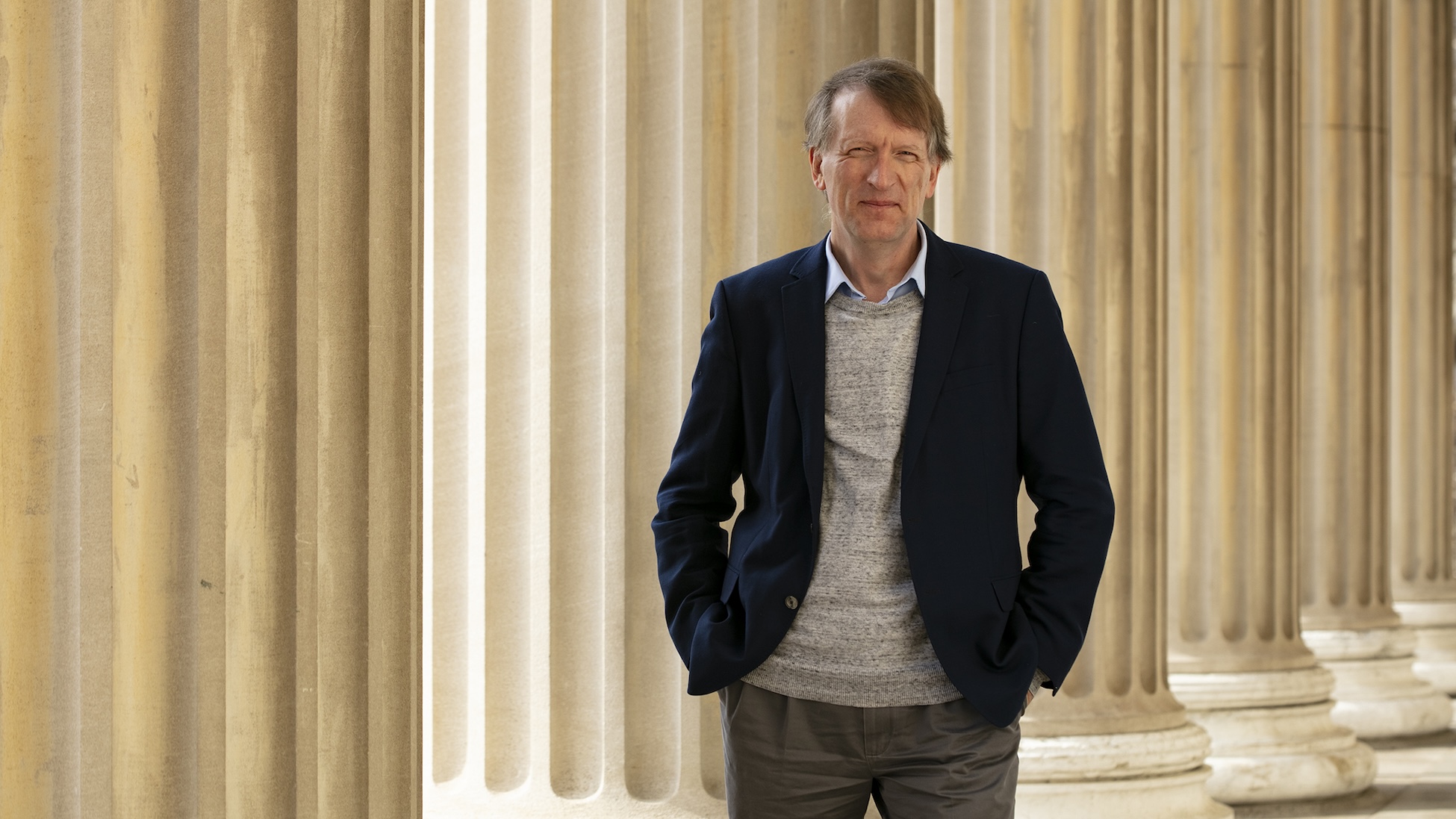
Vishal Misra
Snapshots from MLSS 2026
Credit: Brooke Slezak/Siobhan Mullan
3. Agentic AI is more than just a buzzword.
Taqiya Ehsan, a PhD candidate in electrical and computer engineering at Rutgers University, whose research collaborates with Columbia’s Center for Smart Streetscapes, said the sessions dedicated to agentic AI stood out as particularly useful.
"We hear the agentic AI buzzword everywhere. Most of us don't really know what it means," she said. The summer school addressed that gap head-on, bringing in experts who build these systems to explain exactly what agentic AI is and how it works in practice.
Specifically, a talk by Brendan Rappazzo Hogan – a Morgan Stanley representative of alphaLab – on the firm's agentic AI framework stood out to Ehsan, offering a rare look at how a major financial institution is putting these systems into practice outside the lab. "It was really, really helpful to get insight into exactly what AI agents are from the experts who are building it," she added.
4. AI research must be interdisciplinary.
Transformative breakthroughs in AI rarely come from just one discipline – and the summer school made sure participants understood the importance of drawing AI research from multiple backgrounds.
Zachary Laborde appreciated the strong emphasis on interdisciplinary research and the importance of these intersections beyond the lab. Coming in with a background in psychology, Laborde was drawn to the program specifically to understand how language models — tools largely outside his own research — were reshaping fields like robotics and embodied AI.
"My work doesn't involve natural language processing or large language models, but a lot of recent work has shown that in spaces like robotics and embodied AI, using language models leads to incredible results," he said. "I was hoping to better understand those components to be able to apply them to my work, or to work that I might do in the future."
For Emily Bejerano, what stood out most about the summer school was the sheer range of people and perspectives in the room. "I just thought it was a great opportunity to meet a lot of people from a variety of different areas with this overlapping interest in AI, and how we can leverage it to help our systems," she said. "I love meeting people from all around the world with various interests, hearing about their research, and sharing my research to get valuable perspectives from different people."
The 2026 Machine Learning Summer School delivered on the comprehensive view of the field that Columbia Engineering set out to showcase. From the theoretical promise of causal AI to the practical demands of interpretability, the agentic AI systems reshaping industries, and the deeply interdisciplinary nature of the work itself, participants left with more than just new technical knowledge – but a sharper sense of where the field is headed, and the responsibility that comes with building it.
CUbiC Annual Review 2026 Highlights
Student achievements
The annual review also commemorated the student research being done across the three themes of CUbiC. Theme 1 is research that takes a systems-level approach to improving bandwidth and connectivity.
The first award went to Michael Cullen, a fifth-year PhD student at Columbia. He’s been working with CUbiC since the start of the center on the incorporation of photonics to improve bandwidth for AI training systems. His project tested photonic and electronic architectures to test how the two could work together in a simulated environment.
“We can leverage the best of our photonic design and marry it with the best of other circuit designs and achieve really nice results in hybridized communications,” said Cullen.
Anriban Banik, a third-year PhD student from UC Santa Barbara, took home the next award for Theme 1. Banik worked on a framework to improve millimeter-wave radar networks, a system that uses electromagnetic waves to map spaces.
“We wanted to utilize multiple views and introduce multiple radars so we can scale up to a huge network,” he said. Banik’s research leveraged techniques including real-time processing and one-shot fusion to improve calibration of the radar networks.
CUbiC’s second theme is improving bandwidth by developing more efficient electric and photonic links. The first award went to Yunping Wang, a PhD student from UC Berkeley. His project tested a new photonic chiplet for high-bandwidth connectivity with a host system.
Omar Bekdache, a third-year PhD student from the University of Illinois, also won the award for Theme 2. He tested a new framework for compute connectivity. “My biggest takeaway was the set of new insights that emerged from our COCO working group discussions and experiments, such as modeling the COCO fabric and recognizing that compute energy often dominates connectivity energy,” Bekdache said.
The third theme for CUbiC research is improving wireless connectivity, including developing the technology that could lead to next-generation wireless networks.
Jurui Qi, a PhD student from UC San Diego, won an award for Theme 3. He presented a hybrid reconfigurable intelligent surface (RIS). Qi describes his hybrid RIS as a “hardware platform for future communications.” This technology could be used in future 6G networks, and Qi reported promising results indicating that his hybrid RIS could enable real-time device localization.
The second award for Theme 3 went to Nagesh Patle, a fifth-year PhD student at UC Berkeley. His project was tackling limits in power delivery for eventual use in data centers.
“We can shrink the inductors, make our transients really fast, and increase our efficiency,” he said. “The trade-off, of course, is higher cost and more complexity.” Patle proposed a hybrid switch capacitor that could deliver high voltage in a design only a few millimeters tall.
The CUbiC annual review concluded after the awards ceremony. In the next year, the team of researchers, students, and industry partners will continue to develop the connectivity solutions. At the conclusion of her opening remarks, Bergman summed up the last year of CUbiC. “We’ve delivered,” she said. “We've delivered these immensely energy-efficient, bandwidth-dense connectivity solutions at the system level. We have this new technology now.”
The construction manager of the future will not compete with AI, they will manage with AI.
Ibrahim Odeh
How is AI currently being used in construction?
AI is already being deployed in predictive scheduling, risk forecasting, cost estimation, safety analytics, image recognition for site monitoring, and automated document review. We are seeing machine learning models analyze historical project data to predict delays and cost overruns before they occur.
But the real transformation is not automation; it is decision augmentation. AI is enhancing human judgment. Construction management is fundamentally about structured decision-making under uncertainty. AI will increasingly provide scenario modeling, risk simulations, and optimization tools that improve strategic choices.
The construction manager of the future will not compete with AI, they will manage with AI.
What type of skills will construction managers need in the next five years?
In five years, the most valuable skills will not be software-specific, they will be cognitive and strategic.
Construction managers will need:
- Data fluency: ability to interpret analytics and AI outputs
- Systems thinking: understanding infrastructure as interconnected networks
- Financial sophistication: capital allocation, risk modeling, PPP frameworks
- Climate resilience literacy
- Executive communication and stakeholder alignment
The role is evolving from project supervisor to strategic infrastructure leader.
We know that sustainability plays a big role in construction management. How does climate risk relate to project planning?
Extreme weather is no longer a contingency scenario; it is a baseline planning assumption. Projects must now incorporate resilience modeling, adaptive design strategies, and long-term lifecycle risk assessments.
This shifts construction from a short-term delivery mindset to a lifecycle stewardship mindset. Planning must now integrate environmental forecasting, financing mechanisms tied to resilience performance, and regulatory adaptability.
This is where academia plays a critical role, preparing professionals who think in decades, not just project timelines.
More about Ibrahim Odeh
Beyond the classroom, Odeh serves as an advisor to global organizations, including his engagement as an industry expert member at the World Economic Forum, where he has actively contributed to the Future of Construction initiative. He collaborates with industry leaders across North America, Europe, and the Middle East on innovation, infrastructure strategy, and digital transformation.
His teaching and innovation have earned some of Columbia University’s highest honors, including the Presidential Award for Outstanding Teaching and the Columbia Engineering Distinguished Faculty Teaching Award. In 2023, he received the McGraw Hill Pathfinder Award for redefining education at a global scale.