Gotham Foundry Launches in Style
Photos by Chris Taggart/Columbia Engineering
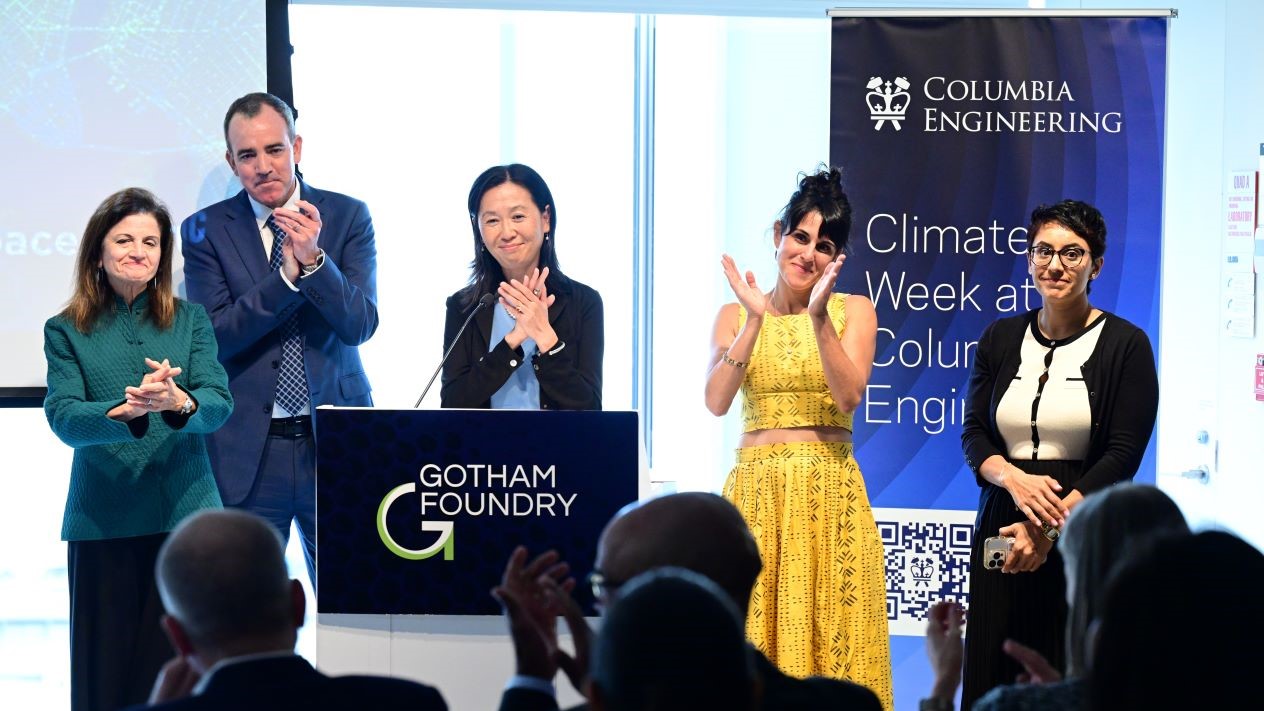
At Gotham Foundry’s Sept. 22 launch event, leaders from across New York City gathered at Columbia’s Jerome L. Greene Science Center for the exciting debut, which included a biomaterials exhibition, a fashion show of bio-derived designs, and remarks from Gotham Foundry Director Helen Lu; Columbia University Provost Angela Olinto; Andrew Kimball, CEO of NYCEDC; Adolfo Carrión, Deputy Mayor for Housing, Economic Development and Workforce; Dr. Joyce F. Brown, president, FIT; Rosemarie Wesson, associate vice chancellor and university vice provost for Research at CUNY; and Neena Chakrabarti, PhD, who spoke on behalf of Genspace; as well as Janet Rodriguez, founder and CEO of SoHarlem.
Community partners from Harlem Biospace and Communitas America were also in attendance, along with faculty from the Gotham Foundry Materials Innovation Team, a transdisciplinary network of engineering and science faculty at Columbia, CUNY, and FIT.
The featured materials exhibit, “Regenerative Vision,” showcased the work of more than 30 start-ups and research teams, demonstrating the transformative power of regenerative materials and green manufacturing approach in the industries Gotham Foundry will initially target: fashion textiles, construction, and healthcare. The event closed with young designers from SoHarlem, an incubator for cultural industries, sporting green fashions they had created as part of their entrepreneurship program with legendary designer Dapper Dan.
Gotham Foundry is initially located at Harlem Biospace at the Mink building in West Harlem. Its permanent home will be in a new Columbia Engineering building on the Manhattanville campus—currently in planning, and set to break ground in 2027 and open in 2030.
“We are thrilled to launch the Gotham Foundry with our partners and the support of the NYCEDC, led by Professor Helen Lu, a true pioneer in regenerative materials,” said Shih-Fu Chang, Dean of Columbia Engineering. “We are looking forward to creating a leading hub for biofabrication and the circular economy as part of a growing innovation ecosystem in Upper Manhattan, bringing together our own history of breakthrough research in sustainability with other academic researchers, industry innovators, and community partners in job training and education.”
“A bold vision for our future is that all human-made products emulate nature’s circular life cycle by demonstrating desired performance and being fully regenerative or degradable at the end of service. Establishment of Gotham Foundry is a major step in fulfilling this vision,” said Lu. “We are so grateful to the NYCEDC for supporting this project and our partners for their ongoing collaboration and commitment. We are eager to seize this opportunity to build a more sustainable future through the promise of novel regenerative materials, while boosting the city’s economy and training a skilled future manufacturing workforce.”
Today, the global market for sustainable materials is valued at $358 billion and is expected to grow to $800 billion by 2032. Advancing innovation in sustainable and biomaterials has the potential to transform key industries that drive New York City's economy, from fashion and construction to plastics and medical supplies. Researchers at Columbia and partner institutions will collectively share their knowledge and rich expertise to bring new materials innovations to industry and consumers. Gotham Foundry will serve as an ecosystem for innovation to fuel a green economy, not just for R&D but to cultivate startups, for education, training, and workforce development, and to become the centralized space open to creators and designers who seek access to a state-of-the-art facility and its resources.
Through its tightly integrated consortium, Gotham Foundry is redefining how infrastructure and commercialization efforts are coordinated. Gotham Foundry will leverage existing infrastructure at Harlem Biospace (for biofabrication and biocharacterization, technical consult, materials library, and training programs), ASRC (for advanced and complex materials characterization), FIT (for fashion prototyping, production, and design), and Genspace (for workforce training).
The new hub is expected to generate $5.12 billion in economic output over the next three decades and will create career opportunities for New Yorkers, including through workforce training programs for entrepreneurs and students. It is supported by LifeSci NYC, the city’s $1 billion initiative to create 40,000 jobs over the next 10 to 15 years, and puts into action the city’s Green Economy Action Plan, a vision that integrates economic and talent development in this space. Gotham Foundry will leverage Columba’s established partnerships with its surrounding community to create opportunities for students and job seekers interested in learning skills for the green economy and to empower the next generation of scientists, engineers, and entrepreneurs.
Lead Photo Caption: From left to right: Kate Ascher, co-director of Gotham Foundry (GF) and professor of practice of urban development at Columbia; Rein Ulijn, co-director of GF and founding director of the CUNY ASRC Nanoscience Initiative; Helen Lu, director of GF and Percy K. and Vida L.W. Hudson Professor of Biomedical Engineering; Theanne Schiros, co-director of GF and associate professor at FIT; and Neena Chakrabarti, board member at Genspace.
Lead Photo Credit: Chris Taggart/Columbia Engineering
Sail… or Fail? Snapshots from the ESC Boat Contest
Credit: Brandon Vallejo / Columbia Engineering
Lead Photo Caption: Setting Sail: Students test out their cardboard creations in Uris Pool.
Lead Photo Credit: Brandon Vallejo / Columbia Engineering
Highlights from Orientation Week
Credit: Tim Lee Photography/ Diane Bondereff/ Columbia Engineering
Academic Assembly
Columbia Engineering’s Academic Assembly held Aug. 27 marked the start of the academic journey for the engineering Class of 2029. Also known as the “Beanie Ceremony,” students receive a custom “Class of 2029” beanie as a part of a longstanding tradition. “First-years in the engineering school had to wear their beanies all year until they weren't first-years anymore,” said Vice Dean Morrison. “We won't make you do that, though. Wear them today. Maybe hold on to them, pull them out at graduation. It'll be a fun memento of your time here.”
The assembly also featured remarks from Assistant Professor of Computer Science Brian A. Smith, recent alum Alex Moreno BS’23, MS’24, and the Engineering Student Council President Janie Zhang BS’26. They each offered words of advice for the first-year students.
“Columbia presents so many opportunities for you to discover your niche, but you have to take advantage of them to reap the rewards,” said Moreno, who was the School’s 2023 Campbell Award recipient. “I wouldn't be where I am today without approaching every day with curiosity and the motivation to learn more about what I could do with my education.”
“[Engineering for Humanity] means that we as engineers have a responsibility to the planet and the people we build for,” advised Zhang as she closed off the assembly. “In practice, it looks like staying informed, being curious, asking hard questions – even if you might not know or like the answer – and most of all, staying empathetic.”
The day before Academic Assembly, Columbia Engineering also welcomed transfer and combined plan students to campus in a special ceremony.
Caption: Columbia Engineering Dean Shih-Fu Chang and Senior Vice Dean of Academic Programs Barclay Morrison III take a selfie with new graduate students.
Credit: Tim Lee Photography/Columbia Engineering