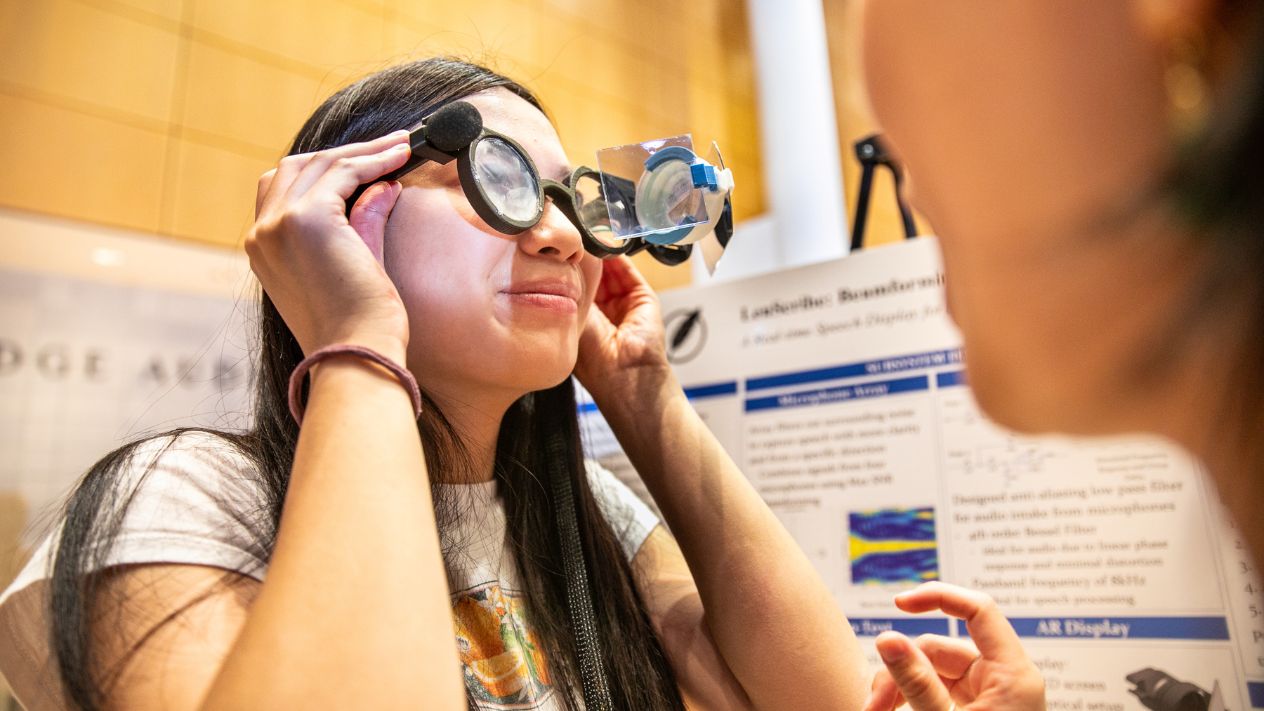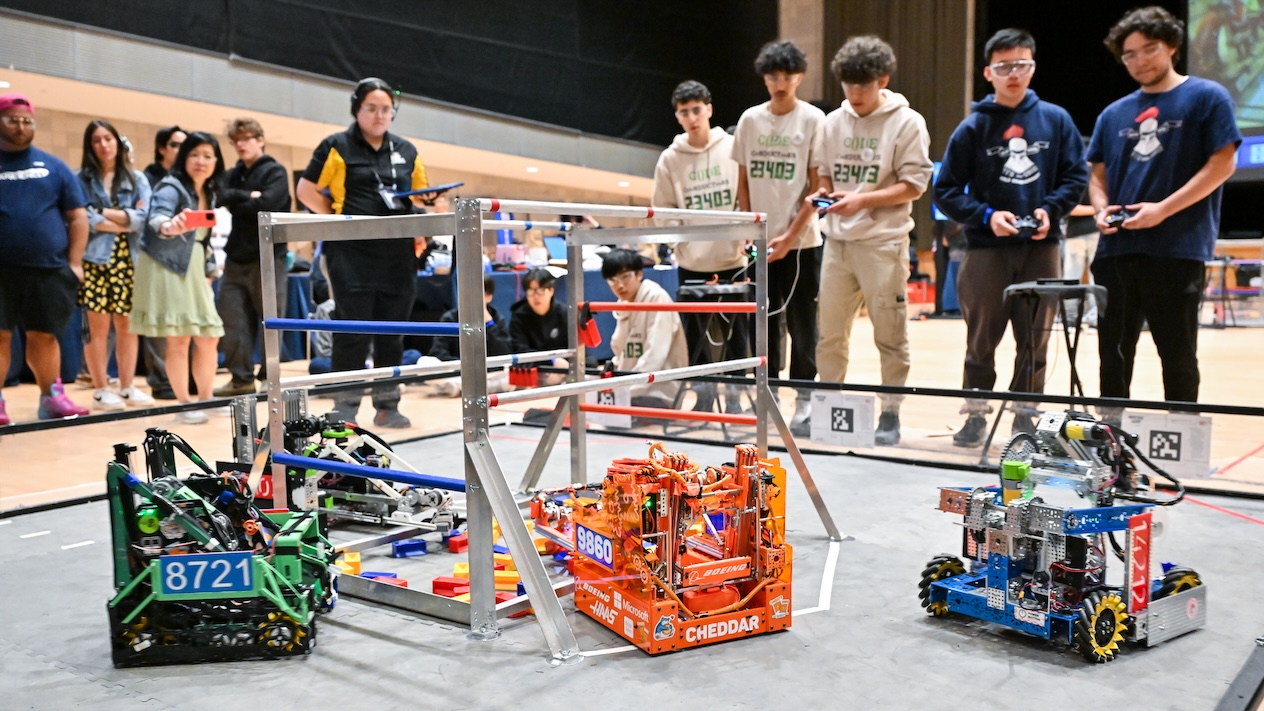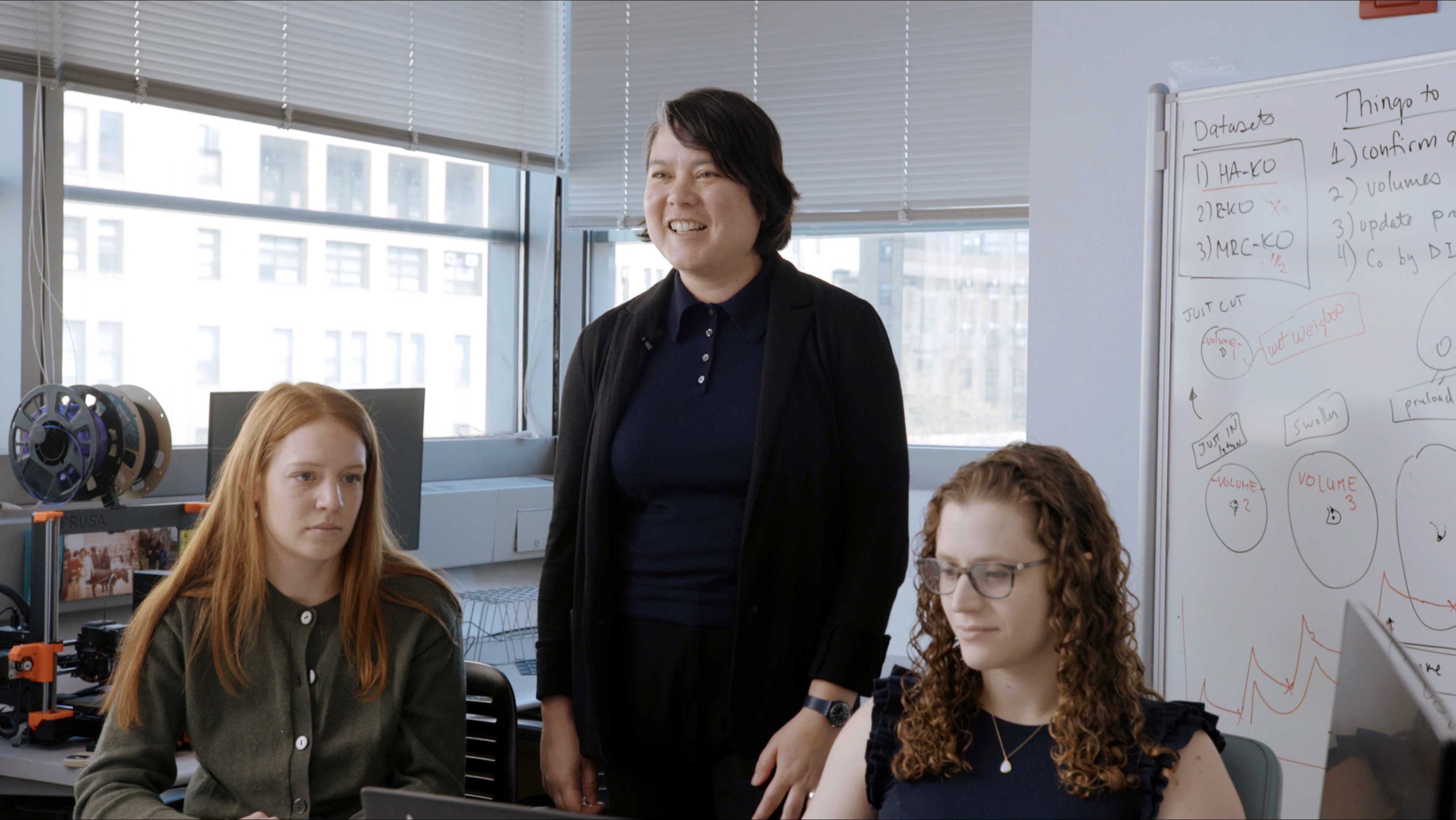
A major theme of the conference was the application of engineering principles and data analysis techniques to a wide range of underaddressed problems in women’s health. 

“Our field can learn from other areas of engineering, such as automotive and aerospace, that already use physics- and data-driven digital twins and models to accelerate product design and solutions,” said co-organizer Kristin Myers, a professor of mechanical engineering at Columbia Engineering. “Women’s health challenges mirror a lot of the major outstanding challenges in health more generally, such as designing sensors and monitors that fit a patient’s need while conveying actionable information to a medical provider.”

The daylong event featured keynotes from Silvia Blemker, professor of biomedical engineering at the University of Virginia; Steven Levine, the senior director of virtual human modeling at Dassault Systèmes; and Sandra Brown, the dean of the College of Nursing and Allied Health, Southern University and A&M College. The expert panels covered gynecologic health, preterm/pregnancy health, pelvic floor health, commercialization and the regulatory path, and education and workforce.


Lead Photo Caption: Christine Hendon, associate professor of electrical engineering, who develops innovative imaging technologies to study human tissue and disease.

Lead Photo Credit: David Dini/Columbia Engineering

“Mechanism design is a fundamental aspect of mechanical engineering,” explained Hod Lipson, James and Sally Scapa Professor of Innovation in the Department of Mechanical Engineering and director of Columbia’s Creative Machines Lab, where the work was done. “It is an important aspect of many fields, ranging from robotics to aerospace and even toy design. But like electronics and chemistry, it is one of those fields where simulation is easy while creativity is difficult, and so it lends itself well for generative AI.”

The AI doesn’t always have an answer. 

“When the AI is confounded, it produces a blurry design,” said Jiong Lin, who led the work. “The blurry response could indicate that it cannot complete the design, or that there is more than one solution. We don’t really know.”

The researchers lament that they don’t understand how the AI reaches its designs. “We don’t really know how it thinks. We can test it and find its limits, but it can’t yet teach us new design principles,” said Jialong Ning, who co-led the work. “It’s like the AI developed a kind of gut intuition that it can’t explain.”

Risks and limits

The researchers acknowledge that these are early days for automating mechanical design. So far, the AI can only design planar mechanisms with a single degree of freedom, composed only of rigid linkages connected with revolute joints. “This is just the beginning. Our goal is to expand this process from 2D to 3D, to multiple degrees of freedom, and from rigid linkages to other types of components such as springs, gears, wheels, soft materials, and even other kinds of actuators,” Lipson added.

The work is part of Lipson’s decades-long quest to automate creativity. Serving as a design engineer in his early career, Lipson set his target on designing machines that can design other machines. “Instead of solving problems one at a time, I concluded we should try to design a machine that can solve problems autonomously. Then, all we would have to do is point it at the problem we want to solve.” 

The vision of automating creativity was challenged by skeptics who insisted that creativity was uniquely human. “With generative AI, we are beginning to see the rise of truly creative machines,” Lipson says, who named his lab after this quest. “AI’s newfound ability to create code, materials, circuits, molecules – and now mechanisms – will ultimately allow us to reach new parts of the design space we could not explore with our naked human imagination. We have been stuck in a tiny corner of the possible for too long; we are about to unleash a vast new world of engineering possibilities.”


Lead Photo Caption: Sample of input curves and the generated mechanisms. Color represents speed.

Lead Photo Credit: Creative Machines Lab

About the Study

Title: Generative Synthesis of Kinematic Mechanisms

Conference: NeurIPS 2025

Authors: Jiong Lin, Jialong Ning, Judah Goldfeder, and Hod Lipson. Jinchen Ruan built the physical copy of the machine.

Funding: The study was supported by US National Science Foundation (NSF) AI Institute for Dynamical Systems (DynamicsAI.org).

Robot watches itself talking 

Achieving realistic robot lip motion is challenging for two reasons: First, it requires specialized hardware containing a flexible facial skin actuated by numerous tiny motors that can work quickly and silently in concert. Second, the specific pattern of lip dynamics is a complex function dictated by sequences of vocal sounds and phonemes. 

Human faces are animated by dozens of muscles that lie just beneath a soft skin and sync naturally to vocal chords and lip motions. By contrast, humanoid faces are mostly rigid, operating with relatively few degrees of motion, and their lip movement is choreographed according to rigid, predefined rules. The resulting motion is stilted, unnatural, and uncanny.

In this study, the researchers overcame these hurdles by developing a richly actuated, flexible face and then allowing the robot to learn how to use its face directly by observing humans. First, they placed a robotic face equipped with 26 motors in front of a mirror so that the robot could learn how its own face moves in response to muscle activity. Like a child making faces in a mirror for the first time, the robot made thousands of random face expressions and lip gestures. Over time, it learned how to move its motors to achieve particular facial appearances, an approach called a “vision-to-action” language model (VLA).

Then, the researchers placed the robot in front of recorded videos of humans talking and singing, giving AI that drives the robot an opportunity to learn how exactly humans’ mouths moved in the context of various sounds they emitted. With these two models in hand, the robot’s AI could now translate audio directly into lip motor action.

The researchers tested this ability using a variety of sounds, languages, and contexts, as well as some songs. Without any specific knowledge of the audio clips' meaning, the robot was then able to move its lips in sync.

The researchers acknowledge that the lip motion is far from perfect. “We had particular difficulties with hard sounds like ‘B’ and with sounds involving lip puckering, such as ‘W’. But these abilities will likely improve with time and practice,” Lipson said. 

More importantly, however, is seeing lip sync as part of more holistic robot communication ability. 

“When the lip sync ability is combined with conversational AI such as ChatGPT or Gemini, the effect adds a whole new depth to the connection the robot forms with the human,” explained Yuhang Hu, who led the study for his PhD. “The more the robot watches humans conversing, the better it will get at imitating the nuanced facial gestures we can emotionally connect with.” 

“The longer the context window of the conversation, the more context-sensitive these gestures will become,” he added. 

The missing link of robotic ability

The researchers believe that facial affect is the ‘missing link’ of robotics. 

“Much of humanoid robotics today is focused on leg and hand motion, for activities like walking and grasping,” said Lipson. “But facial affection is equally important for any robotic application involving human interaction.”

Lipson and Hu predict that warm, lifelike faces will become increasingly important as humanoid robots find applications in areas such as entertainment, education, medicine, and even elder care. Some economists predict that over a billion humanoids will be manufactured in the next decade.

“There is no future where all these humanoid robots don’t have a face. And when they finally have a face, they will need to move their eyes and lips properly, or they will forever remain uncanny,” Lipson estimates.

“We humans are just wired that way, and we can’t help it. We are close to crossing the uncanny valley,” added Hu.

Risks and limits

This work is part of Lipson’s decade-long quest to find ways to make robots connect more effectively with humans, through mastering facial gestures such as smiling, gazing, and speaking. He insists that these abilities must be acquired by learning, rather than being programmed using stiff rules. 

“Something magical happens when a robot learns to smile or speak just by watching and listening to humans,” he said. “I’m a jaded roboticist, but I can’t help but smile back at a robot that spontaneously smiles at me.”

Hu explained that human faces are the ultimate interface for communication, and we are beginning to unlock their secrets.

“Robots with this ability will clearly have a much better ability to connect with humans because such a significant portion of our communication involves facial body language, and that entire channel is still untapped,” Hu said. 

The researchers are aware of the risks and controversies surrounding granting robots greater ability to connect with humans. 

“This will be a powerful technology. We have to go slowly and carefully, so we can reap the benefits while minimizing the risks,” Lipson said. 


Lead Photo Caption: Featured on the cover of Science Robotics, Hod Lipson and his team have created a robot that, for the first time, is able to learn facial lip motions for tasks such as speech and singing.

Lead Photo Credit: Jane Nisselson/ Columbia Engineering

About the Study

Title: “Learning Realistic Lip Motions for Humanoid Face Robots”

Authors: Yuhang Hu, Jiong Lin, Judah Allen Goldfeder, Philippe M. Wyder, Yifeng Cao, Steven Tian, Yunzhe Wang, Jingran Wang, Mengmeng Wang, Jie Zeng, Cameron Mehlman, Yingke Wang, Delin Zeng, Boyuan Chen and Hod Lipson

Funding: The study was supported by US National Science Foundation (NSF) AI Institute for Dynamical Systems (DynamicsAI.org) and a gift from Amazon to Columbia AI institute.

Available Programs


  • CS@CU MS Bridge Program in Computer Science

    The CS@CU MS Bridge Program in Computer Science is a well-established pathway for students without a formal undergraduate background in computer science. The program provides comprehensive preparation in programming, data structures, discrete mathematics, and core computing concepts.

    Students apply directly to the Bridge Program and, upon successful completion of the required coursework and GPA benchmarks, transition into the MS in Computer Science.

    Program structure

    • Part-time, non-degree Bridge program
    • Apply to the CS@CU MS Bridge Program via the graduate application
    • Transition to the MS upon successful completion
    • Not eligible for F-1 visa sponsorship during the Bridge phase
  • IEOR MS Bridge Program

    The IEOR MS Bridge Program is designed to equip students for success in the Master of Science in Business Analytics (MSBA) or the Master of Science in Management Science and Engineering (MS&E) programs. The Bridge Program provides a clear and structured pathway for students who may lack some of the quantitative, coding, or data science skills required for direct admission.

    Business Analytics MS Bridge Program

    The MS in Business Analytics Bridge Program is designed for students with strong academic or professional potential who need additional preparation in quantitative methods, computing, or data science before transitioning into the Master of Science in Business Analytics.

    Students apply directly to the Bridge Program and, upon successful completion, transition into the MS in Business Analytics.

    Program structure

    • Part-time, non-degree Bridge program
    • Apply to the Business Analytics MS Bridge Program via the graduate application
    • Transition to MS after Bridge completion
    • Not eligible for F-1 visa sponsorship during the Bridge phase

    Management Science and Engineering MS Bridge Program

    The Management Science and Engineering Program prepares students from non-engineering or partially quantitative backgrounds for advanced study in management science, optimization, analytics, and systems engineering prior to transitioning into the MS&E MS curriculum.

    Students apply directly to the Bridge Program and, upon successful completion, transition into the MS in Business Analytics.

    Program structure

    • Part-time, non-degree Bridge program
    • Apply to the Management Science and Engineering MS Bridge Program via the graduate application
    • Transition to MS after Bridge completion
    • Not eligible for F-1 visa sponsorship during the Bridge phase
  • Electrical Engineering MS Bridge Program

    The Electrical Engineering MS Bridge Program supports students from related quantitative or scientific backgrounds who lack formal electrical engineering training. Students complete targeted foundational coursework aligned with their intended area of specialization before transitioning fully into MS-level study.

    Program structure

    • Part-time, non-degree Bridge program
    • Apply to the Electrical Engineering MS Bridge Program via the graduate application
    • Transition to MS after successful completion
    • Not eligible for F-1 visa sponsorship during the Bridge phase
  • Biomedical Engineering MS Preparation Pathway

    The Master of Science in Biomedical Engineering welcomes high-achieving students from a range of academic backgrounds, including other engineering disciplines (e.g., mechanical, electrical, civil) and allied sciences (e.g., biology, chemistry, physics, computer science). While Biomedical Engineering does not offer a formal Bridge Program, admitted students may be required to complete additional coursework—beyond the standard MS curriculum—if specific foundational gaps are identified during the admissions review.

    Program structure

    • Full-time or part-time MS enrollment
    • Apply directly to the Biomedical Engineering MS program. If additional preparatory coursework is required, it will be specified in the admission offer.
    • Eligible for F-1 visa sponsorship
  • Civil Engineering and Engineering Mechanics MS Bridge Program

    The Civil Engineering and Engineering Mechanics MS Bridge Program supports students without a civil engineering undergraduate degree by providing focused preparation in mechanics, fluids, structures, and related areas. Bridge requirements are determined at admission and completed prior to or alongside graduate coursework.

    Program structure

    • Full-time or part-time MS enrollment
    • Bridge coursework integrated into MS program
    • No separate Bridge application is required. Apply directly to the Civil Engineering and Engineering Mechanics Master of Science program.
    • Eligible for F-1 visa sponsorship
  • Chemical Engineering Scientist-to-Engineer (S2E) Program

    The Scientist-to-Engineer (S2E) program is an integrated pathway within the MS in Chemical Engineering for students without an undergraduate degree in chemical engineering.

    Students complete an intensive, accelerated set of undergraduate-level chemical engineering courses during their first semester, covering core concepts needed for success in the graduate curriculum. Degree completion is typically achieved in three semesters.

    Program structure

    • Full-time or part-time MS enrollment
    • Bridge coursework completed within the MS program
    • No separate Bridge application is required. Apply directly to the Chemical Engineering Master of Science program.
    • Eligible for F-1 visa sponsorship
  • Mechanical Engineering MS Bridge Program (Coming Soon)

    The Mechanical Engineering MS Bridge Program prepares students without an undergraduate degree in mechanical engineering to enter the MS in Mechanical Engineering curriculum with confidence. The program emphasizes core areas such as mechanics, thermal fluids, design, and materials.

    Bridge requirements are assigned upon admission to the MS program and are completed prior to or alongside graduate coursework.

    Program structure

    • Full-time or part-time MS enrollment
    • Bridge coursework integrated into MS program
    • No separate Bridge application is required. Apply directly to the Mechanical Engineering Master of Science program.
    • Eligible for F-1 visa sponsorship
       
  • Computer Engineering Bridge Program

    The Columbia Computer Engineering MS Bridge program will enable students with undergraduate degrees in fields other than electrical engineering, computer engineering, and computer science to take preparatory courses before enrolling in the CE MS degree program. The Computer Engineering Bridge Program offers two distinct tracks, enabling students to acquire the essential foundational skills tailored to their specific interests within the MS curriculum. One track is designed for students aiming to specialize in Computer Systems (Track A), while the other prepares students for specializing in Computer Chip Design (Track B). Students complete targeted foundational coursework aligned with their intended area of specialization before transitioning fully into MS-level study. 

    Program structure

    • Part-time, non-degree program
    • Apply to the Computer Engineering MS Bridge Program via the graduate application
    • Transition to the Computer Engineering MS after successful completion
    • Not eligible for F-1 visa sponsorship during the bridge program

Frequently Asked Questions


  • Who should consider an MS Bridge Program?

    MS Bridge Programs are ideal for students with strong academic or professional records who may be missing specific undergraduate coursework required for direct entry into an engineering MS program.
     

  • Do Bridge Programs lead to a degree?

    Yes, the goal is the students complete the corresponding Master’s of Science program they have been admitted to. Note that the Computer Science, Electrical Engineering, Business Analytics, and Management Science + Engineering bridge programs are not degree-granting on their own. These serve as a pathway into a Columbia Engineering MS program, after which students complete degree requirements. The Biomedical Engineering, Chemical Engineering, Civil Engineering and Engineering Mechanics, and Mechanical Engineering bridge programs are integrated into the MS program, and thus are degree-seeking programs. 

  • Are Bridge students eligible for student visas?

    This will vary by program. Students enrolled directly in the Biomedical Engineering, Chemical Engineering, Civil Engineering and Engineering Mechanics, and Mechanical Engineering bridge programs are eligible for F-1 visas

    Students in the Computer Science, Electrical Engineering, Business Analytics, and Management Science + Engineering bridge programs are not eligible for F-1 visa sponsorship until they transition into the MS.

  • Can Bridge requirements be waived?

    In many programs, previously completed coursework may be reviewed for possible waivers, typically requiring a minimum grade of B or higher.

  • When are application deadlines?

    The priority deadline for most Bridge Programs is February 15. Applicants are encouraged to review individual program pages for the most up-to-date information.

  • What materials are required to apply?

    The following materials must accompany the online application for on-campus graduate programs. 

    • Transcripts
    • Three Letters of Recommendation
    • Personal Statement
    • Resumé or Curriculum Vitae
    • Video Interview
    • Graduate Record Examination (GRE) General Test Scores (optional)
    • English Language Exam Scores (TOEFL, IELTS, Duolingo) required for applicants educated in a country other than Australia, Canada, Ireland, New Zealand, Singapore, the UK, Ghana, Nigeria, Kenya, and the United States of America.
    • $85 non-refundable application fee (payable by a major credit card through the online application system)
  • How do I apply?

    Interested students should apply using the On-Campus MS and PhD Programs application found here.


Lead Photo Caption: Left to right: Shih-Fu Chang, Steven Feiner, Fermi Wang.

Subscribe to Mechanical Engineering